
Rhinoncus
Rhinoncus
Description
How to identify
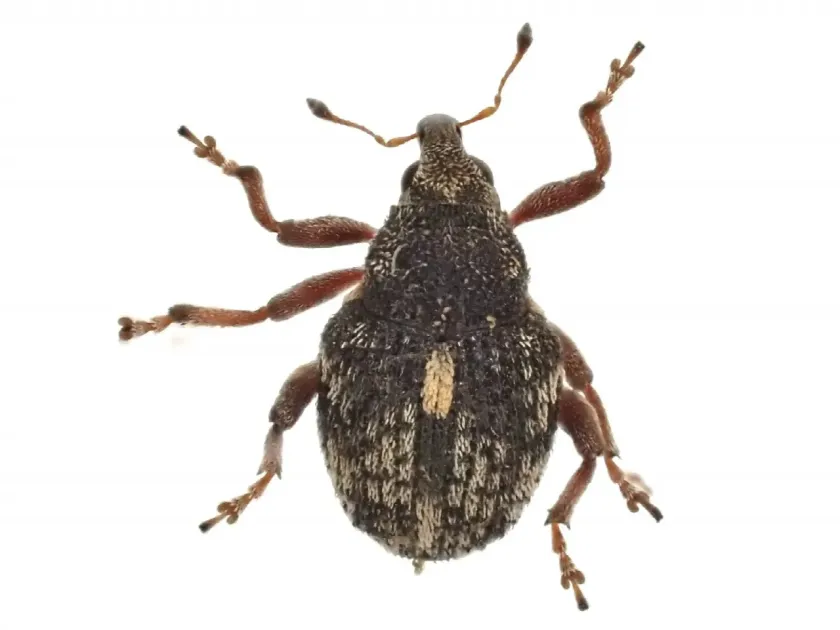
Rhinoncus is a genus belonging to the Curculionidae family within the order Coleoptera. These are small beetles, typically measuring 2–3 mm in length, featuring the characteristic snout and body shape common to many weevils.
The coloration ranges from dark brown to almost black, with bodies often covered in dense scales that may give them a grayish or brownish appearance. Adult beetles are capable of flight, allowing them to disperse quickly across fields.
The larvae of Rhinoncus are legless, fleshy, and C-shaped, usually white or yellowish with a distinct brown head. They live cryptically, feeding internally within plant tissues or residing in the soil.
The life cycle involves complete metamorphosis, progressing through egg, larval, pupal, and adult stages. In most species, the adult beetles are the primary stage that overwinters in protected areas.
Identification often requires magnification, as key taxonomic features, such as the shape of the pronotum or the specific structure of the scales, are difficult to observe with the naked eye in field conditions.
What it damages
Rhinoncus species primarily feed on plants in the Polygonaceae and Amaranthaceae families. They are known as significant pests of buckwheat, and they are also frequently found on various species of knotweed and dock.
Adult beetles cause damage by feeding on leaves, creating small holes that reduce the photosynthetic surface of the plant. During periods of high infestation, this can severely impact the vigor and growth rate of young plants.
Larval feeding is generally more destructive, as they mine the tissues of stems, leaf stalks, or damage reproductive organs. This disrupts the transport of water and nutrients, leading to wilting and deformation of the affected plant parts.
Infested plants become more susceptible to secondary fungal or bacterial pathogens, which further reduces yield potential. In high-density populations, the cumulative loss of marketable crop quality can be substantial.
The pest also utilizes wild weeds as alternative hosts, creating a reservoir for the population near agricultural fields. This constant presence makes it difficult to eliminate the pest entirely through simple field management.
When it appears
Overwintering adults typically emerge in late spring, corresponding with the initial vegetative growth of their host plants. This period marks the beginning of their feeding and reproductive cycle.
The peak activity of adults usually occurs during the first half of summer, which aligns with the rapid development of the larval stages. During this window, regular field scouting is essential to detect early signs of infestation.
The generation cycle typically concludes by mid-to-late summer, after which the new generation of adults seeks overwintering sites. Depending on the climatic region, one or more generations may occur in a single growing season.
As autumn approaches, the adults migrate to overwintering habitats, such as the upper soil layers, crop debris, or the base of perennial weeds. Managing the pest during this phase is challenging due to their cryptic behavior.
Favorable weather, such as warm and humid spring conditions, can lead to earlier and more synchronized emergence, necessitating proactive monitoring and timely implementation of control measures by the agronomist.
Signs of infestation
The first visible indicators of infestation are the characteristic "windowpane" or small holes in the leaf blades, resulting from the feeding activity of adult beetles.
Upon inspecting the stems, one may observe entry holes created by the larvae. Splitting these stems often reveals internal galleries filled with larval excrement, along with the larvae themselves.
Yellowing or wilting of individual plant sections, despite adequate moisture, often points to internal stem damage or stress caused by larval mining in the crown or lower stalk area.
Stunted plant growth and delayed development are observed in areas with higher pest pressure. This is often noticeable when comparing affected patches to healthy sections of the field during a visual assessment.
- Adults found on leaves during morning inspections (they often drop to the ground when disturbed).
- Presence of internal larval galleries within vegetative structures.
- Premature leaf drop following severe damage to petioles.
Control measures
The primary control strategy is cultural management, which focuses on eliminating wild Polygonaceae weeds (like knotweed and dock) that serve as breeding reservoirs for the pest.
Implementing a robust crop rotation plan helps disrupt the life cycle of the weevil, preventing the buildup of population densities in a specific field over successive seasons.
Deep autumn plowing (tillage) is effective in disrupting the overwintering habitat of the beetles, exposing them to harsher winter conditions and increasing mortality rates.
Chemical control involving the application of insecticides is recommended during periods of peak adult activity, provided that population counts exceed the economic threshold for the specific crop.
Biological control alternatives, including the use of entomopathogenic fungi or specialized natural enemies, are currently being investigated as potential components for an integrated pest management (IPM) system.
Taxonomy
- Latin name
- Rhinoncus
- Order
- Coleoptera (beetles)
- Family
- Curculionidae
- EPPO code
- RHNUSP
Discussion
No discussions yet — be the first.