
Thistle head weevil
Rhinocyllus conicus
Description
How to identify
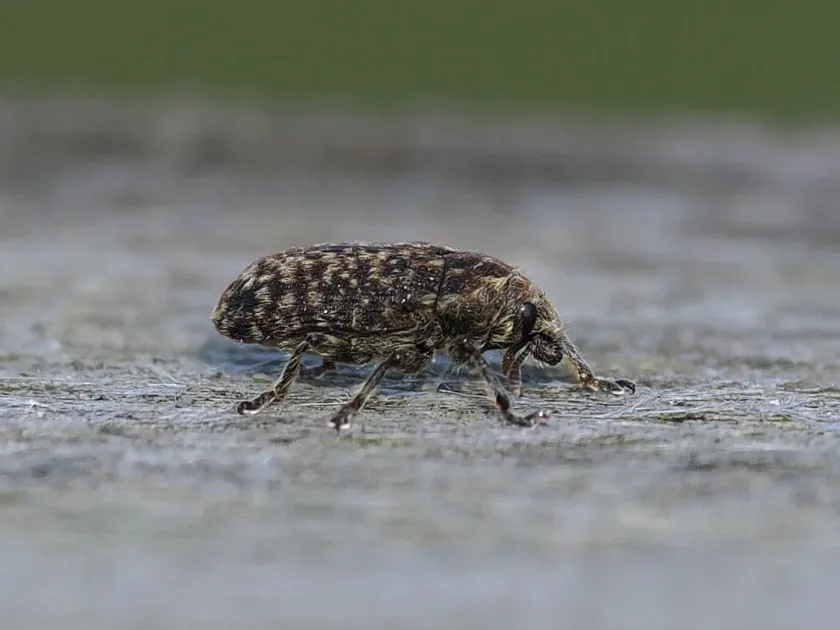
The thistle head weevil (Rhinocyllus conicus) is a coleopteran insect belonging to the Curculionidae family. Adult weevils are roughly 4–6 mm long and possess a distinctive snout used for feeding and laying eggs.
Their bodies are covered in dense, mottled greyish-brown scales, which act as camouflage, allowing them to blend perfectly with the bracts of thistle flower heads.
The larvae are legless, C-shaped grubs that are cream-colored with a darker, chitinized head capsule, specifically adapted for development within the confined space of a flower head.
This species is univoltine, completing only one generation per year. Its life cycle is perfectly synchronized with the phenology of its host plants in the Asteraceae family.
Originally from Europe and Asia, it was introduced into other regions, such as North America, specifically as a biological control agent to manage invasive thistle populations.
What it damages
The thistle head weevil feeds exclusively on plants in the tribe Cardueae, primarily thistles of the genus Carduus and Cirsium. They are specialists that rarely shift to other crops.
The primary damage is caused by the larvae, which feed on the developing seeds and the receptacle of the flower head, effectively destroying the plant's reproductive potential.
By consuming the internal tissues, the larvae prevent the plant from producing viable seeds, which significantly reduces the spread of these invasive weeds in pastures and field margins.
Adult weevils also cause minor damage by feeding on the leaves, creating small, circular holes, although this is usually economically insignificant compared to the damage caused by larvae.
While the weevil is beneficial for weed suppression, its potential to impact non-target, rare, or native species of thistles is a subject of ongoing ecological concern.
When it appears
Adult weevils emerge from hibernation in early spring as temperatures rise, typically coinciding with the early bud formation of host plants in late April or May.
Females lay their eggs on the surface of the bracts of thistle buds. These eggs are covered with a protective layer of frass, which hardens and protects them from predators.
Larvae hatch and immediately bore into the bud. The larval development period occurs through June and July, during which they grow rapidly within the developing flower head.
Pupation occurs inside the flower head in late summer. Upon emerging as adults, they feed for a short period before seeking sheltered locations to overwinter.
Overwintering takes place in leaf litter, debris, or under the bark of nearby trees, where they remain dormant until the following spring season.
Signs of infestation
A primary indicator of infestation is the presence of small, dark, shield-like structures on the bracts of thistle buds, which are the egg masses deposited by females.
As larvae feed internally, the flower head may show signs of premature wilting, deformity, or uneven development compared to uninfested buds.
Dissecting the flower head during the larval development stage will reveal tunnels, necrotic tissue, and the presence of larvae or pupal chambers.
A significant reduction in seed output from a patch of thistles is a classic sign of high weevil activity and is often the goal of biological control programs.
Small, rounded "shot-hole" damage on the leaves is a common visual cue of adult weevil presence, indicating their emergence and feeding activity during the summer months.
Control measures
In most agricultural contexts, the thistle head weevil is considered an ally in weed management, as it naturally suppresses invasive thistles without chemical input.
If management is required to prevent spread, the most effective approach is to physically remove and destroy thistle heads before the adult weevils emerge.
Broad-spectrum insecticides are strongly discouraged, as they kill the weevils and other natural enemies, often leading to secondary pest outbreaks.
Cultural practices, such as maintaining healthy pasture cover and timely mowing of weeds, can help manage thistle populations effectively without needing to target the weevils themselves.
- Avoid the use of non-selective insecticides near weed patches.
- Monitor thistle populations during the spring bud stage.
- Use integrated pest management to balance the role of the weevil with other weed control strategies.
Taxonomy
- Latin name
- Rhinocyllus conicus
- Order
- Coleoptera (beetles)
- Family
- Curculionidae
- EPPO code
- RHILCO
Discussion
No discussions yet — be the first.