
Thistle head weevil
Rhinocyllus
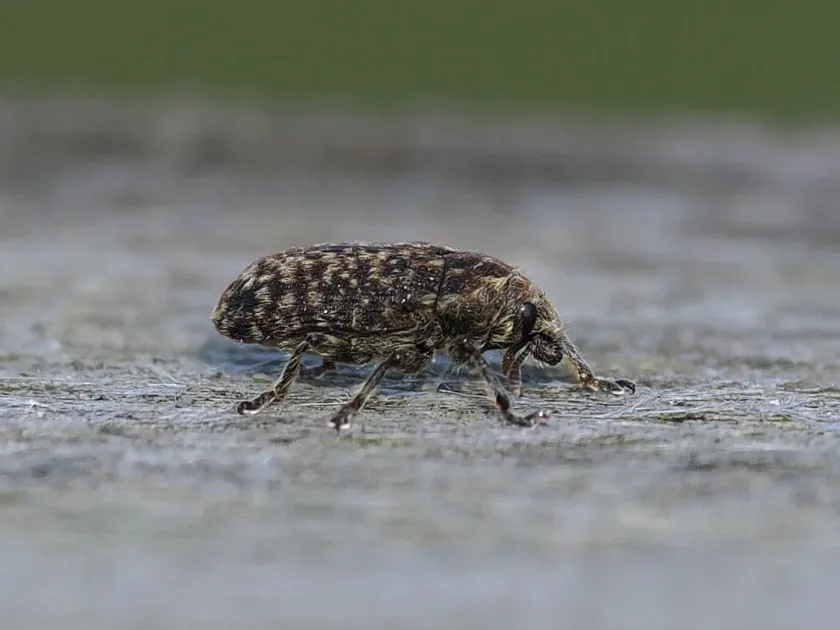
Description
How to identify
The thistle head weevil (Rhinocyllus conicus) is a beetle belonging to the Curculionidae family, widely known as a seed predator of thistles and related Asteraceae.
Adults are small, measuring 4–6 mm in length, with a robust body covered in gray or dark brown scales, often featuring a distinct mottled pattern.
They possess a prominent, curved snout characteristic of the weevil family, which they use for feeding and excavating sites for egg deposition on flower buds.
The larvae are legless, C-shaped grubs with creamy-white bodies and a dark brown head capsule, specifically adapted for life within the flower head.
The species was originally native to Europe and North Asia but has been introduced to other continents as a biological control agent for invasive thistles.
What it damages
The primary damage is caused by the larvae, which feed exclusively within the flower heads of their host plants, destroying the developing seeds.
By consuming the receptacle and ovules, the larvae significantly reduce the seed set of the plant, often leading to total sterility of the infested flower head.
In addition to larval feeding, adults cause minor damage by chewing on foliage and stems, although this rarely impacts plant health significantly.
While often beneficial for suppressing invasive weeds, the weevil can become a nuisance if it spreads to beneficial Asteraceae species used in agriculture or gardening.
The cumulative impact of the feeding reduces the reproductive success of the host plant, effectively acting as a natural population limiter.
When it appears
The insect typically completes one generation per year, with adults overwintering in sheltered locations such as leaf litter or plant debris near host plants.
As spring temperatures rise, the adults emerge and begin feeding on the young tissues of the emerging thistle rosettes and stems.
Mating occurs throughout the spring, and females deposit eggs on the outer bracts of the developing flower buds, protecting them with a specialized fecal shield.
Larval development proceeds inside the flower head, where they move through several instars while consuming seeds and floral tissues.
Pupation occurs within the dry receptacle, and the new generation of adults emerges in late summer, shortly before entering their overwintering phase.
Signs of infestation
The presence of the weevil is often indicated by small, circular feeding punctures on the leaves of the host plants during the early spring.
The most diagnostic sign is the presence of hardened, dark, shield-like deposits on the surface of the flower buds, which cover the female’s eggs.
Infested flower heads may show signs of abnormal growth, wilting, or failure to open properly due to the feeding damage inside the receptacle.
Upon dissecting a suspected flower head, one can observe larval tunnels and a lack of viable, well-developed seeds compared to healthy specimens.
In cases of severe infestation, the flower head may appear stunted and eventually turn prematurely brown or dry out completely.
Control measures
Control efforts are typically centered on mechanical or physical suppression of the weed hosts rather than eradication of the weevil itself.
Mowing or removing thistle heads before the larvae have a chance to complete their development is the most effective way to limit populations.
Chemical control is rarely recommended for this species as it is often valued for its role in managing invasive thistle populations in natural habitats.
If necessary, systemic insecticides applied during the early adult feeding stage can reduce the number of females available to lay eggs.
- Early season mechanical control of host weeds.
- Preservation of natural parasitoid wasps that keep populations in check.
- Regular monitoring of host plant clusters for egg-shield presence.
Taxonomy
- Latin name
- Rhinocyllus
- Order
- Coleoptera (beetles)
- Family
- Curculionidae
- EPPO code
- RHILSP
Discussion
No discussions yet — be the first.