
Palm weevil
Rhinastus latisternus
Description
How to identify
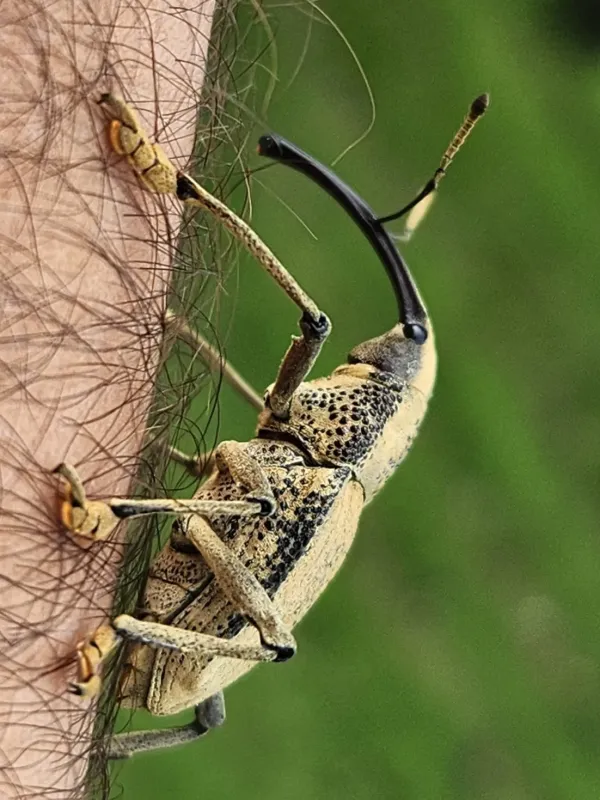
The palm weevil (Rhinastus latisternus) is a member of the Curculionidae family. It is a highly specialized beetle characterized by its elongated snout, which is adapted for boring into plant tissues.
Adult beetles possess a hard, dark-colored exoskeleton that provides protection while they navigate through the palm bark.
The life cycle involves an egg-laying stage within the palm tissue, followed by a larval development phase that typically lasts several months depending on environmental conditions.
The larvae are white, legless grubs with powerful mandibles capable of consuming dense woody tissues inside the palm.
Due to the cryptic nature of its life cycle, Rhinastus latisternus is often difficult to detect until the damage has become severe.
What it damages
This pest primarily attacks various palm species, impacting both landscape ornamental palms and commercial crops.
The larvae feed on the soft tissue of the trunk and the apical meristem (growing point), which is vital for the tree's health and development.
Severe infestations disrupt nutrient and water transport, causing the palm to lose vigor, yellowing of the fronds, and eventually tree death.
In addition to structural damage, the tunnels created by the larvae serve as entry points for pathogens and wood-rotting fungi.
The ability of the species to spread rapidly makes it a significant threat to palm ecosystems and cultivated plantations.
Signs of infestation
The most prominent sign is the sudden drooping and chlorosis of the youngest fronds located in the center of the palm crown.
Frass (a mixture of excrement and wood shavings) is often observed near entry holes or at the base of the palm trunk.
As the infestation progresses, an audible gnawing sound may sometimes be detected inside the trunk during quiet periods.
Small, circular entry holes are visible on the surface of the bark, sometimes accompanied by sap exudation from the wound.
The collapse of the palm's crown is a final indicator that the internal structures have been completely destroyed by the larval gallery network.
Control measures
Successful management relies on early detection, which is critical for preventing the loss of affected trees.
Systemic insecticides are the preferred treatment method, often applied via trunk injections to ensure the chemicals reach the internal larvae.
Infested trees that have sustained significant damage should be removed and destroyed immediately to prevent the emergence and spread of new adults.
The use of pheromone-based traps is a recommended strategy to monitor adult populations and reduce their numbers in the area.
- Frequent inspection of palm crowns for signs of distress.
- Trunk injection with registered systemic insecticides.
- Sanitation programs including the removal of dead or dying palms.
Taxonomy
- Latin name
- Rhinastus latisternus
- Order
- Coleoptera (beetles)
- Family
- Curculionidae
- EPPO code
- RHIALA
Discussion
No discussions yet — be the first.