
Andean potato weevil
Rhigopsidius
Description
How to identify
The Andean potato weevil (Rhigopsidius tucumanus) belongs to the order Coleoptera and the family Curculionidae. It is a significant agricultural pest primarily found in the Andean highlands of South America, posing a constant quarantine threat to other regions.
The adult beetle is relatively small, with a characteristic elongated snout and a dark, cryptic coloration that allows it to blend seamlessly into the soil. Its morphology is adapted for a lifestyle spent partially buried within the top layers of the soil.
The lifecycle consists of egg, larval, pupal, and adult stages. Females typically lay eggs near the base of potato plants or on the tubers themselves. The larvae are creamy-white, legless, and possess a well-developed head capsule suited for boring into plant tissues.
The larval stage is the most destructive phase. After hatching, the larvae immediately migrate toward the tubers, creating extensive galleries inside the potato meat. The duration of each developmental stage is heavily influenced by ambient temperature and moisture levels.
Adult weevils are largely nocturnal, which makes their detection during daylight inspections difficult. Field monitoring requires specialized methods such as using pitfall traps or targeted soil sampling at depths of 5 to 15 centimeters near the root zones.
What it damages
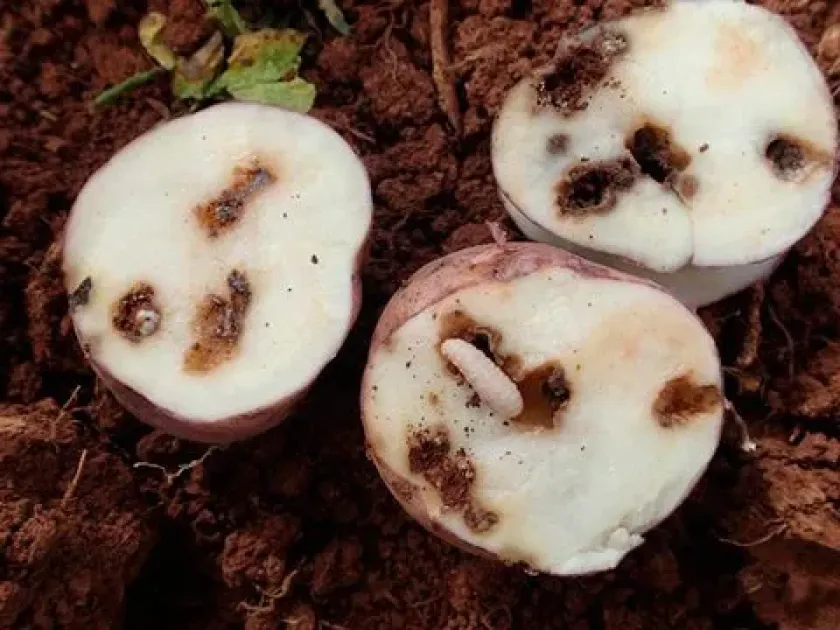
Potatoes are the primary host for Rhigopsidius tucumanus. The larvae feed exclusively on the tubers, creating intricate networks of tunnels that destroy the interior structure of the potato. This damage renders the tuber completely inedible and unsuitable for processing.
Beyond direct feeding damage, the tunnels created by the larvae serve as entry points for various soil-borne pathogens. Bacterial soft rots and secondary fungal infections often follow the infestation, leading to the rapid decay of the entire tuber in storage.
The infestation can also extend to the stolons and the base of the plant stem. By disrupting the transport of nutrients and water from the root system to the foliage, the pest can significantly impair plant vigor and reduce overall tuber yield.
Economic losses due to the Andean potato weevil can be severe, often exceeding 50% in untreated fields. Because of the hidden nature of the larvae, farmers frequently remain unaware of the extent of the infestation until harvest time, when damage is already irreversible.
Alternative hosts include wild species of Solanaceae found in the vicinity of agricultural lands. These plants allow the pest to survive between potato cropping cycles, ensuring that a reservoir of the beetle remains in the environment.
Signs of infestation
The most recognizable sign of an infestation is the presence of small, circular exit or entry holes on the skin of the potato tuber. Often, these marks are surrounded by dry excrement, confirming the presence of larval activity.
Internal damage manifests as dark, irregular galleries that penetrate deep into the tuber's flesh. As the larvae mature and continue to feed, these galleries become larger, eventually leaving the potato hollow and prone to secondary infections.
Field symptoms may include chlorosis or premature wilting of the canopy. While these signs can be confused with other diseases, if they are accompanied by poor tuber development, it may indicate that the root system has been compromised by the weevils.
During the harvest process, tubers may feel lighter than expected if the internal damage is extensive. A thorough visual inspection of the potato skin is required to identify the early stages of infestation before the potatoes are moved into storage.
If potatoes are kept in common storage, increased humidity and a foul smell from rotting tubers are late-stage indicators of a widespread weevil infestation that has facilitated the entry of decay-causing microorganisms.
Control measures
Strict phytosanitary regulations are the first line of defense. Restricting the movement of seed potatoes from infested regions is crucial for preventing the introduction of the Andean potato weevil into new areas where the environment might be suitable for its growth.
Cultural control strategies include implementing long crop rotations. By alternating potato fields with non-host crops, the cycle of the weevil can be disrupted, as the beetle populations generally require a steady supply of potatoes to thrive over several years.
Deep plowing after the harvest is highly effective for reducing pest numbers. This practice exposes larvae and pupae in the soil to predators and adverse environmental conditions, significantly lowering the number of adults that survive until the following season.
Utilizing certified, clean seed is mandatory. All harvested tubers should be meticulously cleaned of soil before being stored. Proper sanitation of farm machinery and tools used in infested fields prevents the transport of beetles to clean parts of the farm.
Chemical control options include the application of soil-active insecticides during the planting phase. Integrated Pest Management (IPM) programs should also prioritize biological control agents and pheromone-based monitoring to determine the optimal timing for interventions.
Taxonomy
- Latin name
- Rhigopsidius
- Order
- Coleoptera (beetles)
- Family
- Curculionidae
- EPPO code
- RHGPSP
Discussion
No discussions yet — be the first.