
Pine resin-gall moth
Retinia resinella
Description
How to identify
The pine resin-gall moth (Retinia resinella) is a small lepidopteran insect belonging to the Tortricidae family. The adult moth has a wingspan of approximately 20 mm and features dark brown wings with silver-grey cross-markings.
The species is well-known for its unique two-year life cycle. During the larval stage, the caterpillar lives inside a specialized structure called a resin gall, which it creates on the shoots of pine trees.
The larvae are brownish with a dark head capsule. They spend most of their life protected by a dense mass of resin, excrement, and silk, which makes them highly resistant to environmental stressors.
Adult moths emerge in late spring or early summer. Females lay their eggs individually near the buds of young shoots, ensuring the larvae have an immediate food source upon hatching.
This pest is found throughout the natural range of Pinus sylvestris, where it specifically targets young stands, often causing visible damage to the crown of saplings.
What it damages
The moth primarily affects Scotch pine (Pinus sylvestris). While it is not usually lethal to mature trees, it can cause severe structural damage to younger saplings and nursery stock.
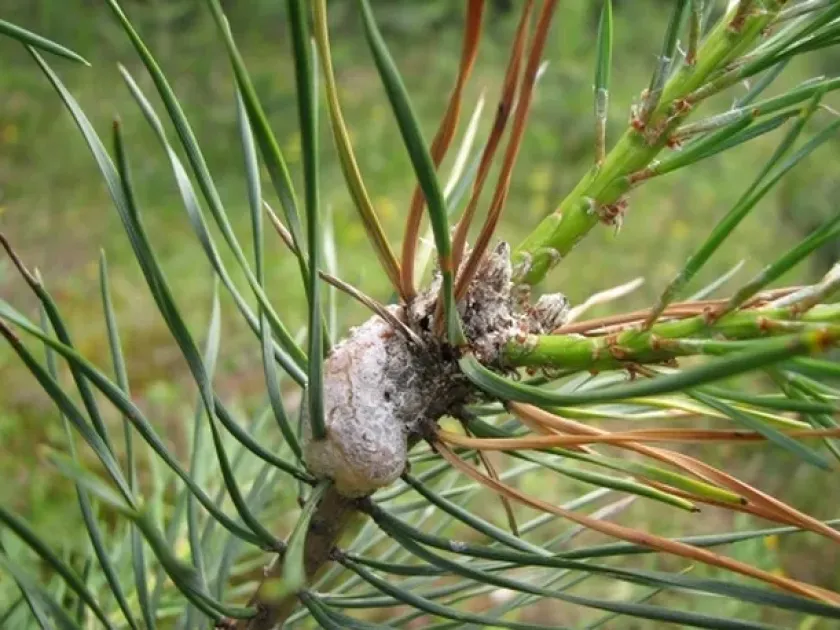
Feeding larvae disrupt the flow of sap in the shoots by boring into the bark. This physiological stress triggers the tree to exude resin, which the larvae use to construct their characteristic galls.
The construction of these galls creates a bottleneck in the branch. As a result, the portion of the shoot above the gall may wither, bend, or die due to restricted nutrient and water transport.
If the terminal bud is infested, the tree loses its primary growth point. This often forces the tree to develop a secondary leader, leading to permanent stem deformity.
Persistent infestations significantly weaken the tree, increasing its vulnerability to subsequent attacks by secondary pests, such as bark beetles, or various fungal pathogens.
Signs of infestation
The most definitive sign of an infestation is the presence of hard, round, or oval resinous nodules (galls) on the twigs, typically located at the base of the shoot.
Shoots affected by the moth often exhibit yellowing needles or premature drooping, particularly when the resin gall is large enough to constrict the shoot significantly.
Stem distortion is a hallmark of past infestations. When a terminal shoot is killed by the larva, the resulting bend in the trunk creates a distinct 'kink' or 'knee' shape.
The galls are easy to spot during the autumn and winter months, as they are hard, dark, and shiny against the bark, remaining on the branches even after the moth has emerged.
A small, circular exit hole on the surface of the gall confirms that the adult moth has successfully completed its metamorphosis and vacated the structure.
Control measures
Silvicultural management is the primary method for controlling Retinia resinella. Maintaining healthy, vigorous stands through proper spacing helps trees withstand the impact of the pest.
In smaller areas, such as parks or pine nurseries, manual removal and destruction of the galls during the winter months is a highly effective way to reduce the population.
Chemical control is rarely justified in large forest stands due to the larvae being protected inside the resin, rendering insecticides largely ineffective against them.
Biological control plays a significant role in keeping populations in check. Various species of parasitoid wasps and birds are known to prey upon the larvae inside the galls.
Sanitary measures, including the removal of heavily infested saplings in areas of mass outbreaks, prevent the pest from spreading to healthier parts of the pine plantation.
Taxonomy
- Latin name
- Retinia resinella
- Order
- Lepidoptera (butterflies)
- Family
- Tortricidae
- EPPO code
- EVETRE
Discussion
No discussions yet — be the first.