
Pine shoot moth (metallica)
Retinia metallica
Description
How to identify
The pine shoot moth (scientific name Retinia metallica) belongs to the order Lepidoptera and the family Tortricidae. It is a small moth whose larvae are specialized pests of various conifer species, particularly pines.
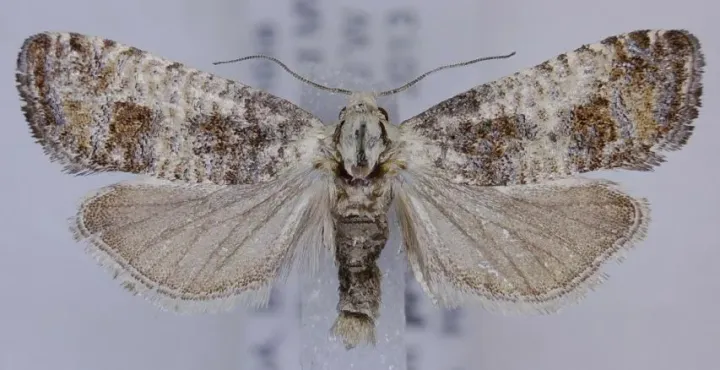
The adult moth has a wingspan of 12–15 mm. Its forewings exhibit a characteristic metallic luster, which gives the species its name. The color ranges from greyish-brown to dark brown with distinct transverse stripes.
Larvae (caterpillars) go through several instars, shifting in color from light yellow to reddish-brown. They possess a dark-colored head, which is a key identifying feature during the larval stage.
Pupae are brownish and typically found inside the damaged shoots or buds. Their location inside the plant tissue protects them from predators and many conventional contact insecticides.
The moth's biological cycle is precisely synchronized with the phenology of pine trees, ensuring that young larvae have immediate access to succulent, energy-rich tissues upon hatching.
What it damages
The primary hosts of Retinia metallica are pine species, notably the Scots pine. The damage is caused by larvae feeding on young shoots and terminal buds.
By boring into the central bud or young shoots, larvae create tunnels that disrupt the vascular flow and nutrient transport. This leads to stunted growth or complete dieback of the affected parts.
Damaged shoots often twist, bend, or become stunted, which significantly affects the overall aesthetic and structural integrity of the tree, especially in young saplings.
The feeding sites are marked by heavy resin flow (pitching), which solidifies into noticeable lumps. This resinous buildup is a direct response of the tree to the mechanical injury.
Persistent infestations weaken the tree, making it susceptible to secondary pathogens, fungal diseases, and other wood-boring insects.
When it appears
Adult moths typically emerge during the summer months, most commonly between June and July. During this time, they mate and lay eggs individually on needles or shoot scales.
After hatching, larvae immediately begin boring into the plant tissue. They remain active as feeders throughout the late summer and early autumn months.
The species overwinters as a larva, often nestled within the damaged bud or shoot, or sometimes beneath bark scales in a silk-lined hibernaculum.
In spring, as sap flow resumes, the overwintered larvae resume feeding and complete their development before pupating within the tunnels they have excavated.
The moth generally completes one generation per year, though climate and local temperatures can influence the exact timing of flight and larval activity.
Signs of infestation
The most prominent sign of infestation is the appearance of resin drops on buds and young shoots, which darken and harden over time.
Visible deformation of shoots, such as twisting or stunted growth (often referred to as 'crooked shoots'), is a clear indicator of previous or active larval feeding.
In spring, buds may fail to open or produce only short, underdeveloped needles, which contrasts sharply with the healthy, elongated shoots of surrounding trees.
Accumulations of brownish frass (larval excrement) mixed with silk webbing can usually be found at the entrance of the larval tunnel.
Small, circular entrance holes in the buds or shoots, often oozing fresh resin, are definitive evidence of recent boring activity.
Control measures
Management of the pine shoot moth involves an integrated approach combining mechanical, biological, and chemical control strategies to protect forest and garden stands.
Mechanical removal and destruction of infested shoots during the larval stage is highly effective, as it directly reduces the pest population before adult emergence.
Biological control agents, such as specific entomopathogenic bacteria, can be applied during the window of egg-laying or early larval hatching to minimize environmental impact.
Chemical control using systemic or contact insecticides is recommended when larval activity peaks, though timing must be precise to ensure maximum effectiveness.
- Use pheromone traps to monitor adult flight patterns and population density.
- Prune and burn infested twigs to prevent further spread.
- Apply systemic insecticides during the early growth season.
- Promote forest health to increase natural resistance and tree vigor.
Taxonomy
- Latin name
- Retinia metallica
- Order
- Lepidoptera (butterflies)
- Family
- Tortricidae
- EPPO code
- PETVME
Discussion
No discussions yet — be the first.