
Retinia cristata
Retinia cristata
Description
How to identify
Retinia cristata is a species of moth belonging to the family Tortricidae, order Lepidoptera. It is a known pest that specifically targets coniferous trees, particularly pines, by attacking their developing shoots.
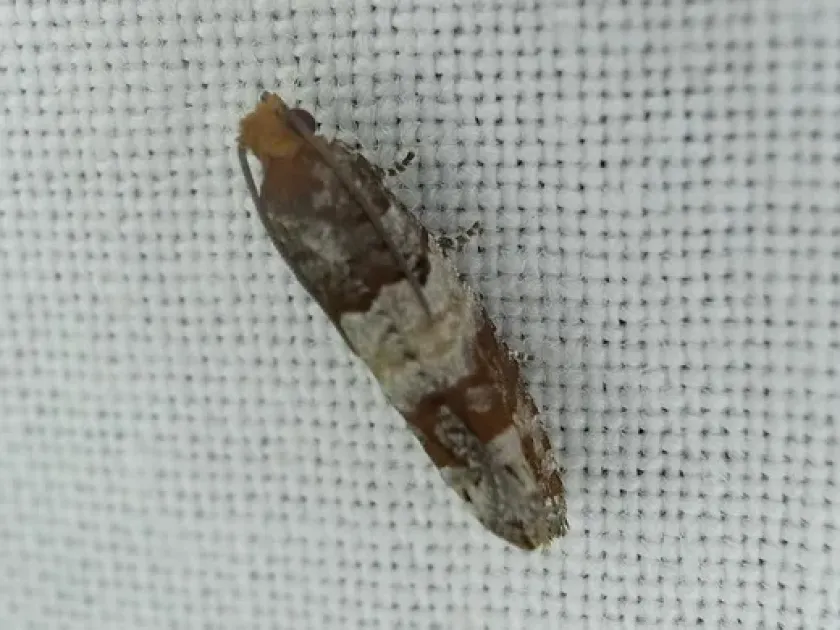
Adult moths are relatively small, with a wingspan of approximately 15–20 mm. Their coloration is adapted for camouflage against pine bark, making them difficult to spot during daytime surveys.
The larvae, or caterpillars, go through several developmental stages. Initially, they are pale, later developing a darker brown body with a distinctive dark-colored head capsule, characteristic of the Tortricidae family.
The biological cycle of this insect is closely synchronized with the phenology of the host plant. Population peaks are often observed in regions with specific climatic conditions that favor the rapid development of larvae.
Due to their concealed way of life, identifying these pests in the early stages requires careful inspection of shoots and terminal buds where the larvae spend most of their time feeding.
What it damages
Retinia cristata primarily damages various pine species (Pinus spp.). Larvae infest the terminal buds and young shoots, excavating internal tunnels that disrupt the structural integrity of the plant.
The primary damage is caused by the larval feeding process, which destroys the meristematic tissues responsible for shoot elongation. This results in stunted growth and distorted, twisted branches.
A classic symptom of infestation is heavy resin secretion at the feeding site. This is the tree's natural response to mechanical injury, which often leaves visible resinous lumps on the stems.
Heavy infestations can significantly weaken younger trees, making them susceptible to secondary pests like bark beetles and various fungal pathogens that enter through damaged tissues.
In forest nurseries, this moth can cause substantial economic loss by ruining the shape and health of saplings, rendering them unfit for sale or reforestation projects.
When it appears
The adult flight period typically occurs in the mid-summer, depending on regional temperatures. During this time, mating occurs and females lay eggs on or near the buds of host trees.
Larvae hatch towards the end of summer and begin their destructive feeding activities. They prepare for overwintering by finding suitable crevices in the bark or entering dormant buds.
The overwintering stage allows the larvae to survive harsh winter conditions. As soon as temperatures rise in the spring, they resume feeding on the emerging new shoots.
The most severe damage to the tree's growth occurs during the spring feeding phase, as the larvae consume the tissues of the succulent new growth that the tree relies on for expansion.
Pupation occurs in late spring or early summer within the tunnels created by the larvae or in sheltered areas, marking the beginning of the next generation's life cycle.
Signs of infestation
The first signs of an infestation include the premature yellowing and wilting of new shoots. This occurs because the larvae have destroyed the internal supply pathways of the branch.
Resin droplets appearing on the base of buds or along the stem are a key indicator of infestation. These droplets often harden over time and become dark, easily visible spots.
Frass (larval excrement) mixed with resin particles is often found around the entrance of the larval tunnels. This debris is a very reliable sign that the caterpillar is currently active.
Distorted growth patterns, such as "shepherd's crook" or twisted terminals, are evidence of past or ongoing larval activity at the tip of the tree or branch.
- Terminal shoots turning brown and drooping.
- Abnormal resin flow at the base of new buds.
- Visible entry holes in twigs or bud scales.
- Stunted or deformed lateral and terminal shoots.
Control measures
Monitoring using pheromone traps is an effective way to track adult activity and predict when eggs will be laid, allowing for precise timing of control measures.
Mechanical removal and destruction of infested shoots during the early stages of infestation can significantly reduce the local population of the pest before they reach maturity.
Biological control, such as using Bacillus thuringiensis sprays, is recommended when the larvae are actively feeding and exposed on the foliage, minimizing impact on non-target species.
Chemical control using systemic insecticides can be effective as these compounds are transported through the tree's vascular system, reaching larvae hidden inside the shoots.
Promoting overall tree vigor through proper site selection, fertilization, and sanitation helps the pines naturally resist and recover from pest attacks, reducing the long-term impact of the moth.
Taxonomy
- Latin name
- Retinia cristata
- Order
- Lepidoptera (butterflies)
- Family
- Tortricidae
- EPPO code
- PETVIN
Discussion
No discussions yet — be the first.