
White-headed pine shoot moth
Retinia albicapitana
Description
How to identify
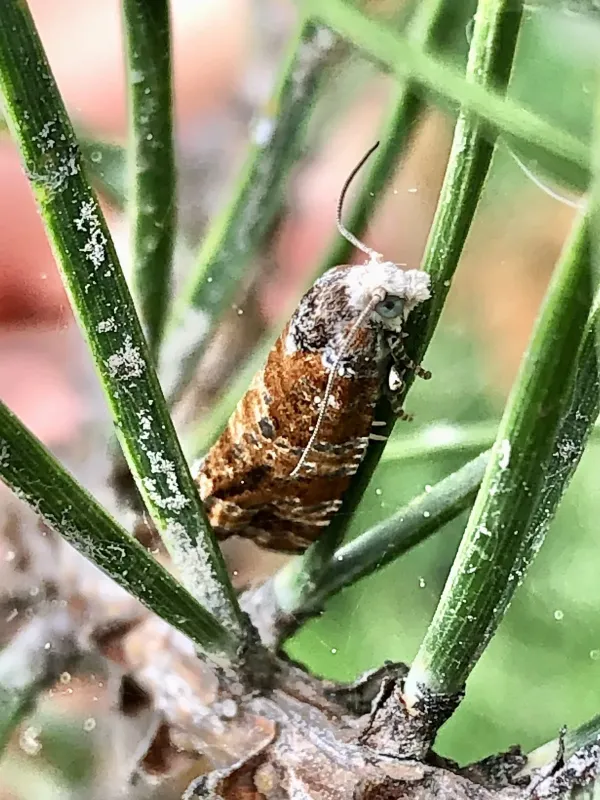
The white-headed pine shoot moth (Retinia albicapitana) is a member of the order Lepidoptera and the family Tortricidae. Adults are small moths with a wingspan of approximately 15–20 mm, identifiable by their characteristic white-scaled head and thorax.
As a specialized pest, the species focuses on pine trees (Pinus), with the larvae living inside the current year's shoots during their development. This habitat provides them with both nutrition and protection.
The larvae progress through several instars, exhibiting a yellowish-brown coloration. Their physiological adaptation allows them to bore efficiently into the woody tissues of the host plant.
The pupal stage occurs within the resinous galleries created by the larvae inside the pine shoot, which serves as a highly effective physical barrier against many environmental threats.
Monitoring this moth is essential in silviculture, especially in young pine plantations where the impact on tree architecture can be significant.
What it damages
The primary damage caused by Retinia albicapitana involves larvae boring into the pith of young shoots. This feeding habit disrupts the transport of nutrients and water, often causing the shoot to wither and die.
The aesthetic and economic value of young pines is heavily impacted, as infestations frequently lead to crooked stems or the loss of the apical leader, preventing the tree from growing straight.
Frequent infestations weaken the tree's overall vigor, making it more susceptible to secondary infections, such as pitch cankers or fungal pathogens that exploit the resinous entry holes.
In high-density outbreaks, the cumulative damage can result in stunting, reduced growth rates, and in severe cases, the mortality of young seedlings or nursery stock.
The visible damage patterns—specifically the distortion of the terminal shoots—make this pest a significant concern for forest management and ornamental conifer production.
When it appears
Adult moths are typically active during the early to mid-summer period, during which time mating and oviposition take place on the surface of young pine twigs.
The larvae hatch shortly thereafter, quickly initiating the boring process into the developing tissues where they will spend the majority of their growth phase.
Overwintering occurs in the larval stage, with the insects remaining inside their galleries within the shoot during the cold winter months.
As spring approaches and the tree's vascular system resumes activity, the larvae emerge from their winter dormancy to resume feeding before preparing for pupation.
Pupation takes place within the existing tunnels, concluding with the emergence of the adult moth to begin the cycle once more.
Signs of infestation
One of the earliest signs of an infestation is the appearance of small, distinct pitch beads or resin flow on the surface of the shoot near the larval entry point.
The presence of fine wood frass and larval excrement mixed with resin often accumulates at the entry site, serving as a clear indicator of active feeding activity.
Visual identification is further aided by the yellowing and subsequent browning of the needles on the infested shoot, which indicates the death of that specific part of the branch.
Deformation of the branch structure, often observed as a characteristic "shepherd's crook" or severe bending of the shoot, is a long-term indicator of past infestation.
Empty pupal casings protruding from the exit holes in the shoot indicate that the adult moth has completed its cycle and successfully emerged from the host tissue.
Control measures
Mechanical control involves the pruning and destruction of infested shoots during the growing season to eliminate larvae before they complete their development.
Chemical control can be achieved through the application of systemic or contact insecticides, provided that the timing aligns with the peak larval hatch window.
Biological control, including the encouragement of parasitic wasps and insectivorous bird populations, is recommended as a sustainable way to manage pest densities.
The use of pheromone-baited traps allows foresters to monitor population spikes accurately and optimize the timing of any necessary intervention.
Integrated Pest Management (IPM) practices, such as maintaining healthy tree vigor and selecting less susceptible site locations, remain the most effective long-term strategies.
Taxonomy
- Latin name
- Retinia albicapitana
- Order
- Lepidoptera (butterflies)
- Family
- Tortricidae
- EPPO code
- PETVAL
Discussion
No discussions yet — be the first.