
Pine shoot moth
Retinia
Description
How to identify
The pine shoot moth (genus Retinia) belongs to the Tortricidae family. These are small moths with a wingspan ranging from 15 to 22 millimeters, typically displaying cryptic coloration that blends with bark and pine needles.
The larvae are caterpillars with colors ranging from pale yellow to reddish-brown, reaching up to 15 millimeters in length. A distinguishing feature is their dark-colored head, which contrasts with the rest of their body.
Because these insects spend most of their life cycle inside the tissues of the plant, they are often difficult to spot until significant damage has already occurred.
The life cycle is closely synchronized with the growth stages of host conifers, making the larvae particularly active during the spring flush of new growth.
Trapping adults using pheromone lures is the gold standard for monitoring, allowing foresters and gardeners to time their intervention strategies accurately.
What it damages
The primary hosts for these moths are various pine species, including Scots pine and stone pine. They are particularly devastating to young plantations and ornamental nursery stock.
Larvae bore into the terminal and lateral buds, consuming the inner tissues. This activity severs the vascular connections, leading to the death or stunting of the current season's growth.
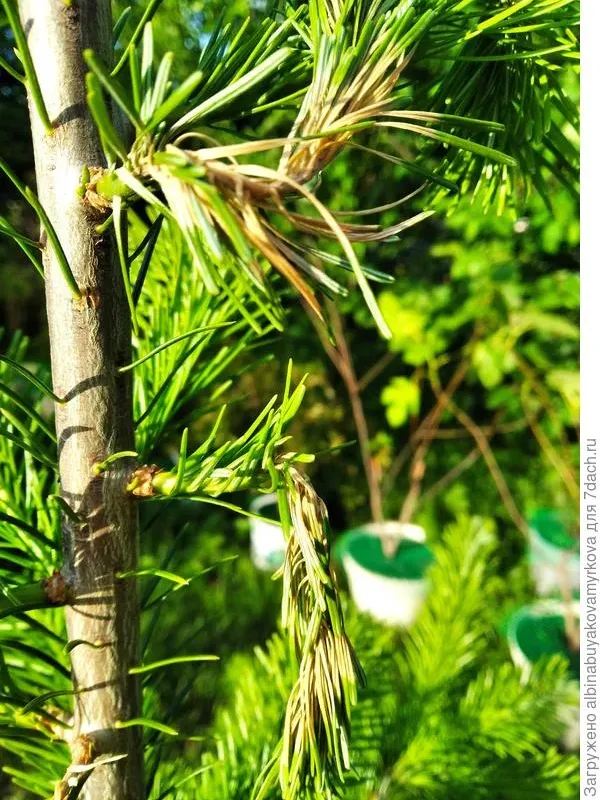
Severe infestations result in distorted crowns, crooked stems, and the characteristic "post-horn" or "flag-like" deformities that ruin the tree's architecture.
Entry wounds created by the larvae serve as infection courts for various fungal pathogens, which can exacerbate the decline and promote secondary infestations by bark beetles.
Economic damage includes reduced timber quality, loss of nursery stock, and high maintenance costs for pruning and removing infested plant parts in managed landscapes.
When it appears
Pine shoot moths generally have a univoltine life cycle, completing one generation per year. Adult moths typically emerge in late spring or early summer.
Females deposit eggs on or near the buds and needles of host trees. The larvae hatch within a couple of weeks and immediately begin searching for a suitable entry point.
Upon finding a bud, the young larva bores inside and constructs a silken nest, where it feeds and remains protected from both predators and environmental extremes.
The winter is spent in the larval stage, diapausing within the infested bud or a small chamber in the stem, protected by a dense, silken hibernaculum.
As temperatures rise in the spring, the larvae resume feeding, grow rapidly, and eventually pupate within the galleries they have excavated inside the shoots.
Signs of infestation
The most prominent indicator is the presence of resin flow at the base of buds or on the stem, often forming visible, hardened droplets that look like beads of amber.
Discoloration and flagging of the terminal shoots are clear signs of larval presence. As the shoot dies, it turns brown and may bend at a sharp angle.
Frass (larval excrement) mixed with needle fragments and resin can often be found near the entry hole, providing evidence of recent larval activity inside the shoot.
Empty pupal casings, often protruding from the exit holes in the withered buds, serve as clear post-emergence evidence that the moth has completed its cycle.
A overall lack of terminal growth and an unnaturally dense or deformed crown are cumulative indicators of chronic infestation in a coniferous stand.
Control measures
Mechanical control, which involves the pruning and destruction of infested buds and shoots before adult emergence, remains one of the most effective management tools.
Chemical applications using systemic insecticides can be effective if timed to coincide with the period when young larvae are migrating on the surface of the plant.
Biological control methods, such as the application of Bacillus thuringiensis, provide an eco-friendly option that targets larvae while preserving beneficial predatory insects.
Promoting a healthy environment for natural predators like birds and parasitic wasps helps to stabilize populations and reduce the risk of massive outbreaks.
Cultural practices, including site selection, balanced fertilization, and avoiding overcrowding in plantations, enhance tree vigor, making them more resilient to larval attacks.
Taxonomy
- Latin name
- Retinia
- Order
- Lepidoptera (butterflies)
- Family
- Tortricidae
- EPPO code
- PETVSP
Discussion
No discussions yet — be the first.