
Golden-crowned kinglet
Regulus satrapa
Description
How to identify
The Golden-crowned Kinglet (Regulus satrapa) is a tiny passerine bird belonging to the kinglet family, Regulidae. It is recognized as one of the smallest bird species in North America, often reaching only 8 to 10 centimeters in length.
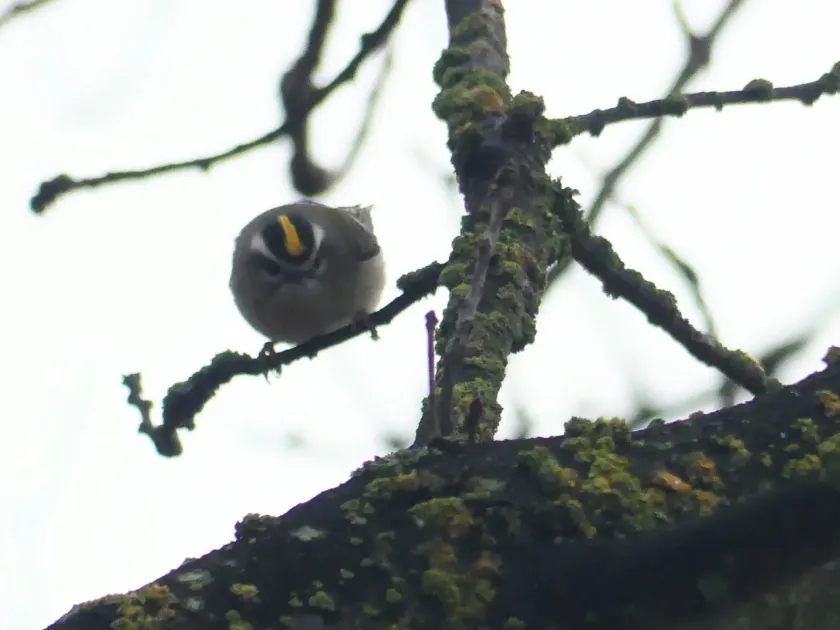
The bird is easily identified by its distinctive yellow or orange crown patch, bordered by black feathers, which is more prominent in males. The overall plumage is a mix of olive-gray on the back and pale white on the belly, providing excellent camouflage.
Physiologically, these birds have a very high metabolic rate, requiring them to forage almost constantly throughout the day to sustain their small bodies, especially in colder climates.
They are characterized by extremely agile flight, often hovering near the tips of pine or spruce needles to pick off tiny insects. Their vocalizations are high-pitched, thin "see-see-see" notes, often hard to detect at a distance.
The species is taxonomically distinct but shares behavioral similarities with other members of the Regulus genus, all of which are adapted to life in dense forest canopies.
What it damages
The Golden-crowned Kinglet is not an agricultural or forest pest; it is an important beneficial organism. It acts as a natural predator of small arthropods, helping to manage insect populations within forest ecosystems.
Its diet consists primarily of small insects and arachnids, including aphids, scale insects, spider mites, and the eggs of various forest pests. By foraging in the canopy, they reduce the number of insects that could otherwise cause significant damage to coniferous growth.
Their impact on forestry is entirely positive. By feeding on potential pests, they help preserve the health and vigor of coniferous trees, acting as a natural biological control agent.
There is no evidence that this bird species damages seeds, buds, or agricultural crops. They are entirely dependent on animal protein from their insect prey for survival throughout the year.
The economic value of this species lies in its role as a natural regulator of insect outbreaks. Encouraging their presence is a sustainable practice for healthy forest management and plantation maintenance.
When it appears
These birds are partially migratory, with many northern populations moving southward during the winter months to avoid extreme temperatures. In milder regions, they may remain resident throughout the year.
The breeding season typically occurs in late spring and early summer. During this time, they construct elaborate cup-shaped nests in dense conifer branches, often high above the ground for protection.
In autumn and winter, kinglets frequently join mixed-species foraging flocks. This behavioral adaptation improves their chances of finding food and provides protection against predators in the sparse winter environment.
Their lifecycle is closely timed with the availability of insect larvae. The spring emergence of insects triggers the peak period for nest building and chick rearing, ensuring high survival rates for the brood.
Environmental conditions, such as severe winter freezes, can affect population dynamics, though their ability to find food in bark crevices and thick needles allows them to endure harsh conditions better than many other insectivores.
Control measures
As a highly beneficial and non-destructive species, the Golden-crowned Kinglet does not require control measures. Instead, management strategies should focus on habitat conservation and protection.
To encourage their population, it is essential to maintain diverse, mature stands of coniferous trees. Dense evergreen foliage is critical for both nesting sites and thermal protection during winter.
The use of broad-spectrum chemical insecticides should be avoided, as these substances can eliminate the birds' food supply and lead to secondary poisoning or population decline within the local ecosystem.
Implementing integrated pest management (IPM) practices allows these natural predators to thrive, reducing the overall reliance on chemical inputs in forestry and neighboring landscapes.
Monitoring the presence and density of kinglets can serve as an indicator of forest health. A robust population of these insectivores often signals a balanced and productive forest ecosystem.
Taxonomy
- Latin name
- Regulus satrapa
- Family
- Regulidae
- EPPO code
- REGUSA
Discussion
No discussions yet — be the first.