
Goldcrest
Regulus regulus
Description
How to identify
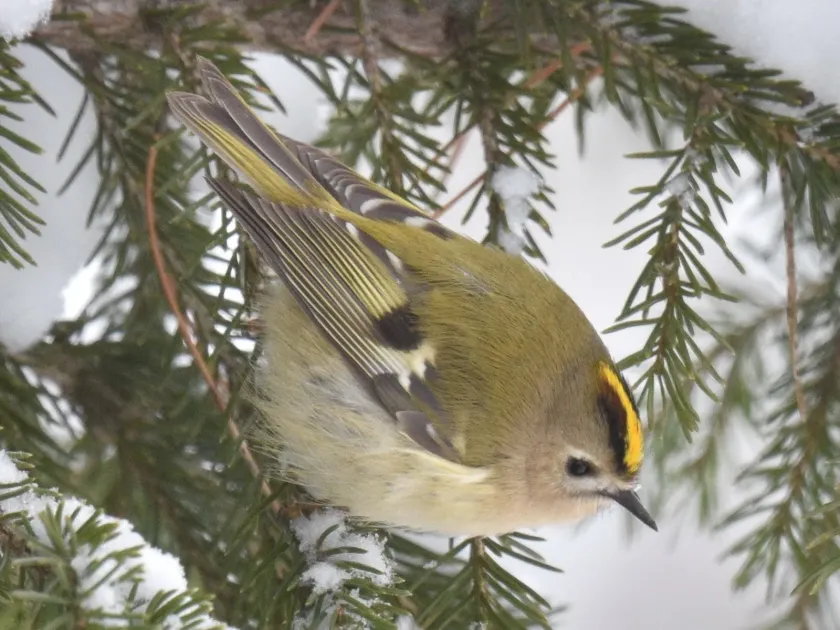
The Goldcrest, scientifically known as Regulus regulus, is a small passerine bird from the kinglet family, noted for its exceptionally small size.
The bird features an olive-green back and a distinctive bright crest on its head, which is orange in males and yellow in females.
Weighing only 5–6 grams, it is the smallest bird species found in Europe, showing remarkable agility and speed while foraging.
Its bill is very thin and needle-like, perfectly adapted for extracting insects from tight crevices within the bark of trees.
Goldcrests are highly energetic and constant in their movement, which makes them easy to identify by their restless behavior in canopy branches.
What it damages
The Goldcrest is not considered a crop pest; rather, it is a highly beneficial species for arboriculture and forest health.
Their diet consists almost entirely of small insects, larvae, and eggs, making them an excellent natural control agent against forest pests.
They do not consume fruit, seeds, or buds, which ensures that they do not harm the economic value of agricultural or forestry crops.
Instead, they provide ecosystem services by reducing the populations of harmful defoliators and sap-sucking insects in coniferous forests.
There is no record of economic loss associated with this species; they are widely welcomed in garden and forestry management.
When it appears
Goldcrests can be sedentary or migratory depending on the geographical location and the availability of food sources during winter.
During the spring and summer breeding seasons, they establish territories and are found mostly in coniferous and mixed forest habitats.
As winter approaches, they often move to warmer areas or gather in small flocks, moving through canopies to search for food in pine and spruce trees.
Their activity levels are highest during the early morning hours when they systematically inspect tree branches for dormant insect stages.
Autumn migration may bring groups of Goldcrests into gardens and urban green spaces where they previously were not present.
Signs of infestation
Identification by sound is the most common method, as they produce a very high-pitched, thin "see-see-see" call that is often overlooked.
Visually, they are spotted by their erratic, flickering movement throughout the outer foliage of coniferous trees.
Signs of their presence include the absence of visible aphid or scale insect colonies on the outer branches where the birds have recently foraged.
Small, mossy, dome-shaped nests attached to the underside of evergreen branches serve as evidence of their successful habitation.
Accumulation of droppings on the needles below a branch indicates that the bird has spent significant time foraging in that specific area.
Control measures
There are no control measures for the Goldcrest, as they are not pests and are categorized as environmentally beneficial organisms.
Agricultural and forestry best practices actually prioritize the conservation of habitats that attract these insectivorous birds.
Management strategies should focus on maintaining a diversity of tree ages and the preservation of evergreen cover for nesting and wintering.
In specialized research nurseries, physical barriers like fine-mesh netting are sufficient to prevent any accidental contact with sensitive seedlings.
- Maintain dense coniferous plantings.
- Avoid heavy pesticide use to ensure a natural food supply.
- Protect nesting sites during the spring period.
Taxonomy
- Latin name
- Regulus regulus
- Family
- Regulidae
- EPPO code
- REGURE
Discussion
No discussions yet — be the first.