
Senegalese jumping weevil
Ramphus senegalensis
Description
How to identify
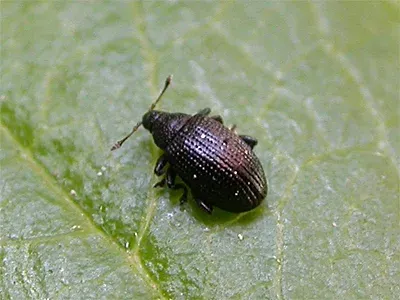
The Senegalese jumping weevil (Ramphus senegalensis) belongs to the Curculionidae family within the order Coleoptera. It is a small insect characterized by its specialized hind legs, which enable it to jump as an evasive maneuver when threatened, distinguishing it from most other weevil species that rely solely on falling or crawling.
What it damages
The pest primarily affects plants within the Rosaceae family. It is recognized as a pest in various orchards, attacking pome fruits such as apple and pear trees. The feeding behavior of both adults and larvae can cause significant physiological stress to the host plants if infestations are severe.
When it appears
The life cycle of the species is synchronized with the budburst of host trees. Adults emerge in early spring to feed on tender new foliage and buds. The reproductive phase follows quickly, leading to the development of the next generation through the warmer months of the year.
Signs of infestation
Signs of infestation are characterized by small punctures in the leaves caused by adult feeding. More critically, the larvae mine the leaf tissue, creating visible tunnels or blotches. Heavy infestations often result in chlorosis, leaf deformity, and the premature shedding of foliage during the active growing season.
Control measures
Control strategies involve the application of systemic insecticides during the early spring peak period. Integrated pest management should also include the removal and destruction of fallen leaves where pupae may overwinter. Maintaining tree health through proper fertilization can help plants withstand damage caused by this insect.
Taxonomy
- Latin name
- Ramphus senegalensis
- Order
- Coleoptera (beetles)
- Family
- Curculionidae
- EPPO code
- RAMPSE
Discussion
No discussions yet — be the first.