
Ramphus
Ramphus
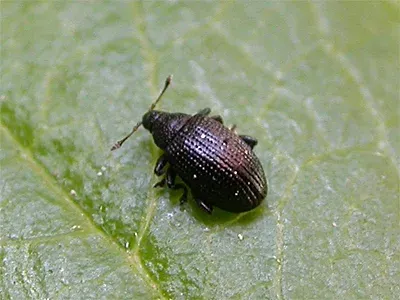
Description
How to identify
The genus Ramphus belongs to the Curculionidae family, commonly known as weevils, within the order Coleoptera. These are extremely small beetles, often characterized by their ability to jump using specialized hind legs, which is an unusual trait for this family.
Adult specimens typically measure between 2 and 3 millimeters in length. Their bodies are compact and often spherical or broadly oval, frequently exhibiting a dark coloration with a metallic sheen or fine pubescence.
The snout, or rostrum, of these beetles is relatively short, distinguishing them from the classic long-snouted weevils. They possess elytra that cover the flight wings, protecting them effectively in various environmental conditions.
Larvae are typical of the weevil family: apodous (legless), creamy white, with a dark head capsule. They are exclusively internal feeders, spending their entire larval life within the leaf tissues of the host plants.
Identification is challenging due to the beetle's miniature size. Professionals typically rely on morphological analysis of genital structures to confirm the species, as visual field identification is often restricted to the genus level.
What it damages
Ramphus species act as specialized phytophagous pests, primarily targeting woody plants. Their host range is mostly limited to members of the Salicaceae family, specifically willows (Salix) and poplars (Populus).
Adult beetles feed on the foliage by chewing tiny, circular holes through the leaf blade, a process known as leaf perforation. This reduces the photosynthetic capacity of the tree.
The primary damage is caused by the larvae, which are leaf miners. They tunnel between the upper and lower epidermis of the leaf, creating narrow, winding paths that expand as the larvae grow.
Widespread infestations result in significant defoliation, which stresses the tree, weakens its growth, and makes it more susceptible to secondary infections, such as fungal pathogens.
Ornamental trees and shrubs often lose their aesthetic value entirely due to the extensive mining patterns and browning caused by the feeding activity of these small weevils.
When it appears
The development cycle of Ramphus is strictly synchronized with the phenology of its host plants. Adults emerge from overwintering sites in early spring, just as leaf buds begin to open.
After a period of supplemental feeding and mating, females deposit eggs into the leaf tissue. This process is facilitated by their snout, which helps them create a precise opening for each egg.
Larvae feed within the leaf for several weeks throughout the spring and early summer. The growth rate is highly dependent on ambient temperature and the health of the host plant.
Pupation typically occurs either within the leaf mine itself or in the soil beneath the plant. Depending on the species and geographical climate, they may complete one or two generations per year.
Winter is passed in the adult stage. They seek refuge in sheltered areas, such as leaf litter, cracks in the tree bark, or soil crevices, demonstrating high resilience to cold temperatures.
Signs of infestation
The most visible sign of an early-stage infestation is the presence of numerous tiny, pinpoint holes in the leaves, created by adult feeding activity.
As the infestation progresses, characteristic meandering lines (leaf mines) appear. These lines are often pale or yellowish, containing blackish frass (larval waste) within the tunnels.
Severe infestations cause the leaves to lose their green color, turn brown, and eventually wither. In some cases, the leaves may curl or deform as the mines expand across the surface.
Disturbing the branches in the early morning can reveal the presence of adult beetles, which will jump off the leaves when threatened. This behavior is a diagnostic feature for the genus.
A general decline in the tree's canopy density and a prematurely withered appearance are clear indicators of extensive larval mining and long-term pest pressure.
Control measures
Effective management of Ramphus requires an integrated approach. The most critical sanitation step is the thorough removal and destruction of fallen leaves in autumn, which eliminates potential overwintering sites for the next generation.
In ornamental settings, applying systemic insecticides during the early spring ensures that the chemical is absorbed by the foliage, targeting the larvae as they initiate mining.
Monitoring is essential to determine the timing of insecticide application. Using sticky traps or visual inspection during the early bud-break stage helps to pinpoint the peak activity of adult beetles.
Biological control, using entomopathogenic fungi or beneficial nematodes, can be effective in sustainable or organic forestry programs, provided the humidity and temperature conditions are favorable.
Promoting a healthy tree environment through proper fertilization and pruning reduces the plant's susceptibility to damage, as vigorous trees can often tolerate low-level pest populations better than stressed ones.
Taxonomy
- Latin name
- Ramphus
- Order
- Coleoptera (beetles)
- Family
- Curculionidae
- EPPO code
- RAMPSP
Discussion
No discussions yet — be the first.