
Elm leaf beetle
Pyrrhalta humeralis
Description
How to identify
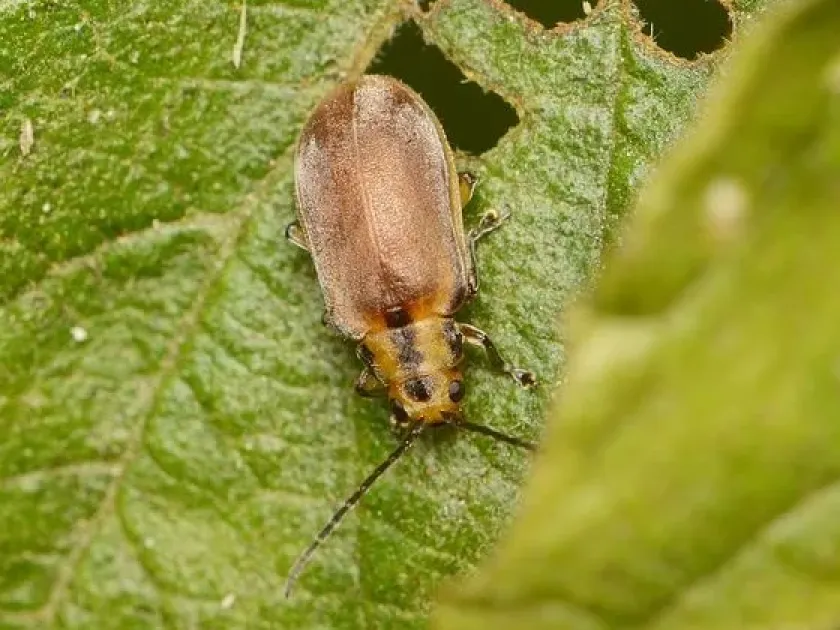
The elm leaf beetle (Pyrrhalta humeralis) belongs to the Chrysomelidae family, the order Coleoptera. Adult beetles are typically 6–7 mm long, with a distinct yellowish-brown body marked by dark patterns on their elytra.
Larvae appear elongated, dark grey or black, often covered with tiny bristles. They go through several developmental instars, becoming increasingly voracious as they grow in size.
Eggs are deposited in small, neat clusters on the undersides of leaves. They are yellow and barrel-shaped, making them a key indicator during early-season visual inspections.
Pupation primarily occurs in the soil or protected crevices of the tree bark near the base of the trunk, providing a safe harbor for the transition stage.
Adults are capable of strong flight, which facilitates their rapid spread across urban landscapes and forest patches, making control measures more complex in densely planted areas.
What it damages
The primary host for this pest is the genus Ulmus (elm trees). Both adults and larvae contribute to significant leaf loss, which can compromise the tree's health.
Adults chew small holes in the foliage, while larvae skeletonize the leaves, feeding on the tissue between the veins, which creates a characteristic lacy appearance.
Heavy infestations lead to premature defoliation. This drastically reduces the tree's ability to photosynthesize, which can cause significant stress and branch dieback over time.
Repeated yearly attacks leave trees susceptible to other pathogens, such as fungal diseases and borers, which often finish off trees weakened by prolonged beetle activity.
The loss of aesthetic value is a major concern in urban settings, where elm trees are often used for shade and landscaping in public parks and residential zones.
When it appears
Adults emerge from winter hibernation in the spring, coinciding with the budding of elm trees. This is the period of initial feeding and subsequent egg-laying.
Larval activity peaks during the early to mid-summer period. During these warm weeks, the larvae feed continuously, causing the most visible damage to the canopy.
Depending on regional climates, the species may complete one or more generations per year. The timing of each generation is highly dependent on local temperatures.
As temperatures drop in the autumn, adult beetles seek out overwintering sites. They often congregate in sheltered areas, including bark fissures, leaf litter, or man-made structures.
Warm spring weather often accelerates the life cycle, leading to an earlier onset of feeding and potentially larger populations throughout the growing season.
Signs of infestation
Early symptoms include tiny holes in the leaves. As the infestation progresses, these holes expand, resulting in skeletonized leaves that eventually turn brown and fall.
- Canopy appearing scorched or "browned out" from a distance.
- Visible clusters of black larvae feeding on leaf undersides.
- Premature leaf drop in mid-summer, leaving branches bare.
- Presence of beetles or their dark fecal droppings on the leaves.
A major sign is the sudden thinning of the canopy, which can be observed from the ground when looking up into the tree during the peak summer months.
Significant infestations may also be accompanied by a subtle change in the tree's overall vigor, showing stunted growth or dying tips at the ends of branches.
Control measures
Integrated Pest Management (IPM) is the most effective approach to handling elm leaf beetle populations, combining various control tactics.
Mechanical control, such as removing egg clusters or shaking larvae onto sheets for disposal, can be effective for small, reachable trees in home gardens.
Chemical control involving systemic insecticides is often used in severe infestations. Applications should be timed precisely to coincide with larval hatch for maximum efficacy.
Biological control methods, including the preservation of natural predators and the use of insect-pathogenic fungi, can help keep populations below the economic injury level.
Cultural practices, such as proper irrigation and fertilization, improve tree health, allowing the elm to better withstand and recover from light to moderate feeding damage.
Taxonomy
- Latin name
- Pyrrhalta humeralis
- Order
- Coleoptera (beetles)
- Family
- Chrysomelidae
- EPPO code
- GALEHU
Discussion
No discussions yet — be the first.