
Lienig's Moth
Pyralis lienigialis
Description
How to identify
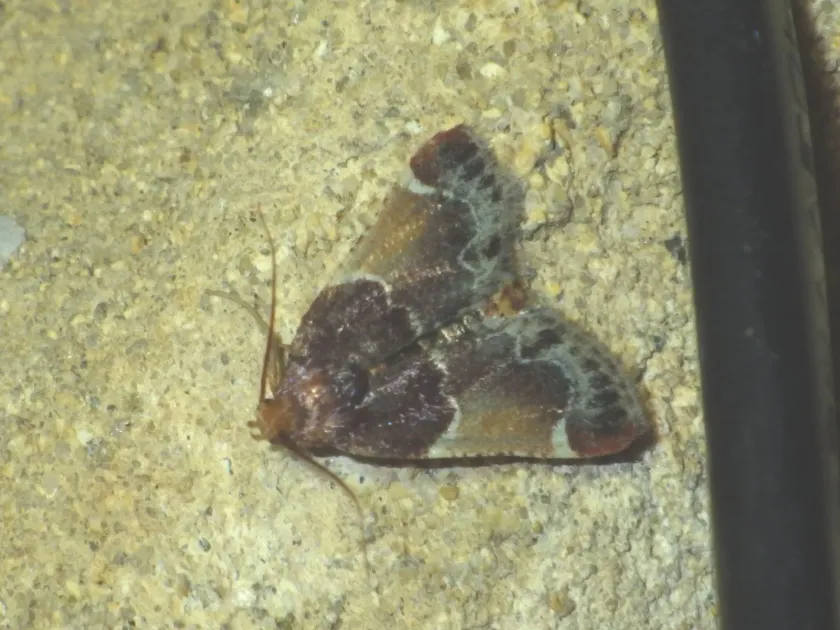
Lienig's Moth (Pyralis lienigialis) belongs to the family Pyralidae, order Lepidoptera. The adult moth is relatively small, with a wingspan of approximately 20–25 millimeters. Its wings display a brownish-gray pattern with dark transverse bands and lighter spots, providing excellent camouflage against tree bark or crop residues.
The larvae are characterized by a chewing mouthpart and a yellowish or grayish-brown body, often marked with small dark spots on each segment. Pupation occurs within thick, silk-lined cocoons, which the larvae construct using silk mixed with bits of the substrate they have been feeding on.
The life cycle consists of four stages: egg, larva, pupa, and adult. Females deposit eggs in clusters on host plants or within crevices. The rate of development is highly dependent on ambient temperature and humidity throughout the growing season, which dictates the number of generations per year.
In field conditions, adults are identified primarily through light traps, as the moths are nocturnal and highly attracted to light sources during dusk and nighttime hours. Distinguishing this species from other Pyralidae requires careful examination of wing patterns and the timing of the flight period.
The species demonstrates significant adaptive plasticity. Larvae can survive unfavorable conditions by retreating into dense shelters, making them difficult targets for many contact-based insecticides during specific stages of their lifecycle.
What it damages
Lienig's Moth is a serious pest primarily affecting stored grains and processed grain products. In field conditions, the larvae can attack stems, seeds, and flower heads of various herbaceous plants, leading to a substantial decrease in crop yield and quality.
Within grain storage facilities, the larvae penetrate grain masses, consuming the embryo and endosperm of the seeds. This leads to a loss of seed viability and a significant reduction in overall commodity weight. Contamination with frass renders the product unfit for consumption or industrial processing.
Beyond direct feeding, the larval activity promotes the growth of secondary microorganisms, including various molds. This encourages the heating of stored grain, which can result in the spoilage of large volumes of inventory over a relatively short period.
In agricultural fields, larvae bore into plant stems, which disrupts nutrient transport and causes wilting or lodging. Mass outbreaks of the pest can destroy a large portion of the reproductive organs of crops, significantly impacting the harvest.
The pest's versatility in food sources allows it to transition from wild hosts to nearby cultivated crops, ensuring the survival of the population even when primary food sources are scarce or depleted during certain seasons.
When it appears
Adult flight typically begins in early June and can persist until the end of August, depending on regional climatic factors and the cumulative heat units. Peak activity for the moths occurs during warm, windless nights.
Larval emergence occurs approximately 10 to 14 days after oviposition. During this phase, the young larvae are most vulnerable to external factors, including biological control agents, as they actively move in search of food and suitable nesting sites.
The active feeding phase of the larvae spans the second half of summer and the early autumn. During this time, the pest causes the most significant damage as it intensifies its feeding to build up reserves for overwintering.
The moth typically overwinters as a late-instar larva or pupa in a protected cocoon. Hibernation sites include cracks in storage facility walls, tree bark crevices, or crop debris, where temperatures remain relatively stable and protected from extreme winter conditions.
The number of annual generations depends on the latitude. In southern regions, two full generations may occur, whereas, in northern regions, the development cycle is often prolonged, resulting in a single annual generation.
Signs of infestation
A primary indicator of infestation in storage is the presence of silk webbing on the surface of the grain, which binds individual grains into small clumps. This serves as clear evidence of larval activity and cocoon construction.
In the field, inspections may reveal holes in stems or the premature yellowing and wilting of flower heads. The presence of fine frass around the base of the plant is a strong indicator of larval feeding activity within the tissues.
The sighting of moths near storage areas or fields during evening hours is a critical signal that the breeding cycle has begun, necessitating immediate monitoring and the implementation of protective measures.
Infested grains show visible hollowed-out sections, frequently covered in fine silk. Such grains have significantly lower weight, have lost nutritional value, and serve as a reservoir for further pest dispersal throughout the storage site.
A rise in temperature within stored grain masses often signifies pest activity. This self-heating creates an environment conducive to mold development, which further degrades the quality of the stored produce and accelerates damage.
Control measures
Sanitation is the cornerstone of pest management. Keeping storage facilities clean and free of dust, debris, and residual grain significantly reduces the availability of hiding spots and food sources for overwintering larvae.
Chemical control, particularly the fumigation of grain stores with approved substances, is an effective way to eliminate the pest across all life stages within enclosed facilities where contact treatment is insufficient.
For field crops, early harvesting is recommended to limit the timeframe during which larvae can inflict damage. Furthermore, deep autumn plowing is a recommended agrotechnical practice to disrupt overwintering sites and reduce the initial population size.
Light traps serve as an effective tool for both monitoring population density and physically reducing the number of adults before they have the chance to lay eggs, providing an environmentally conscious control option.
Biological control, utilizing microbial preparations containing Bacillus thuringiensis, is effective against early-instar larvae. This approach minimizes negative environmental impacts and is highly compatible with integrated pest management (IPM) strategies.
Taxonomy
- Latin name
- Pyralis lienigialis
- Order
- Lepidoptera (butterflies)
- Family
- Pyralidae
- EPPO code
- PYRALI
Discussion
No discussions yet — be the first.