
Hedya dimidioalba (Syn. Ptycholoma lecheana)
Ptycholoma lecheana
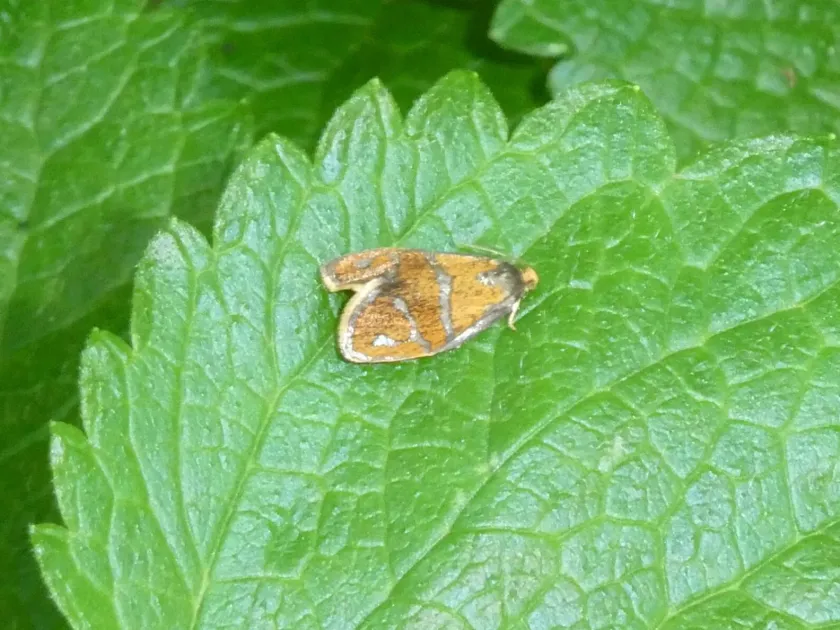
Description
How to identify
The garden moth Ptycholoma lecheana (often discussed alongside leafrollers) belongs to the Tortricidae family. The adult moth has a wingspan of approximately 18–22 mm.
Its forewings are distinctively patterned with brown and yellowish-brown shades, including dark transverse bands that provide camouflage against tree bark.
The larvae are typically olive-green to gray with a dark head capsule, growing up to 20 mm in length during their development phases.
Pupation occurs within leaf rolls, which are securely tied with silk, making them difficult to spot without close inspection of the foliage.
The species is widespread across Eurasia, inhabiting temperate forests, parks, and fruit orchards where it finds abundant resources for its life cycle.
What it damages
This pest is highly polyphagous, targeting a wide range of deciduous trees including apple, pear, plum, and cherry, causing severe horticultural losses.
Larvae feed aggressively on buds and young shoots in early spring, which can stunt tree growth and reduce overall vigor during the critical vegetative phase.
Feeding on flowers and young fruitlets leads to significant yield reduction, as damaged fruit often falls prematurely or becomes deformed.
Beyond orchard trees, it affects ornamental and forest species, including oak, maple, and linden, making it a generalist threat in diverse environments.
Mass infestations can strip foliage from large sections of the canopy, leading to severe defoliation that weakens the tree's health for subsequent seasons.
When it appears
The species overwinters as second-instar larvae, residing in dense silk cocoons hidden within bark crevices or near bud scales for protection.
In spring, as temperatures rise, the larvae emerge to feed on opening buds, marking the start of the primary damage phase of the season.
The pupation stage typically begins in late May or early June, with the moth emerging shortly thereafter to mate and lay eggs.
Adult flight occurs throughout June, and egg-laying is focused on the smooth bark of branches, ensuring the next generation is well-positioned.
The summer generation of larvae appears in July, feeding through the late season until they reach the required stage to enter winter dormancy.
Signs of infestation
The most prominent sign of an infestation is the presence of leaves rolled into tubes or clumps, tightly bound with white silk webbing.
In early spring, damage to buds is observed, often manifesting as hollowed-out or partially consumed tissue that fails to develop properly.
Accumulated frass, or larval waste, trapped inside the leaf rolls or silk nests serves as a clear indicator of the presence of active larvae.
Defoliated patches or damaged fruit skin are common indicators in mid-to-late summer, signaling that the larvae have shifted focus to foliage and fruit.
- Rolled leaves tied with silk.
- Hollowed-out spring buds.
- Visible frass inside nests.
- Damaged fruit epidermis.
Control measures
Mechanical control through bark scraping and the removal of infested leaves or twigs is highly effective for smaller orchards and home gardens.
Installing pheromone traps is a key strategy for monitoring adult populations, allowing for precise timing of biological or chemical interventions.
Chemical control should be applied during the early larval stage, specifically at the green bud phase or immediately post-bloom, using registered insecticides.
Encouraging biodiversity by providing habitats for predatory birds and parasitic wasps helps in naturally suppressing the pest population density.
Regular inspection of the canopy during the spring and early summer is essential to catch early infestations before they spread across the entire orchard.
Taxonomy
- Latin name
- Ptycholoma lecheana
- Order
- Lepidoptera (butterflies)
- Family
- Tortricidae
- EPPO code
- PTYHLE
Discussion
No discussions yet — be the first.