
Elm bark beetle
Pteleobius
Description
How to identify
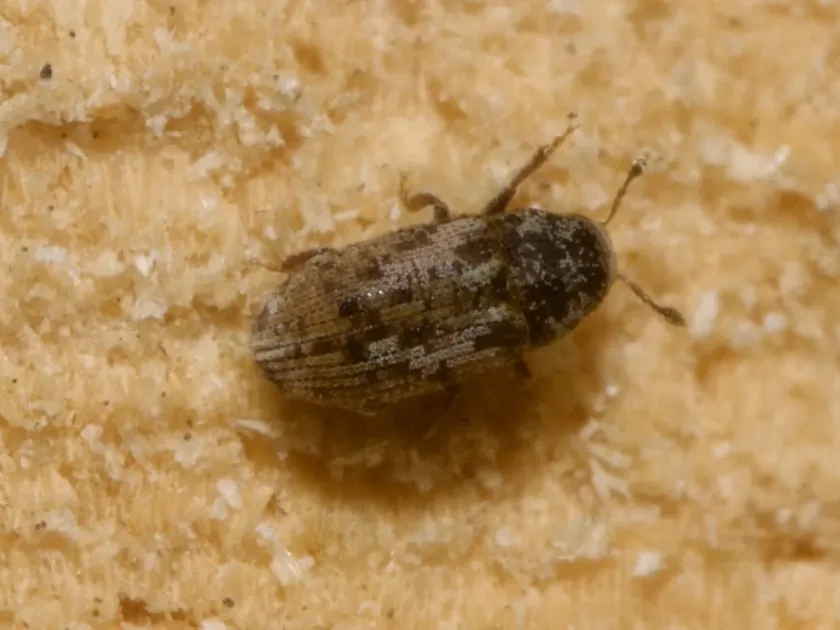
The elm bark beetle (Pteleobius vittatus) is a small beetle belonging to the weevil family and the subfamily of bark beetles (Scolytinae). Adult specimens are typically 2 to 3 millimeters long, with a robust, cylindrical body shape.
The coloration of the adult beetle ranges from brown to almost black. Their bodies are covered with fine setae (hairs), which help them navigate and anchor within the galleries they create beneath the bark of the host tree.
The head is largely retracted into the pronotum, a structural feature common to many bark-dwelling insects. Larvae are white, legless, and possess well-developed mandibles specifically adapted for tunneling through the inner bark.
Due to their cryptic habits, these beetles are rarely seen directly. Identification usually relies on analyzing the specific patterns of the maternal and larval galleries carved into the inner bark and phloem of the host.
Effective identification often requires removing a small section of bark to expose the larval gallery structures, which are distinct for different species within the bark beetle family.
What it damages
The primary hosts for this beetle are elm trees (genus Ulmus). It predominantly attacks trees that are already stressed, weakened by drought, damaged by construction, or otherwise in poor physiological condition.
The beetle causes damage by boring into the cambium and phloem layers. These tunnels disrupt the nutrient and water transport system of the tree, leading to the wilting and eventual death of branches or the entire tree.
Beyond the mechanical destruction caused by feeding, these beetles are notorious for acting as vectors for Ophiostoma ulmi, the fungus responsible for Dutch elm disease. This disease often kills the host tree much faster than the beetles themselves.
High population densities can lead to the rapid destruction of urban elm avenues and shelterbelts. When a tree is heavily infested, it serves as a breeding ground, facilitating the spread of the beetle to nearby healthy trees.
Economic damage is significant in both forestry and urban landscape management, as the removal of dead trees is costly and the loss of mature elms negatively impacts biodiversity and local climates.
When it appears
The flight period of the adult elm bark beetle typically begins in spring, usually April or May, depending on local climate conditions and temperature thresholds. This is when adults emerge to seek suitable host trees for colonization.
After mating, females excavate a gallery under the bark and deposit eggs along the walls. Upon hatching, the larvae begin to feed, creating their own lateral tunnels that expand as they grow.
The beetle’s development cycle includes the egg, larva, pupa, and adult stages. Depending on the latitude and climate, they may complete one or two generations per year, with warmer regions favoring faster turnover.
Pupation occurs in specialized chambers at the end of the larval tunnels under the bark. The emergence of new adults is staggered, which means that the damage-causing activities persist throughout the growing season.
Overwintering occurs primarily in the adult stage. The beetles typically seek refuge under the thick bark of the lower stem or within the forest litter near the base of the tree to survive cold winter temperatures.
Signs of infestation
The earliest symptom of an infestation is the presence of "frass" or boring dust, which resembles fine sawdust and accumulates in bark crevices or at the base of the tree trunk.
As the infestation progresses, the tree exhibits signs of physiological stress, including yellowing leaves, premature leaf drop, and overall crown thinning. Branches often show dieback, turning brittle and dying from the tips inwards.
The most diagnostic sign is found under the bark: a characteristic pattern of maternal galleries with branching larval tunnels. Seeing this pattern confirms the presence of bark beetle activity.
Small, circular "exit holes" on the outer bark indicate that a new generation of beetles has completed its development and emerged, suggesting that the tree is already severely compromised.
If the tree is also infected with Dutch elm disease, symptoms may include characteristic vascular staining visible in cross-sections of infected branches, which often appears as dark streaks in the sapwood.
Control measures
Sanitation is the most crucial control measure. Infested or dead trees must be removed and the wood destroyed or debarked before the beetles can emerge to infest new trees.
Preventive insecticide applications on the trunks of vulnerable but healthy elms during the flight period can help deter beetle attacks. Targeted spraying is recommended for high-value individual trees in urban settings.
Cultural practices that promote tree health are essential. Providing adequate irrigation during dry spells and avoiding soil compaction near root zones helps the tree maintain the vigor needed to resist beetle colonization.
Pheromone traps are used for monitoring beetle populations. These tools help pest managers understand the peak flight times and allow for more precise timing of insecticide applications or sanitation efforts.
In cases of high-value trees, systemic fungicide and insecticide injections can be used. This method delivers the active ingredients directly into the tree's vascular system, providing a robust defense against both the beetle and the associated fungal pathogens.
Taxonomy
- Latin name
- Pteleobius
- Order
- Coleoptera (beetles)
- Family
- Curculionidae
- EPPO code
- PTELSP
Discussion
No discussions yet — be the first.