
Psorobia ovis
Psorobia ovis
Description
How to identify
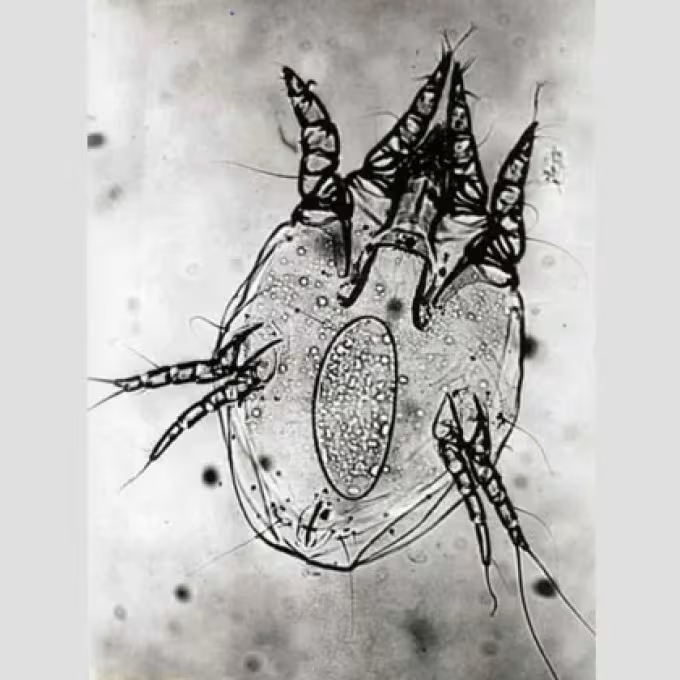
Psorobia ovis, commonly known as the sheep itch mite, is a minute parasitic mite belonging to the family Psorobidae (order Trombidiformes). It is a microscopic organism that completes its entire life cycle on the skin of its host.
Adult mites are extremely small, typically measuring between 0.2 to 0.3 mm in length. Due to their tiny size and pale, flattened bodies, they are virtually invisible to the naked eye during routine field inspections.
These mites inhabit the surface layers of the epidermis and the base of the wool follicles. They feed on skin epithelial cells and skin secretions, which triggers an immune response in the infested animal.
The life cycle—from egg to larva, nymph, and adult—occurs entirely on the sheep's body. Females anchor their eggs securely to the wool fibers or the skin scales near the base of the hair.
The mite spreads primarily through direct contact between animals. Because of its reproductive rate, a single infested sheep can quickly serve as the primary source of an outbreak within an entire flock.
What it damages
Psorobia ovis is a specific parasite of sheep. It does not affect crops or other types of livestock, but it causes significant economic losses in the wool production sector worldwide.
The primary impact of the infestation is a dramatic decrease in the quality of the fleece. The mites disrupt the hair growth process, causing the fibers to become brittle, thin, and prone to breaking.
The intense pruritus (itching) caused by the mite's activity drives the sheep to scratch, rub, and bite at their skin. This mechanical action creates tangled, matted wool patches and can cause significant damage to the staple length.
Chronic infestation leads to a decline in the animal's overall condition. Due to the constant irritation and discomfort, affected sheep exhibit reduced weight gain and lower overall production efficiency.
In severe cases, the skin becomes thickened, crusty, and inflamed. These damaged areas are highly susceptible to secondary bacterial infections, which can result in further health complications for the animal.
Signs of infestation
The most clinical sign of infestation is abnormal behavior, specifically restlessness. Affected sheep frequently rub against fence posts, feeders, or other structures to find relief from the persistent itching.
Upon physical examination, the wool often appears ragged, broken, or discolored. Patches of wool may be matted or partially missing, particularly along the animal's flanks, back, and rump area.
Close inspection of the skin often reveals fine, grayish scurf or scales, which are the result of the mite feeding activity. The skin itself may become rough and lose its natural elasticity over time.
Differentiating Psorobia ovis from other skin-related conditions like lice or sheep scab requires careful observation, as clinical symptoms can sometimes overlap between these different parasites.
Definitive diagnosis requires laboratory support. A skin scraping must be taken from the affected areas and examined under a microscope by a veterinarian to confirm the presence of Psorobia ovis mites or their eggs.
Control measures
Effective control of the sheep itch mite is primarily achieved through the strategic use of acaricidal treatments. It is critical to treat the entire flock simultaneously to ensure that no reservoirs of infestation remain.
Plunge dipping is a traditional and highly effective method for applying acaricides directly to the skin. To achieve success, it is essential to follow the product's concentration and saturation time instructions.
Modern veterinary practice also utilizes injectable formulations that work systemically. These treatments can be very effective in managing mite populations and reducing the labor involved in traditional dipping.
Biosecurity is the first line of defense. All newly introduced sheep should be kept in quarantine and inspected for signs of infestation before being allowed to join the main flock.
Maintaining good sanitary standards in housing and shearing facilities is vital. Regular cleaning and disinfection help reduce the environmental load of mites and minimize the risk of re-infestation.
Taxonomy
- Latin name
- Psorobia ovis
- Order
- Mites
- Family
- Psorergatidae
- EPPO code
- PSRBOV
Discussion
No discussions yet — be the first.