
Two-spotted booklouse
Psocus bipunctatus
Description
How to identify
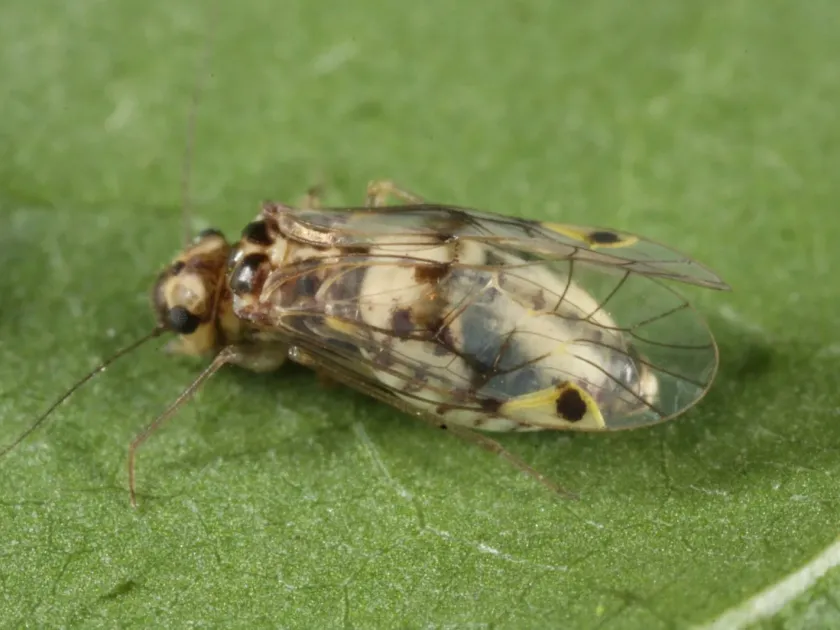
The two-spotted booklouse (Psocus bipunctatus) belongs to the order Psocoptera and the family Psocidae. Adult individuals typically measure between 4 and 6 mm in length.
They are characterized by a yellowish-brown color and, most importantly, two distinct dark spots on their forewings, which gives the species its common name.
The life cycle involves eggs, nymphs, and adults. Under favorable conditions with high humidity, they reproduce rapidly, often forming dense colonies in hidden areas of storehouses.
Psocus bipunctatus nymphs resemble adults but lack wings. They are highly sensitive to environmental moisture levels, which dictates their distribution within a building.
These insects have a broad head equipped with strong mandibles, which they use to graze on microscopic fungal growth, pollen, and organic debris found on various surfaces.
What it damages
Although they do not feed on healthy plant tissues, they are considered pests of stored products and grain. Their presence is primarily associated with mold growth on products.
They cause indirect damage by spreading fungal spores across stored grain, flour, and other food supplies, accelerating the spoilage of the affected products.
In agricultural settings, they can contaminate seeds and plant materials with their frass and exuviae, leading to significant economic losses and quality degradation.
Severe infestations often result in the total devaluation of goods, as the presence of insects and the associated mold makes the product unsuitable for human or animal consumption.
Their activity on packaging materials can lead to structural weakening of paper and cardboard containers, providing further access points for other pests.
When it appears
In temperature-controlled storage facilities, the two-spotted booklouse can remain active and reproduce throughout the entire year without a dormant period.
In outdoor environments or unheated structures, their activity peaks during the warmer months when environmental conditions favor the development of mold, their primary food source.
Springtime marks the resumption of higher activity levels as temperatures rise, allowing nymphs to emerge from their wintering sites and start new generations.
Autumn brings a shift in behavior, as the insects seek stable microclimates, often migrating into buildings to survive the cooling temperatures of the upcoming winter.
The speed of their population growth is directly linked to humidity levels; consistent moisture levels above 60-65% are essential for the survival and multiplication of this species.
Signs of infestation
The primary sign of an infestation is the observation of small, agile insects running across surfaces, particularly on walls, grain bags, or near damp areas in a warehouse.
The presence of translucent or whitish shed skins (exuviae) on surfaces is a clear indicator that a thriving population is present and currently undergoing development.
A persistent musty odor in a storage area is a major red flag, suggesting the presence of mold, which inevitably attracts and supports the booklouse population.
Small irregular marks or scratches on packaging materials often indicate where the insects have been feeding on the organic components or adhesives of the containers.
- Visual sighting of insects on storage surfaces.
- Accumulation of shed nymphal skins.
- Presence of damp, moldy patches on walls or packaging.
- General decrease in grain quality linked to moisture.
Control measures
The most effective strategy is the rigorous control of environmental moisture. Keeping the humidity in storage facilities below 60% inhibits the mold growth necessary for their survival.
Sanitation is critical; regular cleaning of dust and grain residues eliminates the food sources and shelter that allow booklice to establish colonies in warehouses.
Chemical control should be used only as a secondary measure and only if the infestation level is high, ensuring that any insecticide used is food-safe and approved.
Sealing gaps and ensuring proper building maintenance prevent the entry and spread of these insects from external environments or contaminated storage sectors.
Effective ventilation and proper drying of harvested products before storage are essential agricultural practices to maintain product integrity and prevent outbreaks.
Taxonomy
- Latin name
- Psocus bipunctatus
- Family
- Psocidae
- EPPO code
- PSOCBI
Discussion
No discussions yet — be the first.