
Oak bark beetle
Pseudopityophthorus pubipennis
Description
How to identify
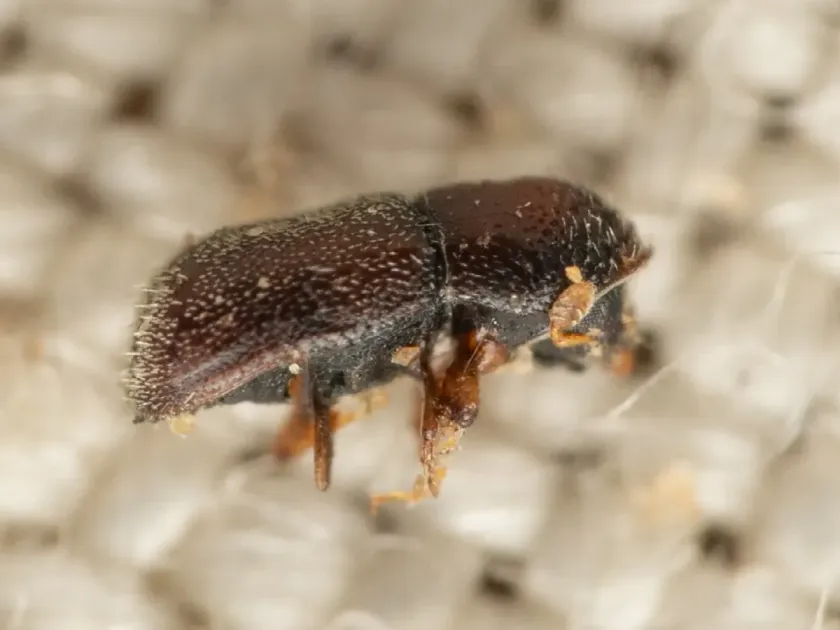
The Oak bark beetle (Pseudopityophthorus pubipennis) is a member of the Curculionidae family, specifically the Scolytinae subfamily. It is a tiny insect, usually measuring between 1.5 and 2.0 mm in length.
The body is cylindrical and dark brown in color. It is distinguished by dense, light-colored hairs on its elytra and pronotum, which gives it a characteristic «fuzzy» appearance when viewed under magnification.
These beetles are capable fliers, which allows them to effectively navigate forest stands to locate susceptible host trees for colonization.
The larvae are legless, white grubs with distinct yellow-brown head capsules. They spend their entire developmental cycle beneath the bark, feeding on phloem tissues.
Unlike some other bark beetle species, this insect is largely nocturnal, making it difficult to spot adults on tree trunks during the day.
What it damages
The primary hosts of this beetle are various species of oak (Quercus). Under specific circumstances, it may attack other deciduous trees that are already under physiological stress.
This beetle is typically a secondary pest, meaning it colonizes trees weakened by drought, disease, mechanical injuries, or competition from other forest vegetation.
Healthy trees with vigorous sap flow can often deter the beetles by exuding sap into entry holes, which traps or drowns the invaders. However, heavy populations can overwhelm even healthy specimens.
The primary damage is caused by the larval galleries which disrupt the transport of nutrients and water within the tree's vascular system, eventually leading to branch dieback or tree death.
In forestry, infestations degrade the quality of the timber, as the galleries create structural tunnels that make the wood unsuitable for high-value applications.
When it appears
The flight season for adult beetles typically begins in late spring or early summer, depending on regional temperature patterns, usually peaking in May and June.
Once a suitable host is found, the female bores into the bark to construct an egg-laying gallery. The life cycle usually lasts for one full growing season.
In warmer climates or during extended, hot summers, these beetles may be capable of producing more than one generation per year, significantly increasing their impact.
The species typically overwinters in the larval or pupal stage inside the bark, although some adults may survive the winter in protective galleries.
Spring activity is triggered by the warming of the trunk surfaces, with sun-exposed trees often being the first to be colonized by emerging adults.
Signs of infestation
The most reliable sign of an infestation is the presence of numerous small, round exit and entry holes in the bark, often resembling tiny pinpricks.
Small piles of frass, or boring dust, can usually be found at the base of the tree or tucked into bark crevices, indicating active feeding by the larvae.
Upon removing a section of the outer bark, characteristic maternal galleries can be observed in the phloem layer. These patterns are diagnostic for the species.
Crown symptoms, such as the yellowing and premature shedding of leaves or the dieback of upper branches, are common indications that the infestation has reached a critical stage.
Increased woodpecker activity on the tree trunk is often a reliable biological indicator of a bark beetle outbreak, as these birds hunt the larvae under the bark.
Control measures
The most effective management strategy is the sanitation of forest stands, which involves the rapid removal and disposal of infested trees before the next generation of beetles emerges.
Proper forest hygiene, including the removal of slash and down logs, is essential to reduce the availability of breeding material for the beetle population.
In urban and ornamental settings, maintaining tree health through regular irrigation and mulching can help trees maintain the vitality needed to resist beetle colonization.
Pheromone-based traps can be used as a monitoring tool to determine beetle activity levels and may help in mass trapping during peak flight periods.
Chemical control is rarely effective for large-scale infestations due to the larvae's protected environment under the bark; therefore, integrated pest management remains the preferred approach.
Taxonomy
- Latin name
- Pseudopityophthorus pubipennis
- Order
- Coleoptera (beetles)
- Family
- Curculionidae
- EPPO code
- PSDPPU
Discussion
No discussions yet — be the first.