
Oak bark beetle
Pseudopityophthorus pruinosus
Description
How to identify
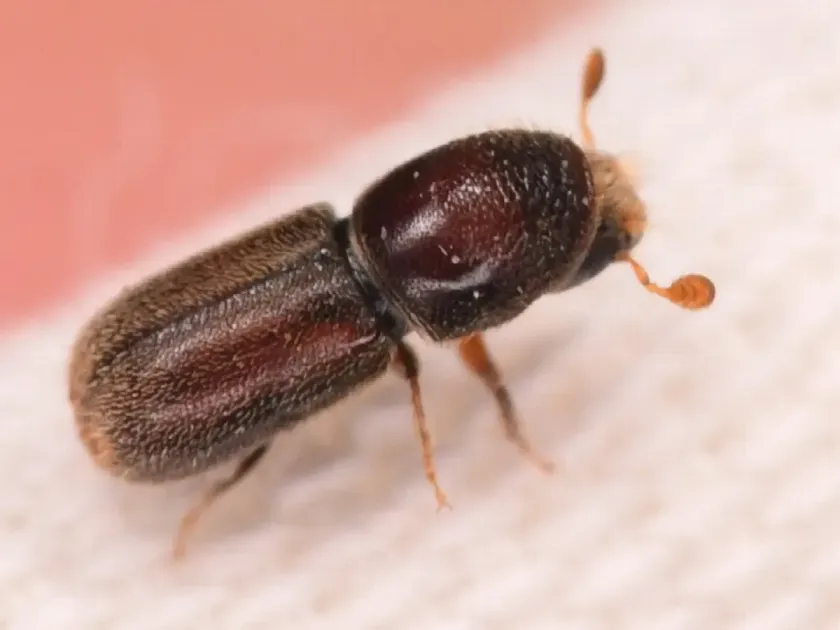
The oak bark beetle Pseudopityophthorus pruinosus is a small beetle belonging to the Curculionidae family (subfamily Scolytinae). Adults typically measure between 1.5 and 2.2 mm in length.
Their body shape is cylindrical and covered with fine hairs, giving the beetle a matte appearance. The head is usually retracted under the pronotum, a common anatomical trait of bark beetles.
Larvae are legless, C-shaped, and possess a light brown head capsule. They spend their entire developmental period beneath the bark of host trees.
These beetles are highly mobile, allowing them to locate stressed trees quickly during the flight period. Proper identification often requires field analysis of the gallery patterns under the bark.
While often overlooked due to their small size, they play a significant role in the degradation of weakened oak stands.
What it damages
The primary hosts for this beetle are oak species (genus Quercus). It is considered a secondary pest, preferring trees already weakened by drought, disease, or mechanical damage.
Under favorable conditions, such as prolonged dry spells, the beetles can attack trees that are otherwise stable, contributing to the crown dieback process.
Damage is most commonly found on the branches and younger stems, where the phloem layer is thin and easier for larvae to feed upon.
Their galleries disrupt the nutrient flow of the tree and create entry points for various pathogenic fungi, which can ultimately lead to the death of the host tree.
Timber quality is significantly compromised in infested trees, making them unsuitable for high-value wood production in commercial forestry.
When it appears
Adult flight activity typically begins in the spring, once temperatures remain consistently warm, usually peaking in May and June.
After mating, females bore into the bark to construct egg-laying galleries. This period is the most critical time for monitoring and implementing control measures.
The life cycle usually spans one season, though warm summers may occasionally allow for a partial second generation to emerge.
Pupation occurs underneath the bark, and new adults emerge through small circular exit holes, initiating a new cycle of infestation.
Overwintering typically takes place under the bark as either adults or mature larvae, providing protection against extreme cold and desiccation.
Signs of infestation
The first external signs of infestation are tiny, pinhead-sized exit or entry holes visible on the surface of the bark.
Beneath the bark, one can observe complex gallery patterns: a primary longitudinal maternal gallery with shorter lateral larval tunnels.
Affected trees often show signs of crown thinning, yellowing of leaves, or premature leaf drop as the tree loses its physiological integrity.
Fine wood dust, resembling flour or sawdust, often accumulates in the bark crevices near the point of entry.
- Small circular holes on the bark surface.
- Presence of fine wood dust (frass).
- Yellowing or wilting of the crown foliage.
- Visible gallery patterns after removing the outer bark layer.
- Localized peeling of bark in heavily infested areas.
Control measures
Management focuses on sanitation: the timely removal and disposal of infested wood are essential to prevent the spread of the beetle population.
Pheromone traps are used effectively to monitor local populations and can sometimes act as a mass-trapping tool in specific outbreak areas.
Maintaining tree health through adequate irrigation and proper silvicultural practices is the best prevention against successful bark beetle colonization.
Biological control methods, such as preserving populations of predatory beetles and parasitic wasps, help regulate bark beetle numbers naturally.
Chemical control with contact insecticides may be warranted for high-value ornamental trees during the peak flight season to prevent infestation.
Taxonomy
- Latin name
- Pseudopityophthorus pruinosus
- Order
- Coleoptera (beetles)
- Family
- Curculionidae
- EPPO code
- PSDPPR
Discussion
No discussions yet — be the first.