
Oak bark beetle
Pseudopityophthorus minutissimus
Description
How to identify
The oak bark beetle (Pseudopityophthorus minutissimus) is a tiny insect species belonging to the family Curculionidae, subfamily Scolytinae.
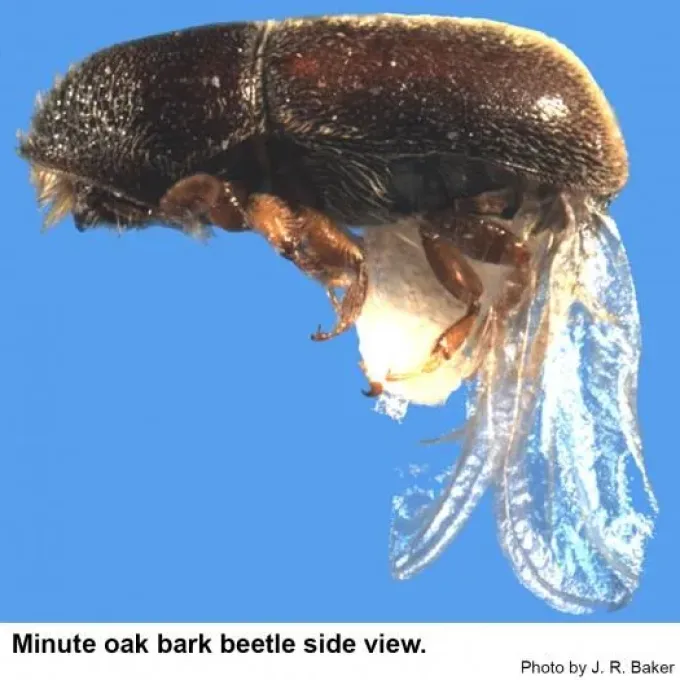
Adult beetles are very small, typically measuring between 1.5 and 2.0 mm in length, and possess a dark brown, cylindrical body covered in fine hairs.
They are classified within the order Coleoptera and are notorious for their cryptic lifestyle, spending most of their life cycle under the bark of host trees.
The larvae are legless and creamy-white, developing within the inner bark and cambium layers of the host, where they remain protected from environmental factors.
Identification is primarily confirmed by the distinctive transverse gallery patterns they etch into the sapwood, which are unique to this specific species.
What it damages
These beetles primarily attack various species of oak (Quercus), showing a strong preference for trees that are already stressed, dying, or recently fallen.
By boring into the tree's vascular system, they interfere with the transport of water and nutrients, which often leads to the decline and mortality of the host.
The damage caused by the gallery formation is compounded by the beetle's role as a vector for various pathogenic fungi, which can exacerbate the tree's decline.
High populations can cause significant damage in forest environments, particularly following periods of extreme drought or other environmental stressors.
Young, healthy trees are less likely to be successfully colonized, but widespread infestation can still occur in stands that have been weakened by climate change.
When it appears
Adult beetles typically emerge in late spring, specifically May or June, to seek out suitable host trees for reproduction and colonization.
Depending on the climatic conditions of the region, the oak bark beetle may complete one or two generations within a single calendar year.
Winter survival is achieved by overwintering in the larval stage, tucked deep within the bark or the outer sapwood layers where they are insulated from cold.
The life cycle is tightly synchronized with the health and physiological activity of the host oak trees, which usually provide the best environment for larval development.
As autumn approaches, the beetles slow their activity, and larvae finalize their development in preparation for the upcoming dormant winter period.
Signs of infestation
The most prominent sign of infestation is the appearance of small, round entry holes on the bark, accompanied by fine, sawdust-like bore dust (frass).
Upon peeling back a section of the bark, one can observe complex, transverse galleries that spread horizontally, distinct from the vertical patterns of other beetles.
Affected trees often exhibit signs of crown dieback, with foliage turning yellow, wilting, or dropping prematurely during the peak of the growing season.
The presence of woodpecker activity is also a frequent secondary sign, as these birds forage for larvae hidden underneath the tree's outer layer.
- Bore dust (frass) accumulation at the base of the tree.
- Visible transverse gallery patterns under the bark.
- Premature leaf yellowing and crown thinning.
- Bark loosening in patches due to gallery excavation.
Control measures
The most effective strategy for managing the oak bark beetle is the systematic removal and disposal of infested or dead trees via sanitary logging.
Removing logging residue and fallen timber from the forest floor is critical to prevent these materials from becoming breeding hubs for the population.
Pheromone traps are used by forestry professionals to monitor population density and to time management interventions accurately across a woodland area.
In urban landscapes or parks, targeted insecticide applications during the beetle's peak flight period can protect high-value specimen trees.
Promoting general tree vigor through proper irrigation and soil care helps oak stands remain resilient against potential colonization attempts by this pest.
Taxonomy
- Latin name
- Pseudopityophthorus minutissimus
- Order
- Coleoptera (beetles)
- Family
- Curculionidae
- EPPO code
- PSDPMI
Discussion
No discussions yet — be the first.