
Oak bark beetle
Pseudopityophthorus
Description
How to identify
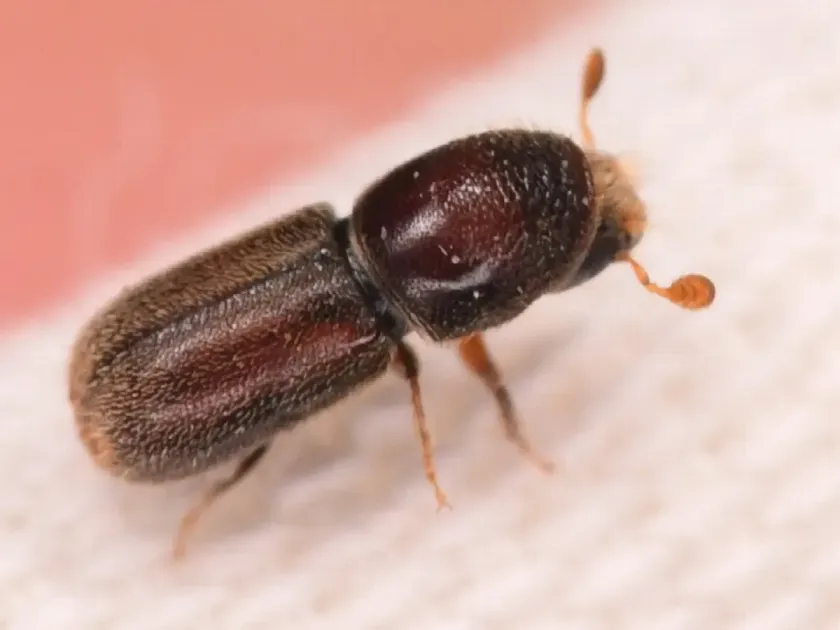
The genus Pseudopityophthorus comprises small beetles belonging to the Curculionidae family and Scolytinae subfamily. These insects are typically cylindrical in shape, measuring 1.5 to 2.5 mm in length.
The body is usually dark brown to black. A key identification feature is the presence of dense, fine hairs covering the elytra, which distinguishes them from many other wood-boring beetles.
Larvae are legless, white-colored, and C-shaped with a hardened, yellowish-brown head capsule. They are exclusively found feeding beneath the bark of their host trees.
Pupation occurs within small, oval-shaped chambers constructed by the larvae in the cambium layer. This protective stage allows the beetle to survive beneath the bark until emergence.
As true bark beetles, their entire developmental morphology is adapted for life within the subcortical spaces of specific tree species, making them highly specialized pests.
What it damages
The primary hosts of Pseudopityophthorus are oak trees (Quercus species). However, under high population pressure, they may also attack beech (Fagus) or chestnut trees.
These beetles typically colonize stressed, weakened, or recently felled trees. Drought, root damage, or overcrowding often predispose trees to successful colonization by these insects.
Damage is concentrated on branches and small-diameter stems. By creating galleries in the phloem and cambium, the larvae disrupt the tree's nutrient transport system.
Persistent infestations cause branch dieback and significantly reduce the tree's vigor, often leading to the eventual death of the affected tree if the infestation is severe.
Beyond direct feeding, these beetles serve as vectors for various fungi, which can further exacerbate the decline of the host tree by causing vascular blockages.
When it appears
Adult flight activity typically begins in late spring, generally from April to May, depending on ambient temperatures and the local phenology of the host oaks.
Depending on the latitude and local climate, the beetle may complete one or two generations per year. Warmer regions favor rapid development and multiple broods.
Overwintering usually takes place in the larval stage, tucked away securely under the bark. This strategy ensures a high survival rate through the coldest months of the year.
The reproductive cycle is closely synchronized with the sap flow of the host tree, making the timing of monitoring efforts critical for effective population management.
Warm and dry summers act as a major catalyst for beetle outbreaks, as water-stressed trees are unable to produce enough defensive resin to repel attacking adults.
Signs of infestation
The most subtle sign of an infestation is the presence of tiny, pinhole-sized entry points on the bark. These are often difficult to spot unless the tree is inspected closely.
Accumulation of fine, granular wood dust (frass) around the bark crevices or at the base of the tree is a strong indicator of active larval feeding and gallery excavation.
Under the bark, galleries are arranged in distinct patterns, usually featuring a central nuptial chamber with secondary larval galleries radiating outwards into the bark tissue.
Visible decline in the canopy, specifically yellowing or browning of foliage on individual branches, often signals that the vascular system of those branches has been severed.
Severe infestations often cause the bark to crack or flake off prematurely, revealing the complex, crisscrossing gallery networks carved by the beetles and their progeny.
Control measures
The primary method of control is sanitation. Infected branches or entire trees should be removed and disposed of before the new generation of adult beetles emerges.
Prompt removal of fresh oak slash or logging debris is essential, as this material acts as a lure and a breeding reservoir for the beetle population.
Pheromone traps are effective tools for monitoring flight periods and suppressing the adult population in high-value ornamental areas or urban parkland.
For highly valued individual trees, systemic insecticides applied as soil drenches or trunk injections can provide protection during periods of extreme beetle pressure.
Maintaining tree health through proper irrigation, mulching, and avoiding mechanical damage to stems is the most sustainable way to prevent colonization by Pseudopityophthorus.
Taxonomy
- Latin name
- Pseudopityophthorus
- Order
- Coleoptera (beetles)
- Family
- Curculionidae
- EPPO code
- PSDPSP
Discussion
No discussions yet — be the first.