
Sitka spruce beetle
Pseudohylesinus sitchensis
Description
How to identify
The Sitka spruce beetle (Pseudohylesinus sitchensis) is a member of the Curculionidae family, specifically recognized as a significant bark beetle species.
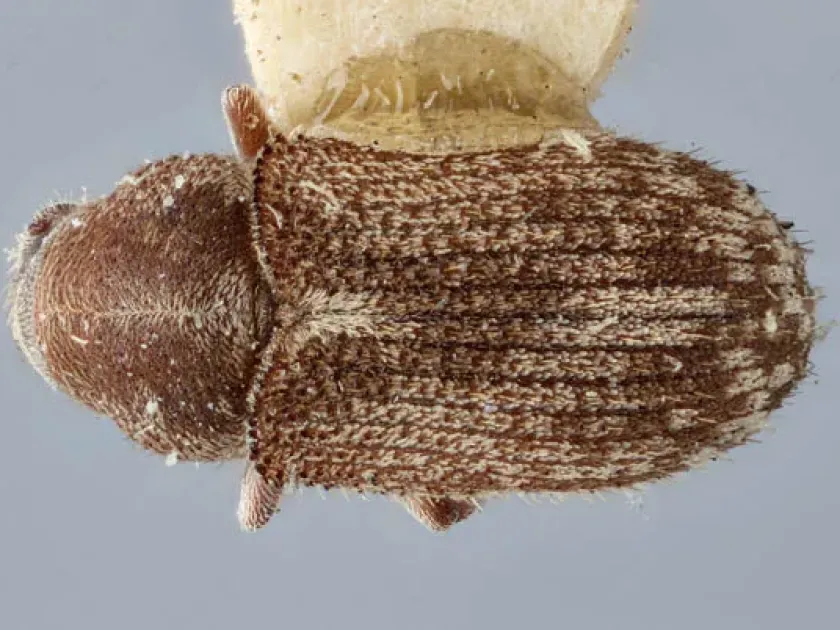
Adult beetles are relatively small, typically ranging from 3 to 5 mm in length, characterized by an oval body covered in dense, patterned scales.
These beetles possess a coloration that blends perfectly with the bark of host trees, typically displaying shades of dark brown and gray-black.
Larvae are legless and curved, with a white, soft body and a hardened brownish head capsule, adapted for tunneling underneath tree bark.
Morphological features, such as the shape of the antennae and pronotum, are used by entomologists to distinguish this species from other related bark beetles.
What it damages
This pest primarily infests the Sitka spruce (Picea sitchensis), though it can occasionally affect other spruce species found within its geographic range.
The primary damage is caused by both adults and larvae feeding on the phloem and cambium layers, effectively girdling the tree and cutting off nutrient flow.
Even healthy trees can become vulnerable when beetle populations reach epidemic levels, leading to rapid crown decline and tree mortality.
The galleries carved by the beetles act as entry points for blue-stain fungi and other pathogens, which further accelerate the deterioration of the tree wood.
Extensive infestations can cause significant economic losses in managed forests by reducing the volume and quality of available timber.
When it appears
Adult emergence typically coincides with rising spring temperatures, as beetles leave their overwintering sites to seek new host trees.
The reproductive phase occurs during the warmer summer months, during which females lay eggs in galleries constructed under the bark.
Depending on the altitude and climate, the beetle may complete its lifecycle within a single year or require a longer duration.
Overwintering usually takes place in the bark of host trees, where both larvae and adults can survive through the colder winter period.
Monitoring the flight period is essential for forest managers to implement timely preventive measures before the mass attack phase begins.
Signs of infestation
One of the first signs of infestation is the appearance of reddish-brown boring dust found in bark crevices or at the base of the tree trunk.
The presence of pitch tubes—small resin blobs on the bark surface—indicates that the tree is attempting to defend itself against the beetle attack.
Crown symptoms, such as fading needles and eventual browning of the entire canopy, are visual indicators that the tree's vascular system has been compromised.
Upon peeling back the bark, distinct galleries carved by the adults and larvae confirm the presence and activity of the Sitka spruce beetle.
In later stages of attack, the bark may begin to slough off in large patches, exposing the sapwood and the underlying gallery networks.
Control measures
Sanitation harvest, which involves the rapid removal and destruction of infested trees, is the most effective method for population control.
Proper forest hygiene, including the removal of slash and logging debris, reduces potential breeding habitats and prevents population spikes.
Pheromone-baited traps can be used to monitor local beetle activity and serve as a tool for attracting insects away from high-value forest stands.
Enhancing forest resilience through thinning and maintaining proper stand density helps trees better withstand and recover from pest attacks.
In sensitive areas or nurseries, biological control agents and carefully timed insecticidal applications may be considered to protect vulnerable young stock.
Taxonomy
- Latin name
- Pseudohylesinus sitchensis
- Order
- Coleoptera (beetles)
- Family
- Curculionidae
- EPPO code
- PSDHSI
Discussion
No discussions yet — be the first.