
Silky bark beetle
Pseudohylesinus sericeus
Description
How to identify
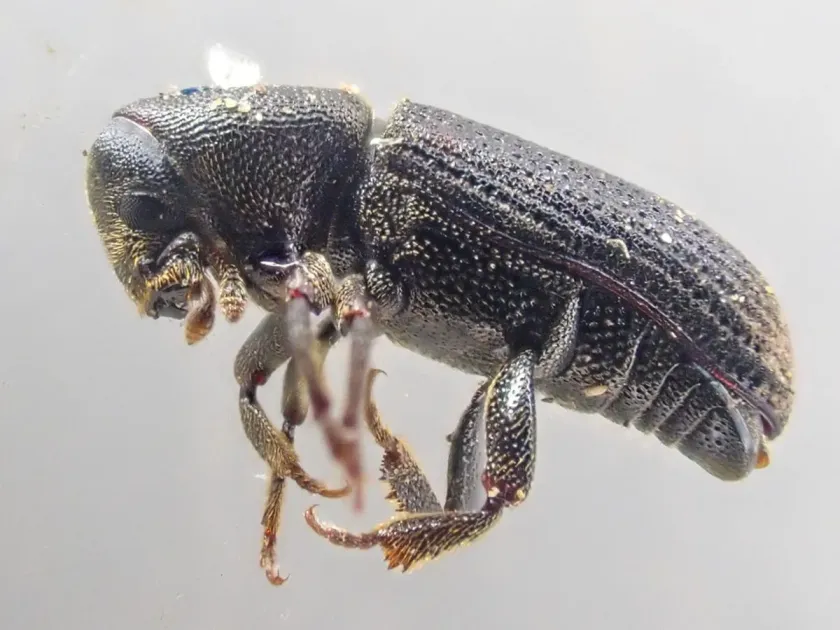
The silky bark beetle (Pseudohylesinus sericeus) is a small wood-boring insect belonging to the family Curculionidae, subfamily Scolytinae. The adult beetle is characterized by a dense covering of scales on its body, which gives it a distinct silky appearance, hence its common name.
The coloration of the adult typically ranges from dark brown to black, allowing it to blend seamlessly into the bark of its host trees. The head is partially retracted under the pronotum, a structural trait typical for this group of beetles.
The antennae possess a club-like terminal segment, which is a key diagnostic feature for the Hylesinini tribe. Due to their small size, usually only a few millimeters in length, these beetles are often difficult to detect until an infestation is well established.
Larvae are white, legless, and have a curved, C-shaped body with a hardened head capsule. They develop within the inner bark, specifically targeting the phloem and cambium layers of the host tree to fulfill their nutritional needs.
The life cycle involves four distinct stages: egg, larva, pupa, and adult. All developmental phases occur under the bark, where the insect is protected from environmental extremes and most predators, contributing to high survival rates.
What it damages
The primary hosts of the silky bark beetle are various conifer species, particularly firs and certain species of spruce. The beetle prefers trees that are weakened by environmental stress, such as prolonged drought, disease, or physical trauma.
The infestation affects both the main stems and thicker branches of the trees. The adult beetle bores into the bark to create egg galleries, while the larvae create feeding galleries that extend outward, effectively girdling the tree's vascular system.
This disruption of nutrient and water flow leads to the rapid decline and death of the infested tree segments. In many cases, the weakened tree becomes susceptible to secondary infestation by other wood-boring insects, accelerating the decay process.
Mass infestations can result in significant ecological and economic losses, especially in timber production zones. The beetle is also a notable threat to forest nurseries, where it can cause localized mortality in young conifer stock.
The severity of damage often depends on the overall health of the forest stand. In healthy, vigorous stands, trees may produce enough resin to pitch out the attacking beetles; however, in stressed stands, the population can grow exponentially.
When it appears
Adult beetle activity begins in the early spring as temperatures rise, signaling the start of the primary flight season for finding new hosts. This period typically aligns with the beginning of the growing season.
Depending on the climatic conditions, one or two generations can occur within a single year. Warmer climates provide more favorable conditions, often shortening the development time of the larvae and increasing the reproductive output.
In late summer, the new generation of adults emerges to engage in maturation feeding before moving to hibernation sites. This period is critical for the survival of the species, as they prepare for the colder months ahead.
Hibernation takes place primarily under the bark of infested trees or within the forest floor litter near the tree base. This strategy allows them to withstand low winter temperatures and ensures that the population is ready to strike in the spring.
Monitoring efforts should be intensified during the spring and late summer when beetle flight activity is at its peak. Data collected during these periods are essential for predicting population outbreaks and planning interventions.
Signs of infestation
The presence of boring dust, a fine sawdust-like material, on the bark surface or around the tree base is the most common sign of infestation. The color of this dust varies depending on the tree species and the age of the gallery.
Entry holes are visible on the outer bark, often surrounded by small resin beads. This resin flow is the tree's defense mechanism attempting to push out the invader, though it is often insufficient once the population density is high.
Foliage yellowing or reddening is a classic sign of internal vascular damage. This indicates that the tree is failing to transport water to the needles, and the process of decay is already well underway within the trunk.
Peeling away a section of the bark reveals the complex pattern of galleries left by the beetles. These galleries are often packed with frass and may contain larvae, pupae, or young adults, confirming an active infestation.
When the bark begins to slough off in large patches, it indicates that the tree is already dead or near death. At this stage, the bark beetle population has likely finished its development and emerged to seek new hosts.
Control measures
Sanitation cutting and the immediate removal of infested trees are the most effective strategies to manage populations. By eliminating these sources of infestation, the spread to neighboring healthy trees is significantly reduced.
Pheromone traps are valuable tools for monitoring beetle populations and detecting arrival times in specific forest stands. These traps help forestry managers make informed decisions about when to apply protective measures.
Good silvicultural practices, such as thinning and maintaining optimal stand density, help keep trees healthy and more resilient to attack. Keeping the forest floor free of excessive deadwood also limits breeding sites.
In high-value areas like nurseries or ornamental plantings, protective insecticide sprays can be applied to trunks before the flight season begins. This creates a barrier that prevents the adults from boring into the bark.
- Implementing regular forest sanitation and removal of deadwood.
- Using pheromone-based monitoring systems to track activity.
- Maintaining tree vigor through proper forest management.
- Applying preventive insecticides in vulnerable nursery settings.
- Encouraging natural predators and parasitic wasps in the forest ecosystem.
Taxonomy
- Latin name
- Pseudohylesinus sericeus
- Order
- Coleoptera (beetles)
- Family
- Curculionidae
- EPPO code
- PSDHSE
Discussion
No discussions yet — be the first.