
Douglas fir pole beetle
Pseudohylesinus nebulosus
Description
How to identify
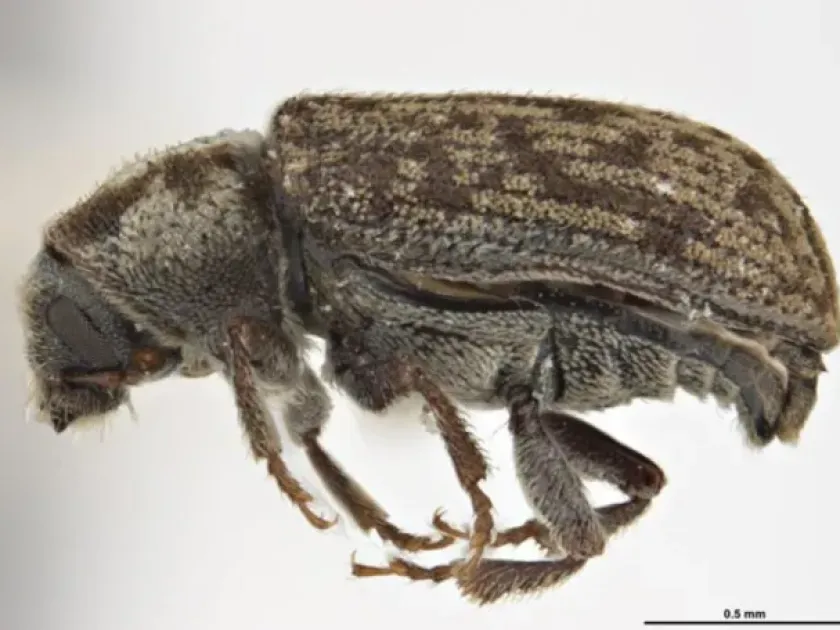
The Douglas fir pole beetle (Pseudohylesinus nebulosus) is a member of the Curculionidae family, subfamily Scolytinae. Adults are small beetles, approximately 3–4 mm long, with a robust, oval-shaped body.
Their coloration ranges from dark brown to black, but the wing covers (elytra) are covered with dense light and dark scales, creating a mottled or "nebulous" pattern.
A key morphological feature is the sculpture of the pronotum and elytra. The head is usually hidden beneath the pronotum, which is characteristic of many bark beetles.
The larvae are legless, white grubs with a yellowish head and powerful mouthparts designed for tunneling through wood tissues.
The pupae are of the free type, white in color, and develop within specialized chambers or "cradles" constructed beneath the host tree's bark.
What it damages
The primary hosts of this beetle are various conifer species, most notably Douglas fir (Pseudotsuga menziesii), as well as true firs and spruce.
Beetles typically attack weakened, diseased, or recently felled trees, but during population outbreaks, they can aggressively infest healthy trees.
Damage is caused by both adults, which create entrance holes and egg galleries, and larvae, which bore extensive winding tunnels through the phloem and cambium layers.
Severe infestations disrupt the tree's nutrient flow, leading to crown yellowing, needle loss, and eventually tree mortality.
In addition to direct damage, the galleries facilitate the entry of fungal pathogens, which significantly accelerate wood decay and structural degradation.
When it appears
The activity of the beetle begins in early spring when temperatures reach optimal levels for the overwintered adults to emerge.
The main flight and mating period occurs between April and May, after which females begin searching for suitable host material for oviposition.
Depending on regional climatic conditions, one or two generations may occur annually, leading to a prolonged infestation period.
Pupation is typically completed by mid-summer, at which point the new generation of adults begins maturation feeding before seeking new hosts.
The insect primarily overwinters as an adult in the forest floor litter, in bark crevices at the tree base, or within the galleries they have excavated.
Signs of infestation
The first indicator of infestation is the appearance of reddish-brown boring dust (frass) accumulating around entrance holes or within bark fissures.
Small, circular entrance holes are visible on the tree trunk surface, marking the points where beetles have bored through the bark.
Mass infestations often result in the yellowing or browning of the foliage, providing a clear visual cue that the tree's vascular system has been compromised.
Removing a section of the bark reveals a complex network of feeding galleries on the sapwood surface, characteristic of this specific beetle species.
Increased resin flow or "pitching out" at the point of attack can also indicate the tree's attempt to defend itself against the beetle invasion.
Control measures
The primary control measure is the timely sanitation and removal of infested trees before the new generation of beetles can emerge and spread.
Conducting regular forest pathology monitoring is crucial for the early detection and management of beetle outbreaks in forested areas.
Silvicultural practices that maintain tree vigor, such as proper stand thinning and the removal of logging slash, help prevent successful beetle colonization.
Pheromone-baited traps can be used to monitor beetle population levels and, in some cases, to reduce the number of adults during the peak flight season.
In specific situations, such as ornamental groves or forest nurseries, the application of registered systemic insecticides may be considered for protection.
Taxonomy
- Latin name
- Pseudohylesinus nebulosus
- Order
- Coleoptera (beetles)
- Family
- Curculionidae
- EPPO code
- PSDHNE
Discussion
No discussions yet — be the first.