
Pseudohylesinus dispar
Pseudohylesinus dispar
Description
How to identify
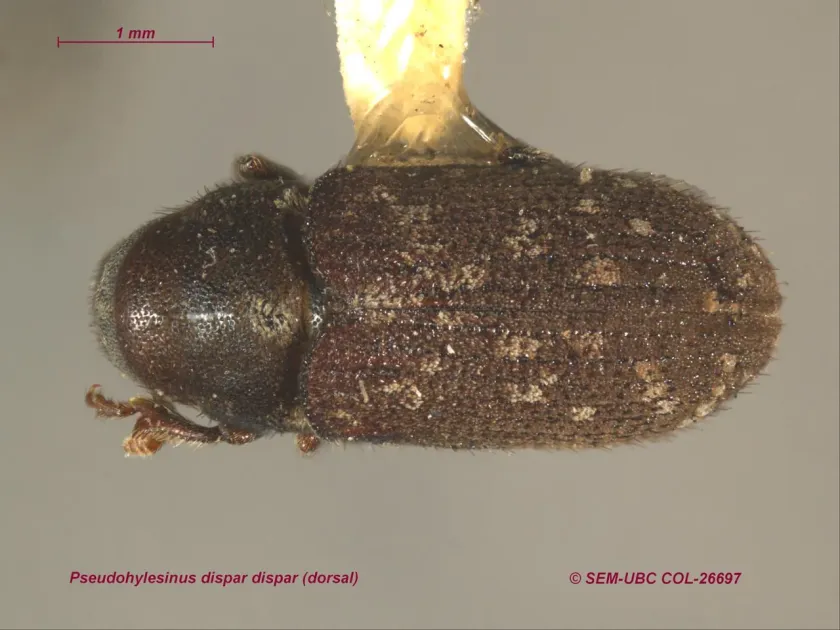
Pseudohylesinus dispar is a small bark beetle species belonging to the Curculionidae family and Scolytinae subfamily. Adult beetles typically measure between 3 to 4 mm in length.
Their bodies are densely covered with scales that create a distinctive mottled or marbled appearance. This feature is the most reliable way to distinguish them from other similar bark beetles.
The head is hidden under the pronotum, a structural characteristic common among the Hylesinini tribe. They possess elbowed antennae with a club, which are essential for navigating their tunnels.
Larvae are legless, white, and C-shaped with a yellowish-brown head capsule. They spend their entire development phase feeding within the host tree's cambium and phloem layers.
Pupae are housed in individual pupal chambers, which the larvae carefully excavate in the outer sapwood or inner bark before completing their transformation.
What it damages
The primary hosts for this pest are coniferous trees, with a specific preference for true firs and certain spruce species. It mostly targets weakened or stressed trees.
In forest ecosystems, the beetle exploits trees suffering from drought, mechanical damage, or competition, accelerating their decline and eventual death.
The damage is caused by both adults and larvae. Adults bore through the bark to establish egg galleries, while larvae feed perpendicular to the main galleries.
These feeding tunnels disrupt the transport of water and nutrients, effectively girdling the tree if the infestation is heavy enough to surround the trunk.
Continued infestation often leads to secondary attacks by other pathogens and insects, which together cause rapid mortality in affected forest stands.
When it appears
Adult flight typically commences in early spring as temperatures rise, usually triggered by the first warm days of the year in temperate climates.
The breeding season is extended, with the potential for multiple overlapping generations in warmer regions where the climate allows for continuous development.
Larval activity reaches its peak during the summer months. The warmth beneath the bark facilitates rapid larval growth and metabolism during the prime growing season.
Pupation generally occurs in late summer or early autumn. New adults emerge and may seek additional food or prepare overwintering sites.
Overwintering is primarily done by adult beetles, which retreat into protective galleries under the bark of the host tree or within the lower trunk section.
Signs of infestation
The most reliable sign of an active infestation is the presence of boring dust, a mixture of frass and wood particles, near the base of the trunk or in bark crevices.
Small, inconspicuous entry holes are often the only external evidence. These holes are usually concentrated on the lower sections of the tree trunk.
Foliage discoloration, shifting from deep green to yellow or reddish-brown, indicates that the tree's vascular system has been compromised by beetle activity.
Increased woodpecker activity on a specific tree is a clear indicator that the tree is heavily infested with bark beetle larvae and pupae.
The loosening or sloughing off of bark flakes reveals the intricate patterns of larval galleries underneath, marking the advanced stage of infestation.
Control measures
Sanitation felling is the most effective management practice. Infested trees should be removed and processed before the new generation of beetles emerges.
Proper forest hygiene, including the prompt removal of slash and logging debris, is crucial to prevent the creation of breeding hotspots in the forest.
Pheromone traps are widely used for monitoring population levels and can be deployed to mass-trap adults in highly threatened forest areas.
Encouraging natural predators, such as parasitoid wasps and woodpeckers, helps maintain biological balance and reduces the overall beetle pressure.
In ornamental or nursery settings, systemic insecticide treatments can be applied to high-value trees as a preventive measure against beetle boring.
Taxonomy
- Latin name
- Pseudohylesinus dispar
- Order
- Coleoptera (beetles)
- Family
- Curculionidae
- EPPO code
- PSDHDI
Discussion
No discussions yet — be the first.