
Pseudohylesinus
Pseudohylesinus
Description
How to identify
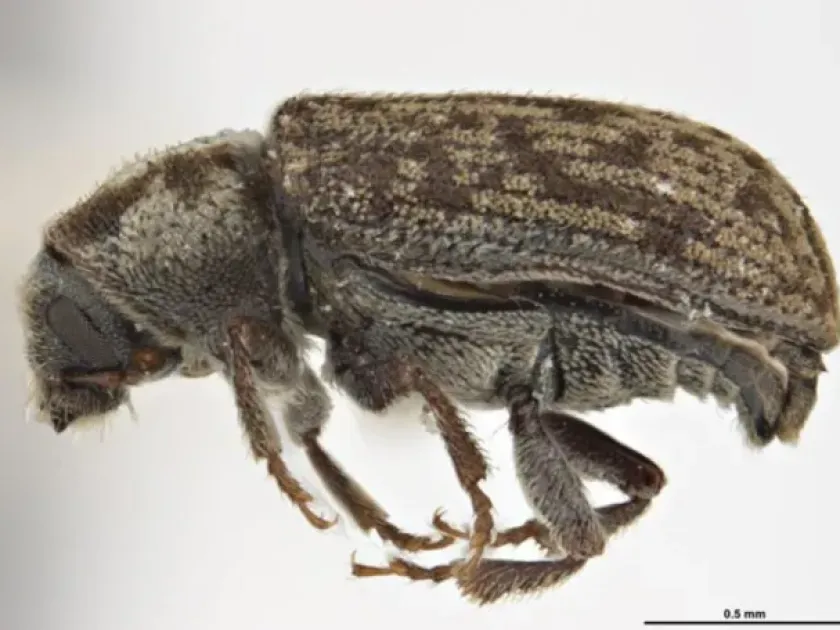
Pseudohylesinus is a genus of bark beetles belonging to the family Curculionidae and the subfamily Scolytinae. These are relatively small beetles, typically measuring 2 to 5 millimeters in length.
Their bodies are cylindrical and densely covered with scales or setae, providing a dull, mottled appearance that helps them blend in with the bark of host trees.
The pronotum is transverse and wider than long, while the elytra feature distinct rows of punctures that form longitudinal striae.
Larvae are legless, white, and possess a distinct, sclerotized head capsule, which is a classic morphology for bark-inhabiting beetle larvae.
Diagnostic identification typically involves examining the antennal club structure and the scaling patterns on the dorsal surface of the insect.
What it damages
Pseudohylesinus species primarily target coniferous trees, showing a strong preference for members of the Pinaceae family, such as Abies (fir) and Picea (spruce).
They attack both stressed and healthy trees, though they are most successful in colonizing trees that have been weakened by drought, disease, or mechanical damage.
The beetles bore through the outer bark to reach the phloem and cambium layer, where they excavate feeding and egg-laying galleries.
Extensive gallery formation by the adults and their larvae disrupts the translocation of water and nutrients, eventually causing the tree to wilt and die.
Furthermore, these beetles act as vectors for various pathogenic fungi, contributing to the further decline of the host tree’s health.
When it appears
Adult beetles emerge in the spring once the ambient temperature becomes favorable for their flight and mating activities.
The peak reproductive period, during which egg galleries are constructed and eggs are deposited, usually occurs throughout late spring and early summer.
The duration of the life cycle varies depending on the species and environmental temperature, often taking one full year to complete.
Overwintering occurs primarily at the adult stage, with the beetles finding refuge beneath the bark or within the protective layer of the forest floor litter.
Activity diminishes as autumn temperatures drop, signaling the beetles to seek overwintering sites to survive the dormant season.
Signs of infestation
The primary indicator of a Pseudohylesinus infestation is the presence of frass, a fine, sawdust-like material pushed out of the entry holes by the beetles.
Small, circular entrance holes in the bark are often visible, and in healthy trees, these may be accompanied by pitch tubes or resin flow at the site of attack.
Peeling back the bark reveals complex, branching gallery systems etched into the sapwood and inner bark, which are distinct signatures of the genus.
As the infestation progresses, the foliage of the affected tree begins to fade from green to yellow, then to reddish-brown as the tree dies.
Crown dieback and premature needle drop are late-stage symptoms indicating that the conductive tissues of the trunk have been fatally damaged.
Control measures
Sanitation is the most effective management strategy; removing and destroying infested trees before the next generation of beetles emerges is crucial.
Proper forest hygiene, including the prompt removal of slash and logging debris, minimizes the availability of breeding material for the beetle population.
Pheromone traps are valuable tools for monitoring beetle activity and suppressing populations in high-risk forest areas or nurseries.
In ornamental or high-value plantings, contact or systemic insecticides can be applied to the bark during the initial flight period to prevent colonization.
- Implement regular forest health monitoring.
- Maintain tree vigor through appropriate silvicultural practices.
- Encourage natural predator populations such as parasitic wasps and clerid beetles.
Taxonomy
- Latin name
- Pseudohylesinus
- Order
- Coleoptera (beetles)
- Family
- Curculionidae
- EPPO code
- PSDHSP
Discussion
No discussions yet — be the first.