
Mexican pine beetle
Pseudips mexicanus
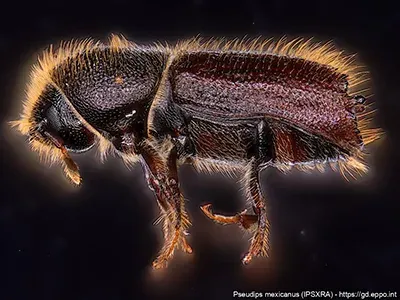
Description
How to identify
The Mexican pine beetle (Pseudips mexicanus) is a member of the Coleoptera order and the Curculionidae family, specifically belonging to the Scolytinae subfamily.
These beetles are small, typically ranging from 3 to 5 millimeters in length, with a cylindrical body shape adapted for boring into trees.
Their coloration is generally dark brown to black, providing camouflage against the bark surface they inhabit throughout their life cycle.
An identifying feature of this species is the structure of the declivity on the elytra, which features a distinct indentation lined with teeth.
The larval stage consists of legless, white grubs with brown-colored head capsules, residing exclusively within the phloem and cambium layers of the host tree.
What it damages
The primary hosts for the Mexican pine beetle are various species of pine trees found across North America, especially in high-altitude forest ecosystems.
While the beetle prefers weakened, stressed, or fallen trees, healthy trees can also fall victim during major population outbreaks.
This beetle specifically targets the upper portions of the tree trunk where the bark is thinner, allowing easier access for adult beetles.
The construction of galleries by adults and larvae severs the tree's nutrient transport system, leading to rapid water loss and tree mortality.
Extensive damage results in significant economic loss, as the timber becomes unsuitable for use due to boring galleries and associated fungal infections.
When it appears
The flight season of the Mexican pine beetle begins when spring temperatures become consistently warm, allowing adults to emerge and find new hosts.
Depending on the local climate and latitude, the species can complete multiple generations within a single calendar year.
Females bore into the host bark and create long maternal galleries, depositing eggs along the edges as they progress through the phloem.
Upon hatching, larvae feed by constructing perpendicular galleries, eventually undergoing pupation within specialized chambers under the bark.
Overwintering usually occurs in the adult or late larval stage, deep within the tree bark or near the tree base to survive cold conditions.
Signs of infestation
A primary indication of infestation is the presence of fine, brown boring dust (frass) that accumulates on the bark or at the base of the tree.
Resin pitch tubes may also appear on the surface of the bark, representing the tree's attempt to repel the attacking beetles through sap flow.
The crown of the infected tree will show progressive discoloration, shifting from its natural green to yellow and finally to a deep reddish-brown.
Removing a small strip of bark will reveal complex gallery patterns created by the feeding activities of the developing insects.
As the tree declines, it becomes highly susceptible to other secondary pests and wood-rotting fungi, further accelerating the tree's death.
Control measures
Sanitation harvest is the most effective control measure, involving the removal and destruction of infested trees to eliminate the breeding reservoir.
Proper forest management requires the removal of logging debris and slash, which can serve as fertile ground for future beetle generations.
Pheromone traps are widely used in integrated pest management to monitor local beetle population levels and time potential interventions.
In high-value nursery or ornamental settings, localized insecticidal applications can protect specific trees during peak flight periods.
- Regular forest health monitoring.
- Prompt sanitation of infested timber.
- Use of pheromone-based monitoring tools.
Taxonomy
- Latin name
- Pseudips mexicanus
- Order
- Coleoptera (beetles)
- Family
- Curculionidae
- EPPO code
- IPSXRA
Discussion
No discussions yet — be the first.