
Eastern bark beetle
Pseudips concinnus
Description
How to identify
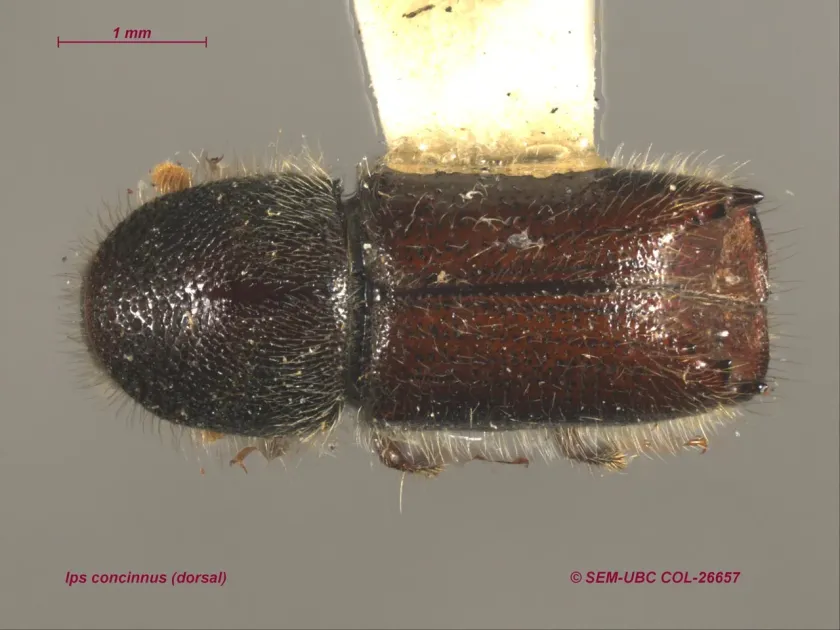
The eastern bark beetle, known scientifically as Pseudips concinnus, is a significant forest pest belonging to the Curculionidae family and Scolytinae subfamily. Adult beetles typically measure between 4 to 5 mm in length and exhibit a dark brown to black coloration.
A distinctive feature of this species is the structure of the elytral declivity, which bears small teeth. This physical trait is crucial for the beetle, as it helps in clearing the frass (boring dust) from the tunnels excavated under the bark.
Larvae are legless, white grubs with a distinct brown head. They develop primarily in the cambium layer of the host tree, consuming the tissue and disrupting the nutrient flow of the tree throughout their growth cycle.
Taxonomically, the species is part of the Coleoptera order. Its behavior and evolutionary traits have made it a persistent threat to healthy coniferous forests, particularly in regions where it finds optimal host conditions.
The beetle exhibits high adaptability to varied forest environments. Its life cycle involves several stages, including egg, larva, pupa, and adult, with the adult stage being the primary vector for forest infestation.
What it damages
The primary hosts for Pseudips concinnus are coniferous tree species. While it shows a strong preference for spruce, it can also infest pine and fir, especially when the population density reaches outbreak levels.
The damage is caused by the adults and larvae tunneling into the cambium. This process cuts off the tree’s phloem, effectively starving the plant of water and nutrients, which eventually leads to tree mortality.
In terms of forest economics, this pest is a major cause of timber loss and forest degradation. A severe infestation can result in the rapid decline of large forest tracts within a few growing seasons.
Trees that are already weakened by abiotic stressors like prolonged drought, wind damage, or root rot are the most susceptible to initial attacks, though healthy trees may be killed during mass outbreaks.
The resulting tree mortality creates gaps in the canopy, alters forest composition, and significantly increases the fuel load, which subsequently elevates the risk of catastrophic forest fires.
When it appears
Adult beetles typically emerge from overwintering sites in early spring as temperatures consistently climb above 12 degrees Celsius. This onset of flight signals the beginning of the new infestation season.
The beetle's developmental speed is highly dependent on ambient temperature. In warmer climates or during exceptionally hot summers, multiple generations can occur, significantly increasing the pressure on the host trees.
By late summer, the new generation of adults completes their development under the bark. They eventually emerge to feed or find appropriate locations to undergo diapause during the winter months.
Overwintering takes place primarily in the forest floor litter or near the base of the tree trunks, where the insulating layer of snow provides protection against sub-zero temperatures.
Climate patterns, specifically spring temperatures and summer precipitation levels, are the primary drivers of population dynamics, dictating whether the beetle population remains stable or escalates into a major outbreak.
Signs of infestation
One of the earliest indicators of an infestation is the presence of fine boring dust, often described as frass, gathering in bark crevices or at the base of the affected tree.
As the tree begins to succumb, the needles will transition from their normal green color to a pale yellowish hue, eventually turning reddish-brown and falling off entirely.
Upon closer inspection, the bark surface displays numerous tiny entry holes made by the beetles. Removing a patch of bark reveals intricate galleries that reflect the breeding and feeding patterns of the species.
Resin flow or "pitch tubes" may sometimes be visible on the trunk as the tree attempts to defend itself against invading beetles, though this defense fails when the attack is overwhelming.
The activity of woodpeckers in the canopy is a strong indicator of bark beetle presence, as these birds seek out larvae under the bark, often leaving behind large patches of stripped bark.
Control measures
Sanitation cutting remains the most effective strategy for managing outbreaks. By identifying and removing infested trees before the next generation of beetles emerges, foresters can effectively disrupt the life cycle.
Pheromone-baited traps are widely used for monitoring population levels and timing management activities. They are excellent tools for early detection, allowing for a swift response before widespread damage occurs.
Maintaining forest health through proper silvicultural practices is essential. Thinning stands to reduce competition and prevent the accumulation of storm-damaged timber helps keep the forest resilient.
It is critical to process or dispose of logging residues, as these can serve as breeding grounds for new generations of bark beetles if left on the forest floor for too long.
- Implement proactive sanitary harvesting.
- Deploy pheromone traps for monitoring.
- Remove fallen or damaged timber promptly.
- Encourage biological control agents such as predatory beetles.
Taxonomy
- Latin name
- Pseudips concinnus
- Order
- Coleoptera (beetles)
- Family
- Curculionidae
- EPPO code
- IPSXCC
Discussion
No discussions yet — be the first.