
European spruce bark beetle
Pseudips
Description
How to identify
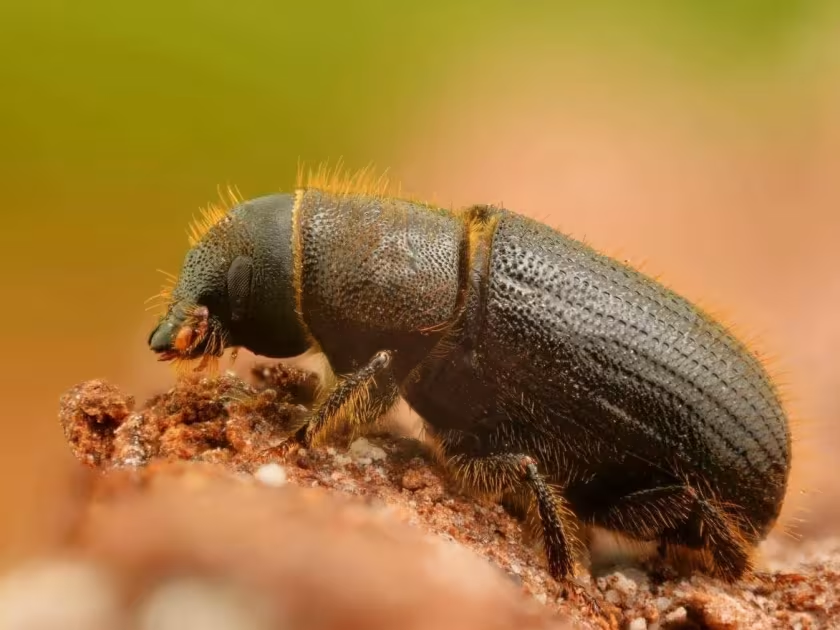
The European spruce bark beetle (Ips typographus, often part of the Pseudips group) is a highly destructive insect belonging to the Curculionidae family and Scolytinae subfamily. Adults are small, cylindrical, and dark brown, measuring between 4.2 and 5.5 mm in length.
A key diagnostic feature of this beetle is the apical declivity at the end of the elytra, which features four pairs of teeth. This structure is used by the beetle to push sawdust and frass out of its tunnels while drilling.
Larvae are legless, white with a yellowish head capsule, and feed primarily in the phloem and cambium layers of the host tree. They are rarely seen, as they develop entirely under the bark.
The species relies heavily on chemical signaling. They release aggregation pheromones when they find a suitable host, which prompts mass colonization by other beetles, quickly overwhelming the tree's defenses.
The beetle's biology is optimized for rapid population growth, allowing them to exploit environmental weaknesses in forest stands. They are considered one of the most serious pests in Eurasian spruce forests.
What it damages
The primary host of this beetle is the Norway spruce (Picea abies), though it can infest other conifers such as pine or larch if the trees are significantly stressed by drought or storm damage.
The beetle bores through the bark into the inner layer, cutting off the flow of nutrients and water throughout the tree. This process, combined with fungal infection, leads to the rapid death of the host.
Mass outbreaks can destroy thousands of hectares of forest in a single season. The resulting deadwood creates a high risk of forest fires and significant financial losses for timber production.
Even if the tree is not killed immediately, the damage to the cambium layer makes the wood susceptible to blue stain fungi, which significantly degrades the quality and value of the timber.
Once a stand is infested, the beetle populations expand exponentially, moving from the initial focal points to healthy neighboring trees, creating a dangerous feedback loop in the forest ecosystem.
When it appears
The activity of Ips typographus is strongly temperature-dependent, with the main flight period starting in spring when temperatures consistently reach above 15°C.
Overwintering adults emerge first to find new hosts. The timing of this emergence is critical for foresters to implement control measures such as trap trees or pheromone lures.
Depending on the climatic zone, the beetle can complete one to two generations per year. In exceptionally warm and dry summers, the development cycle accelerates, leading to an increased number of generations.
Beetles overwinter under the bark of standing trees or in the leaf litter at the base of the tree. They remain in a state of diapause until environmental conditions become favorable again.
Climate change, manifesting as milder winters and hotter summers, has significantly increased the incidence and severity of outbreaks across Europe in recent years.
Signs of infestation
One of the earliest signs of an attack is the presence of brown boring dust (frass) gathered in bark crevices, at the base of the trunk, or on spiderwebs near the tree.
Entry holes, approximately 2 mm in diameter, can be observed on the bark. Sometimes, the tree will exude resin in an attempt to push the beetle out, resulting in pitch tubes on the bark surface.
The crown of the tree starts to show signs of stress as foliage turns from healthy green to pale yellow, eventually turning reddish-brown once the tree is completely dead.
Loosening bark is a later stage sign. Upon peeling back pieces of bark, one can see the characteristic star-shaped or branched galleries carved into the wood by the parent beetles and larvae.
Increased woodpecker activity on specific trees often indicates that the tree is already heavily infested with beetle larvae, which serve as a primary food source for these birds.
Control measures
Sanitation felling is the most effective management tool. Infested trees must be identified and removed from the forest before the next generation of beetles emerges and spreads to healthy trees.
Pheromone traps are widely used for monitoring and mass trapping, providing foresters with real-time data on beetle population dynamics throughout the growing season.
Trap trees (freshly felled logs) can be utilized to attract beetles. Once the logs are heavily infested, they must be debarked or removed/destroyed to kill the larvae within.
Biological control agents, such as specific fungi or predatory insects, are being studied as potential long-term solutions to keep populations below the economic threshold without using chemicals.
- Early detection and rapid response.
- Effective management of windthrow and storm-damaged timber.
- Maintaining forest health through proper silvicultural practices.
- Monitoring using pheromone-based systems.
Taxonomy
- Latin name
- Pseudips
- Order
- Coleoptera (beetles)
- Family
- Curculionidae
- EPPO code
- PDIPSP
Discussion
No discussions yet — be the first.