
Protostrophus simplex
Protostrophus simplex
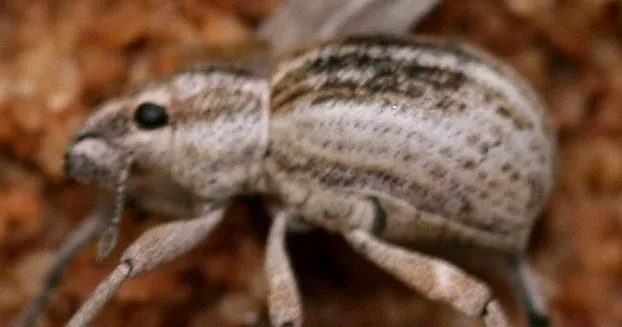
Description
How to identify
Protostrophus simplex is a member of the Curculionidae family, commonly known as weevils. These beetles are characterized by their elongated snouts and compact, oval-shaped bodies typically measuring 4 to 6 millimeters in length.
The adult beetles are covered in dense scales that are typically grayish or brownish, providing them with excellent camouflage against the soil surface and plant debris.
The larvae are typically legless, fleshy, and C-shaped, featuring a distinctively dark head capsule. They spend their entire development phase underground, feeding on roots and organic matter.
These insects exhibit a defensive behavior known as thanatosis, where they feign death and drop from plants when disturbed, making them difficult to spot during routine field scouting.
The life cycle involves a single generation per year, with the adult stage being the primary form for overwintering deep within the soil profile.
What it damages
This weevil is a polyphagous pest, capable of feeding on a wide variety of cultivated crops, including cereals, legumes, sunflower, and sugar beet, which causes significant economic loss.
The adult beetles cause the most significant damage by aggressively feeding on young seedlings, particularly during the cotyledon stage, which can result in stand loss.
Severe infestations often lead to uneven crop emergence, as the beetles consume leaf margins and growing points, significantly hindering the development of the plants.
Beyond the direct loss of biomass, the mechanical damage caused by the beetles' feeding creates entry points for various fungal and bacterial pathogens, leading to secondary plant diseases.
In cases of high pest pressure, the damage can be so severe that replanting of the field becomes necessary, significantly increasing agricultural production costs.
When it appears
The activity of overwintered adults begins in the spring when soil temperatures reach the threshold required for beetle emergence, coinciding with the germination of spring-sown crops.
Peak feeding activity occurs during the seedling emergence phase, as the beetles migrate from overwintering sites in the soil or surrounding vegetation to the newly planted fields.
After the initial feeding period, the beetles mate and lay eggs in the soil. The larvae then develop throughout the summer, living in the subterranean environment.
By late summer and early autumn, the new generation of adults emerges, but they typically remain dormant in the soil until the following spring, ensuring the species' survival over the winter months.
Environmental conditions, such as warm, dry spring weather, often exacerbate the damage by prolonging the period during which seedlings are highly susceptible to weevil feeding.
Signs of infestation
The most prominent sign of infestation is the characteristic irregular, notched feeding pattern on the edges of leaves, often referred to as "leaf scalloping."
Visible gaps in the rows of young crops are strong indicators of a Protostrophus simplex infestation, often resulting from the beetles destroying the plants before they reach significant size.
Field scouting in the early morning is highly recommended, as this is when the beetles are most active on the foliage and easier to observe before they hide in the soil.
Checking the soil surface around the base of damaged plants often reveals the beetles resting, especially if they have just been disturbed or if the sun is not yet too intense.
Monitoring for signs of root feeding by larvae can also be performed through soil sampling, although this is more labor-intensive and typically used for research or threshold assessment.
Control measures
Effective management of this pest relies on an integrated approach, combining cultural practices with targeted chemical interventions to keep populations below the economic threshold.
Crop rotation is a fundamental tool; by avoiding the planting of host crops in successive seasons, growers can disrupt the pest's life cycle and reduce its presence.
Deep plowing in the autumn is a highly effective cultural practice, as it physically destroys overwintering adults and exposes larvae to adverse environmental conditions.
- Using systemic insecticidal seed treatments to protect seedlings.
- Maintaining clean field edges to remove potential pest reservoirs.
- Adjusting planting dates to achieve rapid crop emergence and growth.
If population counts exceed the economic threshold, foliar application of approved contact or systemic insecticides can be used to mitigate immediate damage to the crop stand.
Taxonomy
- Latin name
- Protostrophus simplex
- Order
- Coleoptera (beetles)
- Family
- Curculionidae
- EPPO code
- PROOSI
Discussion
No discussions yet — be the first.