
Maple budworm moth
Proteoteras willingana
Description
How to identify
The maple budworm moth (Proteoteras willingana) is a member of the Tortricidae family. The adult moth is small, with a wingspan of approximately 15–20 mm, exhibiting gray and brown patterns that provide excellent camouflage against tree bark.
The larvae progress through several developmental stages. Initially, they are small and cream-colored, becoming darker as they mature. This species is highly specialized, focusing its life cycle on specific maple varieties, which makes it a significant pest in both forestry and landscape management.
The life cycle is closely synchronized with the phenology of the host maple tree. They typically overwinter as late-stage larvae or pupae in protected crevices of the bark or among leaf litter on the ground.
In spring, as temperatures rise, the larvae become active and begin feeding on succulent plant tissues. The pupation phase occurs within the protection of spun leaves or within damaged buds, ensuring safety from predators.
Adult moths are primarily nocturnal. Females lay eggs near the buds, ensuring that newly hatched larvae have immediate access to the most nutrient-rich parts of the tree during the critical spring growth period.
What it damages
The primary hosts are maple trees, specifically sugar and boxelder maples. The damage is most severe on the developing buds, which can lead to significant growth loss and canopy thinning.
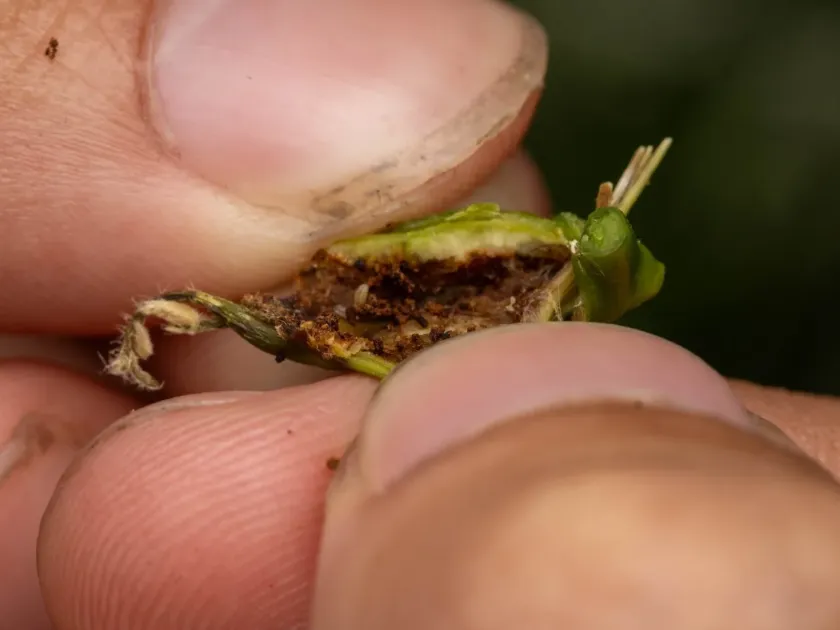
Larvae bore into swelling buds, destroying future leaves and flowers. This results in growth stunting and, in severe cases, the death of young apical shoots, leading to irregular tree development.
Once buds are consumed, larvae move to young leaves. They pull leaves together with silk webbing, creating a protected feeding environment where they skeletonize the foliage, significantly hindering the tree's photosynthetic capacity.
Heavy infestations can lead to partial or total defoliation of branches. This weakens the tree's overall vigor, making it more susceptible to secondary environmental stresses or disease pathogens.
The aesthetic impact is also notable, as damaged trees display distorted growth patterns, such as multiple leaders or stunted terminal shoots, which degrades their value in residential or urban landscapes.
When it appears
Activity begins in early spring, coinciding with the bud-break phase of maples. This is the period of highest risk, as larval feeding can cause irreversible damage to the season's growth.
The main larval feeding period occurs throughout May and June. During this time, the symptoms of infestation become most visible to arborists and property owners.
Adult moth flight of the second generation usually takes place mid-summer, depending on climatic conditions. These moths are highly active at night, focused on mating and egg-laying for the next cycle.
By autumn, the late-generation larvae prepare for overwintering. They seek refuge on the bark or in the soil, entering a state of diapause to survive the winter months.
Regular monitoring from early spring through late summer is recommended to assess the population level and determine if intervention is necessary to protect tree health.
Signs of infestation
The earliest indicator of an infestation is the presence of withered, unopened buds. Upon closer inspection, these buds appear hollowed out, often accompanied by fine, granular larval frass.
The presence of leaves spun together with white silk webbing is a definitive sign of Proteoteras willingana activity on the branches of the maple tree.
- Hollowed or damaged buds in early spring.
- Silk webbing on terminal shoots.
- Distorted or curled leaves with skeletonized patches.
- Holes bored into leaf stalks (petioles).
- Presence of larvae hanging from silk threads when branches are agitated.
Secondary signs include the browning of leaf margins and the general "tired" appearance of the tree canopy as feeding progresses through the season.
Visual surveys should focus on the upper canopy, as larvae often prioritize tender growth located on the outer branches of the tree crown.
Control measures
Sanitation is a primary management strategy. Pruning and destroying infested tips in early spring can significantly reduce the overwintering population before larvae emerge.
Biological control options, such as Bacillus thuringiensis (Bt), are highly effective when applied during the early larval stage. These treatments are target-specific and preserve beneficial predatory insects.
Chemical insecticides should be considered as a last resort, using systemic products applied at the onset of bud-break to target larvae before they shelter themselves within spun leaves.
Proper timing is essential for success. Applications must occur while larvae are exposed and feeding, as once they are protected inside rolled foliage, control becomes substantially more difficult.
Encouraging natural predators, such as parasitic wasps and insectivorous birds, is a sustainable approach to keeping budworm populations below economic injury levels over the long term.
Taxonomy
- Latin name
- Proteoteras willingana
- Order
- Lepidoptera (butterflies)
- Family
- Tortricidae
- EPPO code
- PRTEWI
Discussion
No discussions yet — be the first.