
Promecops
Promecops
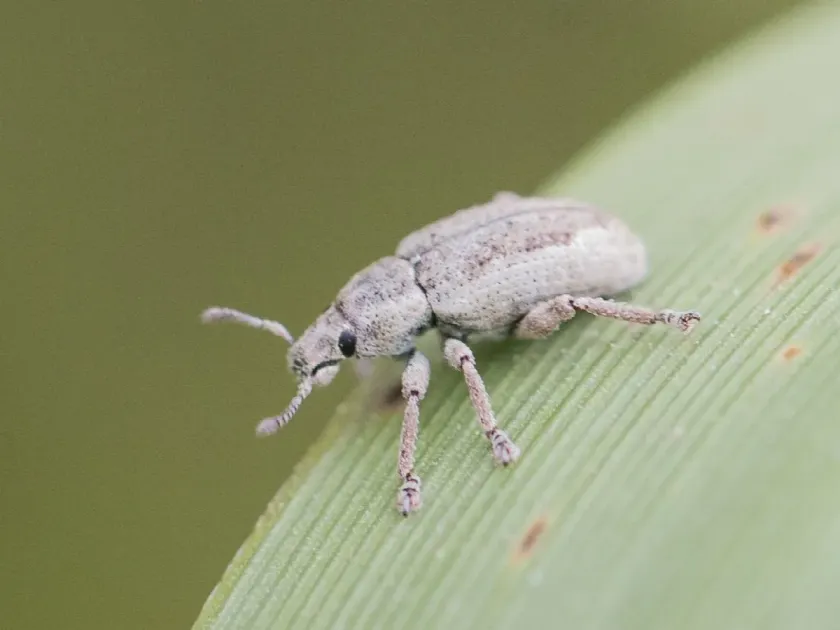
Description
How to identify
Promecops is a genus of beetles belonging to the family Curculionidae (weevils), within the order Coleoptera. These insects are easily recognized by their elongated snouts or rostrums, which is a classic diagnostic feature of the family.
Adult beetles typically exhibit cryptic coloration that blends in with soil particles and plant debris, making them notoriously difficult to detect during standard field scouting sessions.
The larvae are typically legless and have a curved, C-shaped body, which is characteristic of soil-dwelling weevil larvae. They spend the majority of their development hidden beneath the soil surface.
The life cycle follows a complete metamorphosis pattern: egg, larva, pupa, and adult. Each stage is adapted to specific environmental conditions, allowing the species to persist in various agricultural landscapes.
Species within the Promecops genus exhibit varying degrees of host specificity, with some species focusing on particular leguminous crops or perennial shrubs.
What it damages
Damage is caused by both adults and larvae, although the nature of the destruction differs significantly between the two life stages. Adults attack foliage, while larvae focus on root systems.
Adult beetles feed on leaves and young shoots, causing irregular notches or holes in the leaf blades, which significantly reduces the photosynthetic capacity of the host plant.
Larvae feed on roots and root collars, disrupting the transport of water and nutrients. This interference often results in stunted growth, chlorosis, and the eventual death of young seedlings.
Severe infestations during the early stages of crop development can lead to significant thinning of stands, as the root systems are not yet robust enough to withstand larval grazing.
In addition to direct physiological stress, plant wounds caused by the pests can serve as entry points for various secondary pathogens, further complicating the health status of the crop.
Signs of infestation
The first signs of an infestation often appear as ragged leaf edges or irregular holes in the middle of leaves, indicating the presence of active adult feeding.
Patchy wilting or yellowing of plants is a key indicator of root damage. These plants are often easily pulled from the soil, revealing the lack of root structure due to larval feeding.
Adult beetles can occasionally be spotted on the stems or undersides of leaves during the night or periods of high humidity when they are most active.
The "death-feigning" behavior of adult weevils, where they drop to the ground and remain motionless upon disturbance, is a primary identification tactic used by agronomists.
Accumulated frass (waste) on the leaves or the surface of the soil around the base of the plant confirms active feeding and warrants an immediate assessment of pest population density.
Control measures
Integrated Pest Management (IPM) for Promecops relies heavily on crop rotation to break the pest's life cycle by eliminating the required host plants for the larvae.
Deep fall tillage is highly effective, as it exposes soil-dwelling larvae and pupae to extreme temperature fluctuations and predation, thereby reducing the overwintering population.
Chemical control options include the application of registered systemic or contact insecticides when population levels exceed the established economic threshold for the specific crop.
Effective management also requires careful timing of applications to coincide with the most vulnerable stages of the beetle's life cycle to ensure optimal results.
- Maintaining spatial isolation between susceptible crops.
- Consistent weed control to remove alternative hosts.
- Monitoring pest populations using visual inspections.
- Utilizing clean, certified planting material.
Taxonomy
- Latin name
- Promecops
- Order
- Coleoptera (beetles)
- Family
- Curculionidae
- EPPO code
- PRMESP
Discussion
No discussions yet — be the first.