
Proctotrupes viator
Proctotrupes viator
Description
How to identify
Proctotrupes viator is a species within the order Hymenoptera and the family Proctotrupidae. These are small parasitic wasps frequently encountered in agricultural landscapes and forest soils.
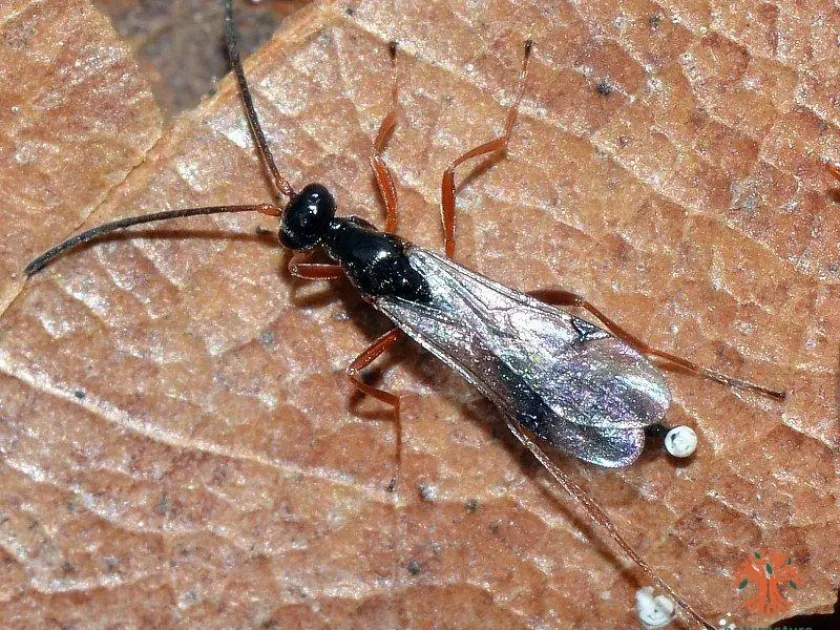
The morphology of this insect includes a slender body, often black, and a notably elongated abdomen in females, which houses the ovipositor used for inserting eggs into host larvae.
They are characterized by simplified wing venation and highly sensitive antennae, which are essential for detecting host larvae buried within the soil matrix.
Unlike many other insects, they do not feed on plant tissues. Their life cycle is entirely dependent on finding and parasitizing the larvae of various ground-dwelling beetles.
As entomologists observe, these wasps are silent guardians of the soil, often remaining unnoticed until population levels of their hosts increase significantly.
What it damages
Proctotrupes viator is not a plant pest. It is a specialized parasitoid that targets soil-dwelling larvae, particularly those of the Coleoptera order, such as wireworms.
Since they only feed on insect hosts during their larval stage, they do not cause any harm to crops, foliage, or roots. In fact, their presence is beneficial for agricultural health.
There is no record of this species damaging commercial crops. Consequently, it should be categorized as an essential beneficial insect rather than a threat to production.
Their predatory behavior on underground pests reduces the overall damage inflicted by root-feeding insects on cereal and vegetable crops throughout the growing season.
A farmer identifying these wasps in their fields should consider them allies in integrated pest management (IPM) strategies, as they provide natural regulation.
When it appears
The adult activity period typically spans from late spring to early autumn, depending on local climatic conditions and the synchronization with host availability.
The life cycle involves the female wasp locating a host in the soil, laying an egg inside it, and allowing the larva to develop by consuming the host from within.
Overwintering is usually achieved in the larval stage, residing safely inside the host larvae deep within the soil profile, protected from external frost.
Emergence occurs when soil temperatures rise in the spring, which is the exact time when ground-dwelling pests begin their feeding activity on plant roots.
Depending on environmental conditions, the species may produce one or more generations per year, maintaining a consistent pressure on host populations.
Control measures
No control measures are needed for Proctotrupes viator, as it is a beneficial insect. Eradication attempts are counter-productive and harmful to the ecosystem.
The best strategy for farmers is to implement IPM practices that avoid the use of broad-spectrum insecticides that inadvertently kill these natural enemies.
Preserving the soil structure through conservation tillage helps protect the lifecycle of these wasps, ensuring their population remains stable for future seasons.
Providing nectar-rich vegetation near crop fields can support the adult populations, as they often require supplemental carbohydrate sources between host-seeking flights.
- Adopt biological control instead of chemical soil fumigants.
- Maintain non-crop vegetation for nectar sources.
- Avoid unnecessary pesticide applications to protect beneficial fauna.
Taxonomy
- Latin name
- Proctotrupes viator
- Order
- Hymenoptera
- Family
- Proctotrupidae
- EPPO code
- PRCOVI
Discussion
No discussions yet — be the first.