
Pristionchus entomophagus
Pristionchus entomophagus
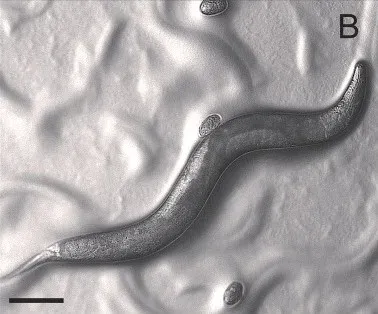
Description
How to identify
Pristionchus entomophagus is a microscopic nematode belonging to the order Rhabditida and the family Diplogastridae. Because of their tiny size, identification in the field is impossible without high-precision laboratory equipment.
Professional identification requires microscopic examination of the stoma and the reproductive system. These morphological features allow specialists to distinguish this species from other beneficial or pathogenic soil-dwelling nematodes.
These organisms are known for their phenotypic plasticity, adapting their feeding behavior between bacterial consumption and predatory or parasitic lifestyles depending on environmental triggers.
Due to their size and cryptic nature, they are often overlooked in standard soil surveys. Proper sampling methods and extraction techniques are required to assess their presence in agricultural soil samples.
Understanding their life cycle is crucial for effective monitoring. They often interact with insects or organic matter in the soil, which helps sustain their populations even in the absence of primary crop hosts.
What it damages
The primary damage caused by Pristionchus entomophagus is linked to root system degradation. As they feed on or migrate through root tissues, they disrupt the plant's ability to absorb water and nutrients.
This feeding activity often creates entry points for secondary pathogens, such as bacteria and fungi, which are the main cause of the widespread root rot observed in infested crops.
Plants affected by these nematodes typically exhibit stunted growth, chlorosis, and reduced vigor. If the infestation occurs early in the growing season, it can lead to significant crop failure and uneven stands.
In addition to physiological stress, the presence of these nematodes can affect the quality of root-based crops during storage, as they may remain associated with the tissues and continue the breakdown process.
The overall economic impact is often cumulative, resulting from reduced yield potential and increased susceptibility to environmental stressors throughout the crop's development cycle.
When it appears
The activity of Pristionchus entomophagus is closely tied to soil temperature and moisture levels. They typically become active when soil temperatures rise above 10-15 degrees Celsius in the spring.
During dry summer months, populations may decline or enter a dormant state within the soil. They possess survival mechanisms that allow them to endure periods of drought by remaining in deeper soil layers.
Increased activity is usually observed in the autumn as temperatures cool and soil moisture increases. This period is vital for the survival and preparation for winter dormancy.
They overwinter in the soil or within decomposing plant residues. Their ability to tolerate cold conditions ensures that they remain present in the field, ready to re-emerge when conditions become favorable.
Early spring planting without proper soil preparation can lead to rapid colonization of new roots as the nematodes emerge from dormancy along with the germinating seeds.
Signs of infestation
The first signs of infestation often appear as patches of stunted or yellowing plants in the field. These areas may enlarge over time as the nematode population spreads.
Upon inspecting the roots, one might find necrotic spots or general browning. The root system is often poorly developed compared to healthy plants, with fewer fine root hairs.
Plants may show symptoms similar to nitrogen or micronutrient deficiency because the damaged root system can no longer support optimal nutrient uptake, regardless of soil fertility levels.
Wilting during the hottest parts of the day, even with sufficient soil moisture, is a common sign of damaged root architecture that cannot meet the transpiration demands of the plant.
In severe cases, the plants may be easily pulled from the soil due to the decay of the primary root system, revealing a lack of structural integrity in the root architecture.
Control measures
The most effective management strategy is a robust crop rotation program. Rotating with non-host crops helps disrupt the nematode life cycle and lowers their population density over time.
Green manure and cover crops, particularly those with bio-fumigant properties like mustard, are recommended to naturally suppress nematode populations in the soil.
Sanitation is key to preventing the spread of these pests between fields. Ensuring that equipment is cleaned before moving from infested to non-infested areas is a critical preventative measure.
Biological soil amendments that promote a healthy microflora can help suppress pathogenic nematodes by increasing competition and predation by other soil organisms.
- Practice deep tillage to expose nematodes to adverse conditions.
- Select nematode-resistant varieties where available.
- Perform periodic soil analysis to monitor population trends.
Taxonomy
- Latin name
- Pristionchus entomophagus
- Order
- Nematodes
- Family
- Diplogasteridae
- EPPO code
- DIPEEN
Discussion
No discussions yet — be the first.