
Andean potato weevil
Premnotrypes vorax
Description
How to identify
The Andean potato weevil (Premnotrypes vorax) belongs to the order Coleoptera and the family Curculionidae. It is a major quarantine pest indigenous to the high-altitude regions of the Andes mountains.
Adult weevils are about 7–9 mm long, typically displaying a dark brown or black coloration that provides excellent camouflage against soil and organic matter.
The body exhibits the classic snout-like structure of the weevil family. As most populations have flightless features, these insects rely on crawling, which influences their local dispersal patterns.
Larvae are small, white-to-cream-colored grubs that reach up to 10 mm in length. They are legless and have a characteristic curved, C-shaped body posture.
Due to their cryptic behavior and dark color, adults are rarely seen during daylight hours, often remaining hidden in the soil or beneath the canopy of potato plants.
What it damages
The primary host of this pest is the potato plant. Adult weevils feed on the margins of potato leaves, creating jagged notches that are easily recognizable during field inspections.
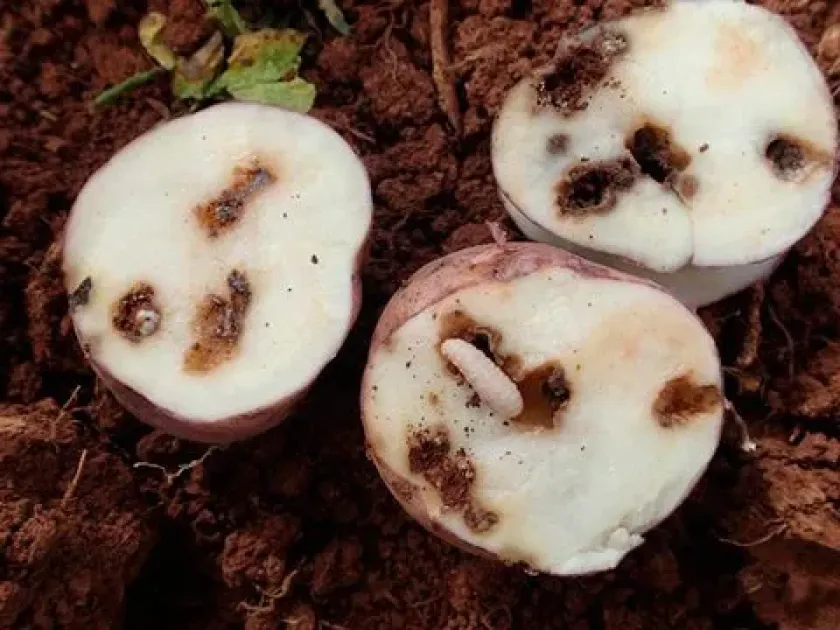
The most devastating damage is caused by the larvae, which bore into the developing tubers. They create complex galleries inside the potato, compromising its structural integrity.
Besides cultivated potatoes, the weevil can infest wild Solanaceae species, which often act as alternative hosts and reservoirs for the pest in agricultural landscapes.
Tubers attacked by larvae lose their commercial value and are prone to secondary infections from soil-borne pathogens, leading to rapid rotting in storage.
Infestations can cause severe yield reductions, sometimes exceeding 50% of the crop, making strict control measures necessary for commercial potato production.
When it appears
The life cycle of the Andean potato weevil is synchronized with the potato growing season. Adults emerge from the soil as temperatures rise in the spring.
Females lay eggs near the base of the plant stem or on the soil surface. Incubation lasts roughly 2 to 3 weeks depending on the prevailing ambient temperatures.
Upon hatching, larvae immediately move toward the tubers. The feeding phase of the larvae inside the tuber can last from one to three months depending on the climate.
Pupation occurs within the soil, where the larvae construct earthen cells. These pupae remain dormant in the ground until the adult insect emerges in the next season.
Adults exhibit significant durability and can survive long periods in the soil or crop debris, making them difficult to eradicate once a field is colonized.
Signs of infestation
Early warning signs include the presence of irregular, notched feeding patterns on the edges of potato leaves, indicating adult weevil activity in the area.
Upon harvesting, small circular entry holes are visible on the skin of the tubers, marking the points where larvae have burrowed into the potato flesh.
Cutting the potato reveals internal damage: deep, twisting tunnels filled with dark frass, rendering the tuber entirely inedible and unmarketable.
Sudden wilting or chlorosis of the potato canopy without evident disease symptoms can sometimes suggest extensive larval feeding on stolons and tubers below the soil.
Evening scouting with artificial light can confirm the presence of adults, as they are primarily nocturnal and tend to hide during the intense daylight hours.
Control measures
Crop rotation is the most effective cultural control method, as it prevents the buildup of weevil populations by interrupting the availability of host tubers.
Deep plowing at the end of the season exposes overwintering pupae and larvae to surface predators and adverse weather conditions, reducing their survival rates.
Using certified, clean seed potatoes is vital to prevent the introduction of eggs or larvae into non-infested regions or newly cleared agricultural land.
Chemical control usually involves applying systematic insecticides during the adult emergence phase, which helps to reduce the egg-laying population in the field.
- Monitor field edges for notched leaves.
- Remove wild Solanaceous weeds.
- Apply pheromone baits for early detection.
- Ensure thorough soil cultivation post-harvest.
Taxonomy
- Latin name
- Premnotrypes vorax
- Order
- Coleoptera (beetles)
- Family
- Curculionidae
- EPPO code
- PREMVO
Discussion
No discussions yet — be the first.