
Andean potato weevil
Premnotrypes solaniperda
Description
How to identify
The Andean potato weevil, scientifically known as Premnotrypes solaniperda, is a destructive pest belonging to the Curculionidae family of the Coleoptera order. Adult weevils are dark gray or brownish in color with a characteristic elongated snout (rostrum), measuring approximately 7 to 9 millimeters in length.
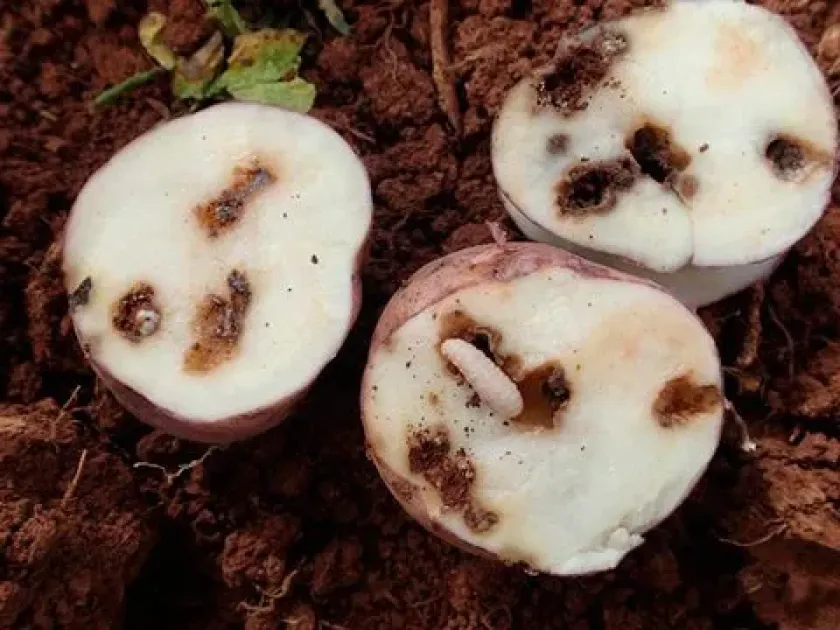
The larvae are the most damaging stage of the insect. They are creamy white with a distinct brown head and grow up to 10 millimeters long. Unlike the nocturnal adult weevils, the larvae spend their entire developmental phase feeding inside potato tubers or in the soil near the plant's root system.
This species is native to the high-altitude Andean regions of South America, which has made it highly adapted to cool mountain climates. Adults are flightless, as their elytra are often fused, meaning the primary mode of dispersal is through the movement of infested tubers or contaminated soil.
Identifying adult weevils in the field is challenging due to their protective coloration, which allows them to blend in with soil particles and debris. Often, the presence of this pest is confirmed only when hidden damage is discovered during the potato harvest.
Due to its high specialization and destructive potential, it is strictly classified as a quarantine pest in many parts of the world. Any accidental introduction into new regions can pose a severe threat to local potato production and national agricultural security.
What it damages
The primary host plant for the Andean potato weevil is the potato (Solanum tuberosum). This pest is capable of infesting both young and maturing tubers, significantly reducing crop yields and rendering the potatoes unmarketable for both domestic and commercial use.
Larvae create deep, winding tunnels within the tubers, filling them with frass (excrement). This physical destruction is compounded by the entry of secondary pathogens, such as soft and dry rots, which often cause the harvested potatoes to spoil rapidly during storage.
While adult weevils may occasionally feed on the edges of potato leaves, causing minor foliage damage, the main economic loss is attributed to the larval destruction of the tubers. The nutritional value and structural integrity of the potato are completely lost once the larva infests the interior.
The level of harm is directly proportional to the population density in the field. Under conditions of heavy infestation, farmers can lose more than 50-80% of their total potato yield if prompt mitigation and containment measures are not implemented.
Because the larvae develop internally, the damage is frequently invisible from the surface of the potato. This creates a significant challenge for farmers, as the extent of the infestation is rarely realized until the harvest, making pre-harvest management critical.
When it appears
The life cycle of the Andean potato weevil is closely tied to the phenology of the potato crop. Adult weevils emerge from the soil at the beginning of the growing season after overwintering deep in the ground or under plant residues.
Females lay eggs in small clusters, primarily in the soil near the base of the plant or in surface cracks. Once the potato tubers begin to form, the emerging larvae migrate into them almost immediately, starting the internal feeding process.
The larval feeding period lasts several weeks, after which the larvae exit the tubers and return to the soil to pupate. Depending on soil temperatures and environmental conditions, the development from egg to adult can take between three to five months.
In high-altitude climates, this weevil generally completes one generation per year. However, because adult emergence from the soil is staggered over a long period, multiple life stages can often be found simultaneously within the same potato field.
Late-planted potato crops are often at higher risk, as the peak activity of adult weevils frequently coincides with the most sensitive stage of tuber formation, providing an ideal environment for larval infestation.
Signs of infestation
The most visible signs of infestation are the characteristic semi-circular notches along the leaf margins, which are created by adults during their nocturnal feeding on the potato foliage.
Inspecting tubers post-harvest often reveals small entry holes that may be plugged with fine soil, making it difficult to detect infestations without cutting into the potato to examine the internal tissue.
When an infested tuber is sliced, the interior shows extensive damage with numerous tunnels filled with larval waste. This spongy, hollowed-out appearance is a diagnostic symptom of a Premnotrypes infestation.
Secondary symptoms may include rotting patches on the tuber, which produce a distinct odor and are often accompanied by the yellowing and premature wilting of the plant canopy as the plant loses its ability to transport nutrients from the compromised tubers.
The presence of adults can be monitored using trap mats made of plant debris placed in the field overnight; the insects congregate under these materials during the day, allowing farmers to assess the local population pressure.
Control measures
The primary strategy for controlling the Andean potato weevil involves strict quarantine protocols to prevent the movement of infested soil or seed potatoes from affected regions to new, clean areas.
- Use only certified, clean seed potatoes free from contamination.
- Implement a long-term crop rotation, avoiding Solanaceous crops in the area for at least 3-4 years.
- Deep plowing of the soil after harvest to expose and destroy pupae in the soil.
- Applying targeted contact and systemic insecticides during the peak periods of adult activity.
- Removing all volunteer potatoes and wild Solanum species that act as reservoirs for the pest.
Chemical control of the foliage is most effective when performed at night, as the adult weevils are strictly nocturnal and emerge from their soil hiding places to feed on the leaves during the darkness.
Biological control methods are increasingly important and include the use of entomopathogenic fungi, such as Beauveria bassiana, which can infect and reduce larval populations within the soil.
Integrated Pest Management (IPM) programs emphasize the use of pheromone or bait traps to monitor population spikes, ensuring that chemical interventions are timed precisely to maximize efficiency while minimizing unnecessary pesticide applications.
Taxonomy
- Latin name
- Premnotrypes solaniperda
- Order
- Coleoptera (beetles)
- Family
- Curculionidae
- EPPO code
- PREMSL
Discussion
No discussions yet — be the first.