
Andean potato weevil
Premnotrypes solani
Description
How to identify
The Andean potato weevil (Premnotrypes solani) is a destructive pest of potatoes in the Andean region. It belongs to the Curculionidae family and is considered a serious quarantine pest in many parts of the world due to its impact on agriculture.
Adult weevils are roughly 7–9 mm long with a dark, mottled grey or brownish appearance, providing excellent camouflage in the soil. They are flightless, meaning their migration is primarily limited to movement through soil or contaminated seed tubers.
The larval stage is the most damaging. The larvae are legless, fleshy, and creamy-white with a distinct brown head capsule. They are exclusively subterranean, spending their life cycle feeding on roots and tubers.
The insect thrives in high-altitude environments, showing remarkable adaptation to cool climates. Its life cycle involves complete metamorphosis, moving from egg to larva, pupa, and finally to the adult beetle stage.
Monitoring this pest is difficult due to its cryptic behavior. Adults are nocturnal, while the larval stages remain hidden entirely within the potato tubers, making internal detection nearly impossible until harvest.
What it damages
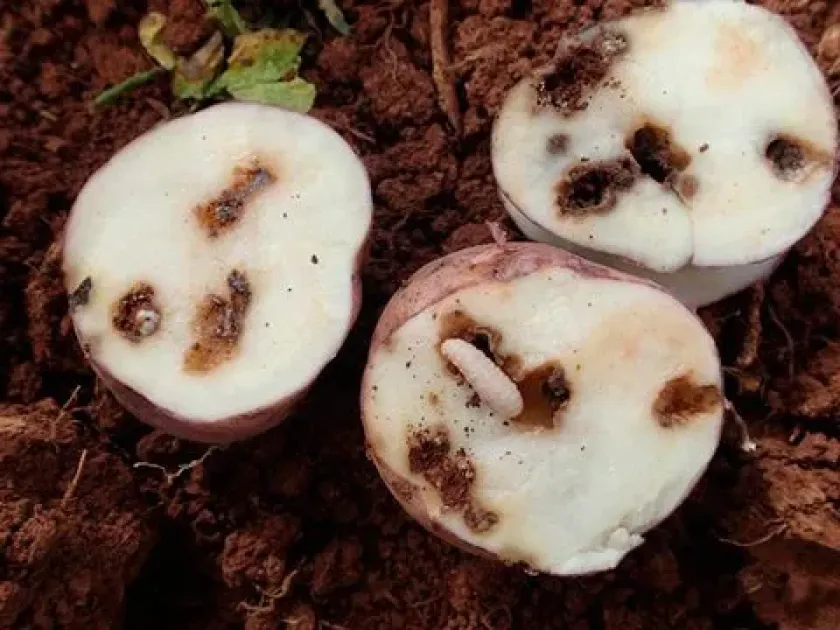
The primary damage is caused by larvae feeding inside potato tubers. Upon hatching, the larvae burrow into the tubers, creating extensive tunnels that ruin the vegetable's quality and structural integrity.
These tunnels often serve as entry points for secondary bacterial and fungal infections, which lead to rapid decay of the potatoes during storage and significantly decrease the market value of the crop.
In cases of high infestation, the damage can be catastrophic, with some reports suggesting that nearly the entire yield of a field can be lost if proper protective measures are not implemented during the growing season.
While adult beetles also feed on potato foliage, leaving characteristic notches along the leaf margins, this damage is minimal compared to the destructive power of the larvae developing deep within the underground harvest.
Furthermore, because the Andean potato weevil is a quarantine pest, its presence in a field results in severe economic losses, as harvested potatoes are restricted from trade and export, preventing them from reaching profitable markets.
When it appears
The seasonal cycle begins when overwintering adults emerge from the soil at the start of the potato growing season. They emerge in response to rising temperatures and the presence of fresh host plants.
Egg-laying occurs near the base of the plant or in soil cracks. The resulting larvae migrate downward through the soil profile to find and penetrate the developing potato tubers, usually mid-season.
Peak larval damage occurs as the tubers are actively bulking. This period is critical for management, as once the larvae are inside the tubers, contact insecticides become ineffective against them.
After completing their development, the larvae exit the tubers and return to the soil to pupate. The pupal stage is spent in a small subterranean chamber, protecting the insect until it emerges as a new adult.
The number of generations per year depends heavily on local climate, though in cooler, high-altitude regions, the life cycle is often synchronized with the single annual potato growing season.
Signs of infestation
The earliest signs of infestation are the notched edges on potato leaves caused by adult feeding. During the day, one might find the weevils hiding under soil clods or organic debris near the base of the stem.
At harvest, signs of the pest become undeniable. The surface of the tubers will exhibit small, circular entry holes, often surrounded by accumulations of granular frass, which is the waste matter left behind by the larvae.
Once the tuber is cut open, the internal network of feeding tunnels is clearly visible. The tissue inside the tunnels may show discoloration and evidence of secondary rot caused by opportunistic pathogens.
- Presence of adults in the soil near the stems at night.
- Circular entry holes on the skin of harvested tubers.
- Wilting or chlorosis of plants with severe root-system damage.
Inspection of soil samples and careful sorting of tubers post-harvest are the most effective ways to assess the population density of the pest within a specific field.
Control measures
Strict phytosanitary protocols are the primary defense against this pest. Ensuring that only certified, weevil-free seed tubers are used is the most vital step in preventing the introduction of the pest into new areas.
Cultural practices, such as crop rotation, are essential. By not planting potatoes in the same location for at least three to four years, farmers can effectively reduce the population levels of the weevil in the soil.
Deep plowing after the harvest helps disrupt the lifecycle by exposing pupae and overwintering adults to surface conditions, where they can be killed by avian predators or unfavorable weather conditions.
Chemical control focuses on the application of systemic or contact insecticides early in the season when adults are active but before they have the chance to lay eggs that lead to larval tuber damage.
Biological control methods, including the use of entomopathogenic fungi or nematodes, offer promising alternatives for integrated pest management programs, aiming to reduce reliance on broad-spectrum synthetic chemicals.
Taxonomy
- Latin name
- Premnotrypes solani
- Order
- Coleoptera (beetles)
- Family
- Curculionidae
- EPPO code
- PREMSO
Discussion
No discussions yet — be the first.