
Andean potato weevil
Premnotrypes pusillus
Description
How to identify
The Andean potato weevil (Premnotrypes pusillus) is a significant pest of the potato crop belonging to the Curculionidae family. It is primarily found in the Andean highlands of South America.
The adult insect is a beetle measuring approximately 6–8 mm in length. Its body is dark gray or brownish, providing excellent camouflage against the soil background.
The snout of the weevil is short and robust, which is characteristic of the genus. Its body is covered in fine hair and scales, giving it a rough texture.
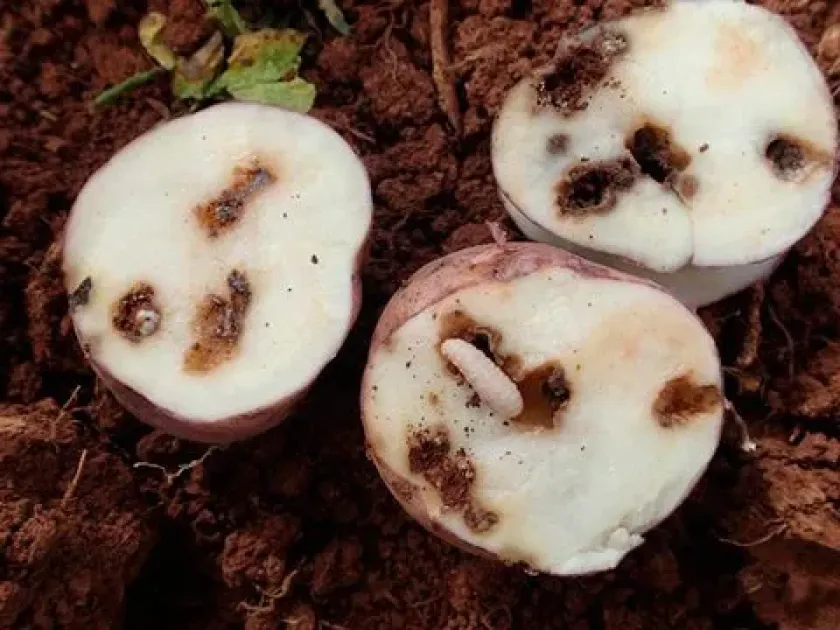
The larvae are creamy-white, legless, and have a typical curved shape found in many weevil species. A fully developed larva can reach up to 10 mm in size.
These insects are largely nocturnal, spending the daylight hours hidden in the soil or under plant debris, which makes direct field observation very difficult.
What it damages
The primary host of the Andean potato weevil is the potato plant. Adult weevils feed on the leaves, but the larvae cause the most severe economic damage.
Larvae tunnel deep into the potato tubers, creating complex networks of galleries. This feeding behavior significantly reduces both the quality and quantity of the harvest.
The galleries made by the larvae create entry points for secondary infections by fungi and bacteria, leading to the rapid decay and rotting of the stored tubers.
In cases of heavy infestation, farmers can experience yield losses of up to 90%, making this pest a major threat to potato production in its endemic regions.
Furthermore, tubers infested with larvae lose their viability as seed potatoes, rendering them useless for future planting cycles and causing further economic strain.
When it appears
The life cycle of the Andean potato weevil is closely synchronized with the growth cycle of the potato plant. Adults emerge from the soil in spring as the plants begin to emerge.
Females lay their eggs near the base of the plant or in the soil. The oviposition period is extended and depends heavily on the local climate and ambient humidity.
Once hatched, the larvae migrate into the soil, locate young potato tubers, and burrow inside to feed until the harvest season approaches.
After finishing their growth stage, the larvae exit the tubers and pupate in the soil at varying depths, where they remain to overwinter until the next season.
The number of generations per year can vary based on local temperatures, though development is generally steady throughout the active growing season.
Signs of infestation
One of the earliest signs of adult presence is the appearance of notched leaf margins, though this is often overlooked due to the nocturnal behavior of the adults.
The most evident sign of damage is the presence of small entry holes on the skin of the potato tubers, often obscured by frass or particles of soil.
When an infested tuber is sliced open, extensive internal tunnels filled with dark excrement become visible, confirming the presence of the pest.
Severely infested plants may exhibit stunted growth, yellowing foliage, or premature wilting, often caused by the destruction of the underground tuber structure.
During the harvest process, tubers may appear deformed or display discolored, sunken areas, which are clear indicators of internal larval feeding galleries.
Control measures
Management of the Andean potato weevil relies heavily on strict quarantine measures to prevent the movement of infested tubers to non-endemic areas.
Agricultural practices, such as crop rotation, are essential in reducing the pest population by eliminating the host plant in subsequent seasons.
Deep plowing after harvest is a highly effective method to disrupt the life cycle, as it exposes the pupae and overwintering adults to adverse conditions.
Chemical control is challenging because the larvae are protected inside the tubers, emphasizing the need for proactive and integrated pest management strategies.
- Using high-quality, certified disease-free seed potatoes.
- Regular monitoring of fields for leaf notch damage.
- Removing and destroying all infested tubers during harvest sorting.
- Incorporating biological controls such as entomopathogenic fungi.
Taxonomy
- Latin name
- Premnotrypes pusillus
- Order
- Coleoptera (beetles)
- Family
- Curculionidae
- EPPO code
- PREMPU
Discussion
No discussions yet — be the first.