
Andean potato weevil
Premnotrypes fractirostris
Description
How to identify
The Andean potato weevil (Premnotrypes fractirostris) belongs to the Curculionidae family of the Coleoptera order. Adult beetles measure approximately 7–9 mm in length and possess a dark brown to black coloration, which acts as camouflage against the soil background.
These weevils are flightless, meaning their natural spread is very slow. However, they are highly efficient at infiltrating potato fields through infested seed tubers, contaminated soil, or agricultural machinery moved between fields.
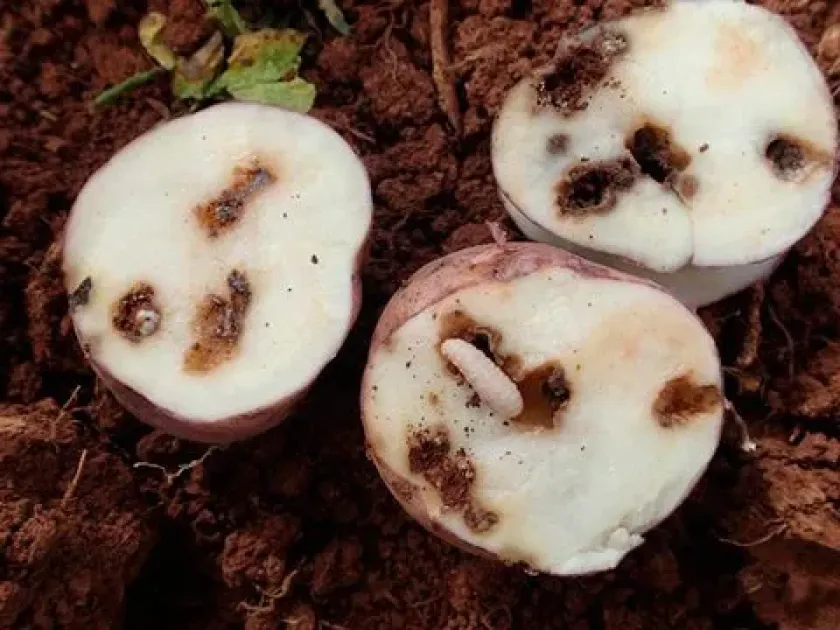
The larvae are legless, cream-colored, and C-shaped with a hardened, dark head capsule. They possess strong mandibles designed specifically for boring into the dense tissues of potato tubers, where they feed and develop.
Adults are nocturnal and tend to remain hidden under soil clods or near the base of potato plants during the day. This behavior makes them difficult to spot during routine field inspections unless specific trapping methods are used.
As a high-altitude pest, this species has evolved excellent survival mechanisms to handle fluctuating temperatures, making it a persistent threat to potato cultivation in its native Andean range.
What it damages
The primary host of the Andean potato weevil is the potato plant (Solanum tuberosum). While adults cause minor damage to foliage by nibbling the leaf edges, the larvae are responsible for the most severe economic losses.
Larvae burrow directly into the developing tubers, creating extensive internal galleries. This destruction renders the tubers unmarketable and often leads to secondary infections such as bacterial soft rot and various fungal diseases.
Potato crops infested with this weevil often show decreased yield quality and quantity. In some instances, if the infestation is heavy, the entire production of a plot can become unsuitable for human consumption or storage.
The galleries created by the larvae destroy the structure of the potato, making it susceptible to rapid decomposition. Even tubers that appear healthy on the outside may be hollowed out and infested on the inside, leading to significant post-harvest losses.
- Total loss of commercial potato quality.
- Increased risk of post-harvest rotting.
- Stunting of plant growth due to root damage.
- High sorting and removal costs for farmers.
When it appears
The lifecycle of the Andean potato weevil is closely synchronized with the potato growing season. They overwinter in the soil as larvae or adults, entering a period of dormancy until the environmental conditions become favorable.
As the potato plants emerge, adult weevils become active, rising from the soil to feed on the young foliage. This is the period when they mate, and females begin looking for suitable sites to lay their eggs.
Females lay eggs in small clusters near the base of the plant stem or in soil cracks. The incubation period allows for a steady hatching rate, ensuring that larvae are present in the soil throughout the critical phase of tuber formation.
Once hatched, larvae migrate downwards into the soil to locate and penetrate the tubers. This larval feeding stage lasts for several weeks, during which the damage to the tuber structure occurs most rapidly.
After completing their development, larvae emerge from the tubers to pupate in the soil. The cycle usually completes in time for the adults to seek overwintering sites as the potato harvest concludes.
Signs of infestation
One of the earliest signs of infestation is the presence of semi-circular notches along the leaf margins of the potato plants, caused by adult weevils feeding during the night.
If you disturb the soil at the base of a plant, adult beetles may fall to the ground and remain motionless, mimicking soil particles. This defensive behavior is a primary reason why they are often overlooked during initial scouting.
At harvest, damaged tubers exhibit visible entry holes on their surface. These holes are clear indicators that larvae have successfully infiltrated the plant tissue to feed on the starch within.
Cutting open a suspected tuber reveals extensive tunneling and frass (larval excrement) within the potato. These galleries are often discolored and may harbor secondary pathogens that accelerate the decay of the tuber.
Sudden wilting of foliage on patches of the field can indicate that the underground parts of the plant have been severely compromised by the larvae, disrupting the plant's ability to transport water and nutrients effectively.
Control measures
Strict quarantine measures are the most effective method to prevent the spread of the Andean potato weevil to non-infested areas. Controlling the movement of seed potatoes is essential for protecting agricultural regions.
Crop rotation is a fundamental management practice. Planting non-host crops in potato-infested fields for at least three to four years helps to reduce the local weevil population significantly as they starve.
Using certified, clean seed potatoes and maintaining weed-free fields are critical. Deep plowing of the soil after harvest helps to expose overwintering stages to natural predators and harsh conditions, reducing the survival rate.
Chemical control, when necessary, involves applying soil-incorporated insecticides at the time of planting to protect the developing tubers. Foliar sprays targeting adults can also be used if monitoring detects high beetle activity.
Biological control agents, such as entomopathogenic fungi and nematodes, offer promising alternatives for integrated pest management (IPM) programs, potentially reducing the reliance on conventional chemical inputs.
Taxonomy
- Latin name
- Premnotrypes fractirostris
- Order
- Coleoptera (beetles)
- Family
- Curculionidae
- EPPO code
- PREMFR
Discussion
No discussions yet — be the first.