
Premnobius cavipennis
Premnobius cavipennis
Description
How to identify
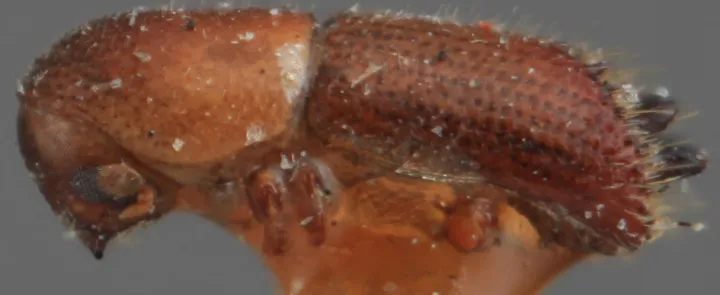
Premnobius cavipennis is a species of bark beetle belonging to the family Curculionidae, subfamily Scolytinae. These beetles are small, cylindrical, and generally dark brown or black in color, typically measuring 2–3 mm in length.
The head of the insect is concealed under the pronotum, a common morphological feature in this group of beetles. Their elytra are marked with fine punctures arranged in longitudinal lines, giving them a striated appearance.
The larvae are legless, white to yellowish grubs with a well-developed, dark head capsule. They spend their entire developmental phase within the tree's wood, which provides both protection and nutrition.
The pupal stage occurs within specialized galleries carved out by the parents. Since the entire life cycle happens inside the host wood, it is difficult to detect the presence of the pest until significant damage has occurred.
The species is distinguished by its specific elytral structure, where the posterior part of the wings features a distinct concavity, which is the defining characteristic for its scientific name.
What it damages
This beetle primarily targets weakened, stressed, or fallen trees. It is known to colonize various broad-leaved tree species in tropical and subtropical regions, often acting as a secondary pest.
In agricultural and forestry settings, P. cavipennis poses a threat to nurseries and plantations where it can attack younger, stressed trees. Its presence can lead to a rapid decline in the health of the host plant.
The feeding activity of adults and larvae involves excavating tunnels that damage the cambium and sapwood layers. This disruption significantly impairs the vascular function of the tree.
The pest is frequently associated with the transmission of ambrosia fungi, which colonize the galleries and contribute to the decay of the wood, further accelerating the tree's deterioration.
Heavy infestations render the timber unsuitable for commercial use, as the extensive gallery systems compromise the structural integrity and quality of the wood.
When it appears
Adult activity is generally continuous throughout the warmer months. In tropical environments, breeding can occur year-round, resulting in multiple overlapping generations.
Mass flights often coincide with periods of high humidity and rainfall, as these conditions are favorable for the beetles to initiate attacks on the bark of host trees.
Overwintering usually takes place inside the galleries within the host tree. Because the beetle remains deep within the wood, it is protected from extreme seasonal fluctuations in temperature.
Spring serves as a primary period for the dispersal of adults seeking new host material. This is a critical time for monitoring and implementing protective measures in susceptible plantations.
Optimal temperatures for development and movement are typically above 15–20°C. In extremely dry or cold conditions, the beetles tend to remain inactive within their established tunnels.
Signs of infestation
The most visible sign of an infestation is the presence of small, round entry holes on the bark surface, usually about 1 mm in diameter. Frass (boring dust) often accumulates around these openings.
The presence of fine, sawdust-like frass on the bark or at the base of the tree is a strong indicator that the beetle is actively excavating galleries within the sapwood.
Foliar symptoms, such as premature wilting or yellowing of the crown, often appear only after the beetle has already caused significant damage to the conductive tissues.
Internal inspection of the wood reveals complex, branched gallery systems that typically penetrate perpendicular to the grain of the wood.
In some cases, tree defense responses may manifest as sap exudation near the entry holes, although this is less common in heavily stressed trees that have already lost their vitality.
Control measures
Sanitation is the most effective management approach. This involves the prompt removal and destruction of infested or dead trees to prevent the emergence and spread of new adult beetles.
Disposal of slash and logging residue is essential, as these materials often serve as ideal breeding grounds for the pest if left on the site for extended periods.
Pheromone traps can be utilized for monitoring beetle activity and population trends, allowing for better timing of chemical interventions if necessary.
Preventive application of systemic or contact insecticides may be warranted in high-value plantations or nurseries during periods of high beetle flight activity.
- Promoting tree vigor through proper site selection and management.
- Using trap trees to aggregate and subsequently destroy local beetle populations.
- Regular field inspections to identify and remove new infestation epicenters.
Taxonomy
- Latin name
- Premnobius cavipennis
- Order
- Coleoptera (beetles)
- Family
- Curculionidae
- EPPO code
- PREBCA
Discussion
No discussions yet — be the first.