
Premnobius
Premnobius
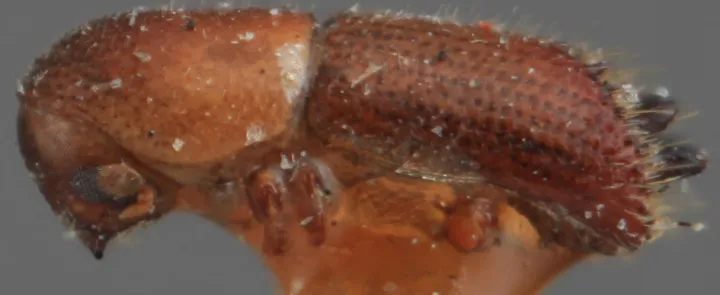
Description
How to identify
Premnobius is a genus of beetles belonging to the family Curculionidae, specifically the subfamily Scolytinae, commonly known as bark and ambrosia beetles. These small insects, typically measuring 2–4 mm in length, are highly specialized for life within wooden tunnels.
The primary distinguishing feature of Premnobius is its symbiotic relationship with ambrosia fungi. These beetles possess specialized structures called mycangia used to transport fungal spores, which they cultivate within their galleries as a food source for their larvae.
The adults exhibit a cylindrical, robust body shape, colored in shades of dark brown to black. This morphology allows them to navigate efficiently through narrow tunnels carved into the xylem of trees. Larvae are apodous (legless), white, and possess a well-defined chitinous head capsule.
Species identification is notoriously difficult due to their microscopic size and the intricate morphological details required for diagnosis, such as the arrangement of setae and the structure of the pronotum.
Field identification primarily relies on the pattern of entry holes and the presence of frass. They are typically found in high-moisture environments, such as freshly cut logs, dying trees, or stumps, where fungal growth is favored.
What it damages
Premnobius beetles primarily impact hardwood and coniferous trees, acting as technical pests that degrade the quality of wood. Their impact is particularly significant in tropical and subtropical regions where forest and plantation health is vital.
The damage is not caused by direct consumption of the wood for nutrition, but rather by the mechanical excavation of tunnels and the introduction of fungal pathogens. These activities compromise the structural integrity and health of the host tree.
In agricultural settings, these beetles can attack economically important plants such as coffee and cocoa. Trees that are already weakened by environmental stress or poor management are highly susceptible to mass colonizations.
The economic impact involves a significant decrease in the value of timber. Once wood is infested with ambrosia beetle galleries and associated fungal stains, it becomes unsuitable for high-quality carpentry or industrial construction purposes.
Furthermore, the tunnels serve as entry points for secondary pathogens and wood-decay fungi, accelerating the degradation of the tree's vascular system and leading to premature death of the affected specimens.
When it appears
The activity of Premnobius is largely governed by temperature and humidity levels. In regions with tropical climates, these beetles can remain active throughout the year, with overlapping generations that do not require a distinct dormant period.
Mass flight periods often coincide with the transition between seasons or the onset of wet weather, which promotes the development of the fungi that the beetles rely on. This is when new host plants are most frequently colonized.
The biological cycle, from egg to adult, is highly temperature-dependent. Warm conditions accelerate larval growth, leading to rapid population surges, especially in areas with a surplus of fallen or stressed woody material.
In temperate zones, overwintering occurs within the larval or adult stage deep inside the wood, where the moisture and insulation provided by the host tree protect the insects from freezing temperatures and desiccation.
Monitoring programs often use pheromone traps to detect the flight of adult beetles, allowing forest managers to implement preventive measures before the population reaches an uncontrollable threshold.
Signs of infestation
The earliest signs of Premnobius infestation are small, perfectly circular entry holes on the bark of the tree. These holes are often accompanied by piles of frass, which appears as fine, wood-colored dust on the surface of the trunk.
Small, thread-like columns of excrement and wood shavings protruding from the holes are a clear indicator of active tunneling by the beetles. These structures are often visible early in the morning before wind or rain clears them away.
Upon cutting into the wood, dark or bluish-black staining is observed around the tunnels. This is the characteristic "ambrosia" symptom caused by the growth of symbiotic fungi, which is a major diagnostic criterion for this group of beetles.
Affected trees may display symptoms of overall decline, including yellowing leaves, wilted branches, or a sudden loss of vigor if the internal vascular system has been severely compromised by the galleries.
Close inspection of the galleries reveals a complex network of tunnels that generally penetrate deep into the sapwood, reflecting the systematic approach of the beetles in cultivating their fungal gardens.
Control measures
Sanitation is the most effective control measure. This involves the prompt removal and destruction of infested trees, stumps, and logging debris to eliminate breeding sites and reduce the local beetle population.
Proper silvicultural practices, such as maintaining optimal tree health through thinning and irrigation, reduce the tree's vulnerability to attack, as vigorous trees are better able to repel colonization through resin flow.
Chemical control using systemic insecticides is generally limited to high-value trees or nursery stock. Applications must be timed precisely to coincide with the emergence of adult beetles to ensure maximum contact efficacy.
Pheromone-based trapping systems are highly effective for mass trapping and monitoring. They help attract and capture adult beetles during their peak flight activity, thereby significantly lowering the pressure on nearby healthy forests.
- Regular inspection of wood piles during storage.
- Use of entomopathogenic fungi as a biological control agent.
- Timely processing of harvested timber to prevent colonization.
Taxonomy
- Latin name
- Premnobius
- Order
- Coleoptera (beetles)
- Family
- Curculionidae
- EPPO code
- PREBSP
Discussion
No discussions yet — be the first.