
Yellow mayfly
Potamanthus luteus
Description
How to identify
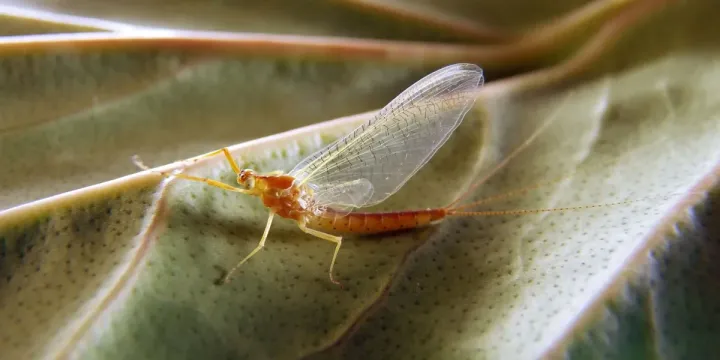
Potamanthus luteus, known as the yellow mayfly, belongs to the order Ephemeroptera and the family Potamanthidae. It is characterized by a delicate body, transparent wings with intricate veining, and three long caudal filaments.
Adult mayflies do not feed, as their mouthparts are atrophied. Their sole purpose during their short lifespan is reproduction, which occurs rapidly after emergence.
The larvae are exclusively aquatic and possess strong mandibles adapted for grazing on organic matter and periphyton found on riverbeds.
These larvae are specifically adapted to flowing water environments, allowing them to anchor themselves effectively on substrates like sand or silt despite strong currents.
Their coloration typically ranges from light yellow to pale brown, which provides excellent camouflage against the substrate of freshwater habitats.
What it damages
In a strict agronomic sense, Potamanthus luteus is not classified as a plant pest. It does not feed on crops and does not cause damage to agricultural vegetation.
However, in some instances, a high density of larvae can lead to the clogging of irrigation filters or intake screens in canals, necessitating mechanical maintenance.
These insects are primarily part of the aquatic food web and do not impact agricultural productivity through direct herbivory or parasitism.
They serve as valuable bioindicators for the health of water sources used in agriculture, reflecting the dissolved oxygen levels and lack of chemical pollution.
Any perceived harm is limited to technical inconveniences in water management systems rather than agricultural crop loss.
When it appears
The mass emergence of adult Potamanthus luteus typically occurs during the summer months, specifically June and July, depending on water temperature.
The life cycle from egg to adult takes approximately one year, with the vast majority of this time spent as a larva submerged in the riverbed.
Adult flight activity is most intense during the evening and night hours, which is when mating and egg-laying occur near the water surface.
Environmental factors, such as water temperature and current speed, are critical for the successful transition from larval stages to adult forms.
The emergence period is usually short, which is a common adaptive trait in mayflies to minimize exposure to terrestrial predators.
Control measures
No chemical control measures are recommended or necessary for the yellow mayfly, as it is a beneficial organism within its native aquatic ecosystem.
If larvae interfere with water intake systems, standard mechanical cleaning of filters and protective screens is the most effective and eco-friendly approach.
Preventing the use of harmful pesticides in and around river systems helps maintain the health of the population and the overall water quality.
Farmers are advised to monitor the cleanliness of their irrigation water, as the presence of such sensitive insects is usually a sign of good water quality.
- Mechanical removal from intake screens.
- Monitoring water quality for irrigation.
- Protection of riparian zones to maintain ecological balance.
Taxonomy
- Latin name
- Potamanthus luteus
- Family
- Potamanthidae
- EPPO code
- PTMNLU
Discussion
No discussions yet — be the first.