
Potamanthus
Potamanthus
Description
How to identify
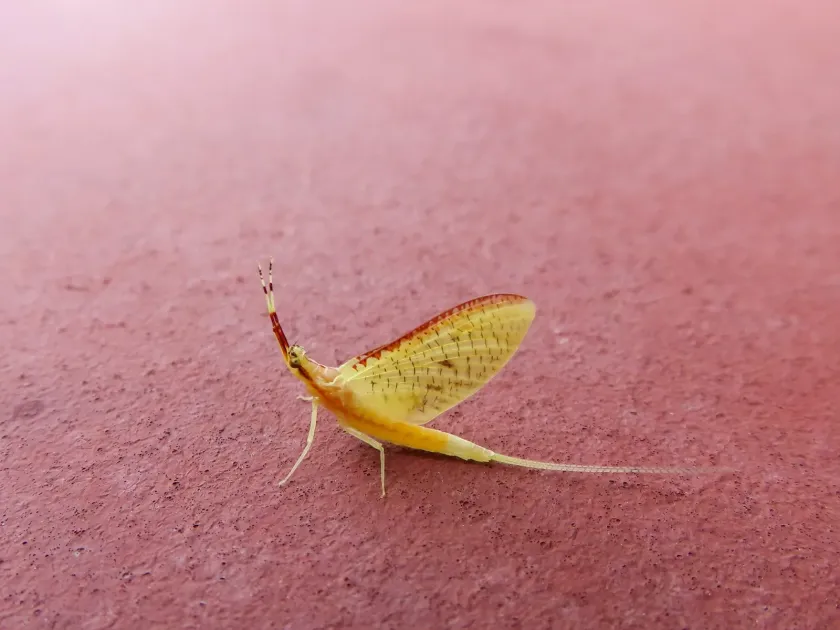
Potamanthus is a genus of mayflies belonging to the family Potamanthidae (order Ephemeroptera). These insects are recognized by their delicate bodies, two pairs of translucent wings, and three distinct caudal filaments.
The adults, commonly known as mayflies, are generally yellowish in color. Their adult stage is ephemeral, often lasting only a few hours to a few days, during which they do not feed.
The larvae, or nymphs, are specialized dwellers of running water ecosystems. They have evolved powerful mandibles that enable them to burrow into sandy or silty riverbeds for protection.
The presence of Potamanthus in a stream is a strong biological indicator of excellent water quality and high dissolved oxygen content.
Because their mouthparts are vestigial in the adult stage, they rely solely on energy reserves accumulated during the long larval stage to complete their life cycle.
When it appears
The emergence of adult Potamanthus typically occurs during the warmer months, with peak activity recorded in June and July. This coincides with favorable atmospheric conditions for mating flights.
The larval development phase is lengthy and entirely aquatic, spanning one to two years before the transformation into a flying adult occurs.
Mating swarms are most frequently observed during late afternoon or evening hours, when the insects leave the water in massive numbers to complete their reproductive cycle.
Environmental factors, such as water temperature and flow rate, significantly dictate the precise timing of emergence within a given local region.
Because the adult life span is so abbreviated, the entire reproductive window for a population is typically finished within a few short weeks of the season.
Control measures
Potamanthus does not consume cultivated crops or plants and is not classified as an agricultural pest. There is no economic damage associated with this insect.
The use of insecticides in riparian zones to control this insect is strictly discouraged, as it causes unnecessary harm to healthy river ecosystems and aquatic biodiversity.
As beneficial insects, they serve as a crucial food source for fish and other aquatic wildlife, making their preservation essential for a balanced local environment.
If adult swarms become a nuisance near farm infrastructure, non-chemical methods such as adjusting lighting can effectively divert them without causing environmental damage.
Sustainable agricultural practices, such as maintaining buffer zones along waterways, help protect these organisms and ensure the continued health of the local ecosystem.
Taxonomy
- Latin name
- Potamanthus
- Family
- Potamanthidae
- EPPO code
- PTMNSP
Discussion
No discussions yet — be the first.