
Spruce bark beetle
Polygraphus rufipennis
Description
How to identify
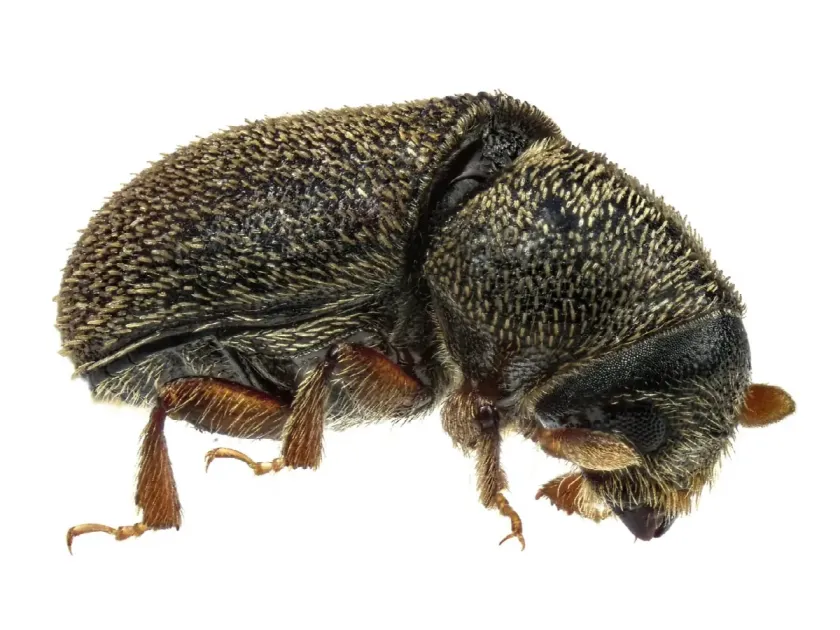
The spruce bark beetle, known scientifically as Polygraphus rufipennis, is a small beetle belonging to the Curculionidae family. It typically measures between 2 to 2.8 mm in length.
The name of the insect comes from its unique physical feature: four distinct teeth located on the rear margin of the elytra, which are clearly visible under magnification.
The body of the beetle is covered in dense, yellowish setae, providing a matte appearance. The coloration ranges from reddish-brown to almost black depending on the individual's age.
Larvae are legless, white-colored grubs with a brown head capsule. They develop in tunnels located just beneath the bark, feeding on the soft phloem and cambium layers.
As part of the Scolytinae subfamily, these insects are specialized in living within the inner bark of coniferous trees, which makes them highly adapted to their niche.
What it damages
This beetle primarily attacks spruce species. While it often prefers stressed or weakened trees, it is also capable of attacking healthy stands during population outbreaks.
The damage is caused by both adults, who construct galleries, and larvae, who create secondary feeding galleries. This activity effectively girdles the tree by destroying the transport tissues.
Once the transport of water and nutrients is interrupted, the tree experiences rapid physiological decline, often leading to total crown dieback and tree mortality.
In addition to direct damage, the beetle creates entry points for fungal pathogens, such as blue-stain fungi, which further degrade the quality of the wood and weaken the host tree.
Large-scale infestations can cause significant economic losses in commercial forests by reducing timber value and causing widespread mortality in mature stands.
When it appears
Adult beetles typically emerge from their overwintering sites in late spring as temperatures rise consistently above 10-12 degrees Celsius.
The peak flight activity coincides with the beginning of the tree's growth season, when the host tree is most susceptible to successful colonization by the beetles.
Depending on local climatic conditions, the spruce bark beetle may complete one or two generations within a single calendar year, significantly impacting population growth.
During the summer months, larvae feed continuously under the bark, undergoing several larval stages before pupating in specially constructed chambers.
As autumn approaches, adult beetles seek shelter either in the inner bark of the host tree or within the forest floor litter to survive the winter temperatures.
Signs of infestation
One of the first signs of infestation is the presence of frass — fine, sawdust-like particles found in bark crevices or at the base of the tree trunk.
Small, circular entrance holes on the surface of the bark indicate where adult beetles have penetrated the tree to begin their mating and gallery construction.
The crown of the tree may exhibit changes in coloration, moving from green to yellow and finally to a reddish-brown as the tree dies due to severe tissue destruction.
Peeling away the bark reveals the characteristic gallery pattern, consisting of a main entrance gallery and radiating larval tunnels that consume the phloem tissue.
Evidence of resin flow, or "pitching out," is a sign that the tree is attempting to repel the beetle attack, though this is often unsuccessful during heavy infestations.
Control measures
Sanitation harvesting is the most critical management tool; removing infested trees before new generations emerge helps reduce the overall population pressure in the area.
Maintaining forest hygiene by quickly processing windthrown and storm-damaged timber prevents these areas from becoming breeding grounds for the beetles.
Pheromone traps are widely used for monitoring population levels and timing management activities to coincide with the most vulnerable stages of the beetle's life cycle.
In high-value ornamental plantings, preventative insecticide sprays can be applied to the trunk during the flight period to deter the beetles from landing.
- Continuous monitoring of stand health.
- Prompt removal of infested logs.
- Use of trap trees to attract beetles.
- Biological control through natural predators.
Taxonomy
- Latin name
- Polygraphus rufipennis
- Order
- Coleoptera (beetles)
- Family
- Curculionidae
- EPPO code
- POLGRU
Discussion
No discussions yet — be the first.