
Ussuri bark beetle
Polygraphus proximus
Description
How to identify
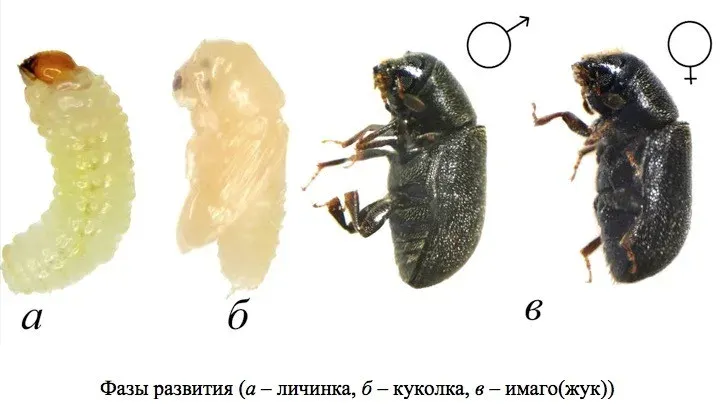
The Ussuri bark beetle (Polygraphus proximus) is a member of the Coleoptera order and the Curculionidae family (subfamily Scolytinae). This small insect measures between 2.2 and 3.0 millimeters in length and has a dark brown or almost black body color.
Adult beetles feature an oval body shape and dense pubescence on the elytra. They have a characteristic club on their antennae, which serves as a crucial taxonomic feature for accurate identification by entomology specialists.
The larvae are legless, white in color, with a yellowish-brown head, reaching about 3 millimeters in length. They develop under the bark, where they complete all main stages of formation until they transform into adults.
The biology of this pest is closely linked to the weakening of forest stands. The polygraph is capable of infesting both standing trees and fresh windfalls, which promotes rapid population growth in coniferous forests.
This species is highly aggressive as it can colonize healthy trees when the population density is high, overcoming the defense mechanisms of conifers, such as the secretion of resin.
What it damages
The primary hosts for the Ussuri bark beetle are coniferous tree species. It causes the most severe damage to fir trees, including Siberian fir, but is also frequently found on spruce and cedar trees.
The pest leads a cryptic lifestyle, feeding on the inner bark and cambium. This causes sap flow to cease, disrupts nutrient transport to the crown, and eventually leads to the death of the coniferous tree.
The damage caused by larvae appears as branching galleries that completely block the flow of nutrients along the trunk. During outbreaks, the beetle can destroy vast forest areas in a very short period.
The damage is exacerbated by the fact that trees weakened by the bark beetle become susceptible to secondary infestation by other wood-boring pests, such as longhorn beetles or jewel beetles, which accelerates forest decay.
The economic impact is reflected not only in timber loss but also in the disruption of ecological balance, loss of forest protective functions, and changes in the species composition of plant communities.
When it appears
The flight of adults and the start of colonization of new trees usually occur in May and June. This period is synchronized with the onset of stable warm temperatures necessary for insect development.
After emerging, the beetles begin searching for a suitable host. They bore into the bark, creating nuptial chambers where mating occurs. Depending on regional climatic conditions, several generations may develop within a season.
Larval activity and feeding under the bark continue until the onset of autumn frosts. By winter, most of the population reaches the adult or larval stage, hiding deep within the bark for successful overwintering.
Spring emergence begins when the average daily air temperature reaches +10 to +12 degrees Celsius. It is worth noting that high humidity and prolonged rain can somewhat slow down beetle flight but do not halt their development.
Monitoring the active season is critical for timely sanitary measures, as the mass flight period offers the best window for localizing infestation hotspots.
Signs of infestation
The first and most noticeable sign of infestation is the appearance of "boring dust" — fine sawdust that falls from entry holes in the bark onto the root collar or into bark crevices.
When inspecting the trunk, one can observe numerous entry holes made by the beetles. As larval galleries expand, the bark begins to peel off, revealing the characteristic star-shaped gallery patterns beneath it.
Changes in needle color — from light green to yellow and reddish-brown — indicate that the tree is in the final stages of decline. By this time, the pests have usually already abandoned the tree.
Copious resin flow is often observed on the trunks of infested fir trees at the entry points. However, in heavily weakened trees, resin secretion may be weak or absent, which complicates visual diagnosis.
The use of pheromone traps allows for the detection of the pest presence at early stages, before external signs of tree damage become obvious to the naked eye.
Control measures
Sanitary logging is the primary and most effective method of control. Removing and disposing of infested trees before the new generation of beetles emerges prevents the pest from spreading.
The use of trap trees helps divert the polygraph population away from healthy stands. Once the beetles colonize these trap trees, they must be debarked or removed from the forest site promptly.
Pheromone traps are justified for monitoring population density and partial trapping of adults. This allows specialists to assess the level of threat and the need for more radical protective measures.
The biological method of control involves using natural entomophagous predators — parasitic wasps and predatory insects — which reduce the bark beetle population density in the natural environment.
An important element of prevention is maintaining the high resistance of forest stands through proper silvicultural management and by avoiding the accumulation of logging debris, which serves as an ideal breeding ground for the pest.
Taxonomy
- Latin name
- Polygraphus proximus
- Order
- Coleoptera (beetles)
- Family
- Curculionidae
- EPPO code
- POLGPR
Discussion
No discussions yet — be the first.