
European spruce bark beetle
Polygraphus poligraphus
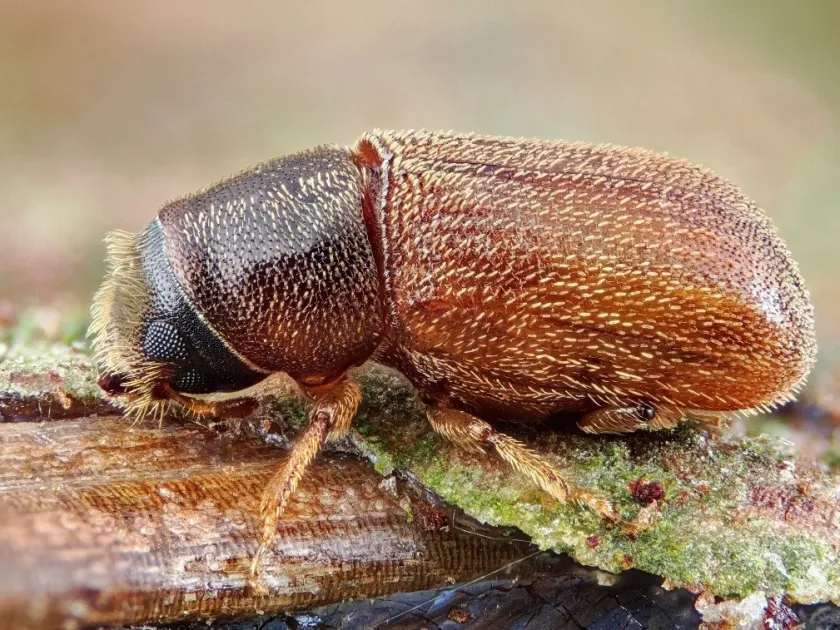
Description
How to identify
The European spruce bark beetle, known scientifically as Ips typographus, is a small beetle belonging to the Curculionidae family. Adults typically measure between 4.2 and 5.5 mm in length.
The body is cylindrical, dark brown or black, and covered with fine hairs. The most distinctive feature is the declivity at the end of the elytra, which features four small teeth on each side, useful for identification.
Larvae are legless, C-shaped, and creamy-white with a yellowish head. They develop exclusively under the bark, feeding on the inner layers of the tree.
These insects are highly adapted to life beneath the bark, where they coordinate their activities through pheromone signaling to ensure successful colonization.
Taxonomically, the species is part of the order Coleoptera. It is widely considered one of the most destructive forest insects in Eurasian coniferous ecosystems.
What it damages
The beetle primarily targets the Norway spruce. While it often selects stressed or weakened trees, high populations allow it to overcome the defenses of healthy, mature trees.
Adults bore through the bark to the phloem layer, creating galleries where females lay eggs. The feeding larvae then create further galleries that effectively girdle the tree.
This girdling process cuts off the transport of water and nutrients, leading to rapid chlorosis, needle loss, and tree death. The process can occur within a single growing season.
Beyond physical damage, the beetles act as vectors for blue-stain fungi, which colonize the wood and further compromise the tree's vascular system.
Massive outbreaks often result in landscape-level mortality of spruce forests, leading to significant economic losses for the timber industry and environmental degradation.
When it appears
The emergence of adults from overwintering sites typically begins in early spring, when temperatures consistently exceed 15 degrees Celsius.
Depending on the latitude and local climate, the beetle may complete one to three generations per year, with warmer summers accelerating the developmental rate.
The entire developmental cycle (egg, larva, pupa, and adult) takes place protected under the bark, shielding them from many external environmental factors.
As winter approaches, mature beetles move to the forest floor or the base of the tree to hibernate in the litter layer or soil, where they survive until the next season.
Climate change is increasing the frequency of beetle outbreaks by extending the length of the growing season and providing more days suitable for colonization.
Signs of infestation
Fine, reddish-brown boring dust (frass) visible in bark crevices or at the base of the trunk is the primary indicator of an active beetle attack.
Tiny, round entry holes on the bark surface are often accompanied by resin flow, as the tree attempts to push out the invaders.
The internal gallery system, consisting of a central longitudinal egg gallery and side larval tunnels, can be revealed by peeling away a portion of the bark.
Crown discoloration, where needles turn yellow or reddish-brown, is a late sign of infestation, indicating that the tree's vascular system has failed.
Extensive bark shedding and woodpecker activity on the trunk are often visible in the later stages of an infestation when the tree is already dead or dying.
Control measures
Integrated Pest Management (IPM) is the best approach to control, focusing on sanitation and monitoring to prevent wide-scale population explosions.
- Sanitation logging: Rapid removal and processing of infested trees before the new generation of beetles emerges.
- Pheromone traps: Used for monitoring population density and mass trapping of adults in high-risk areas.
- Trap trees: Freshly felled trees are placed in the forest to lure beetles; once colonized, the logs are destroyed.
- Encouraging natural predators: Protecting woodpeckers and specific parasitic wasps that naturally reduce bark beetle populations.
- Silvicultural measures: Promoting forest diversity and reducing the proportion of monoculture spruce stands to limit future outbreaks.
Taxonomy
- Latin name
- Polygraphus poligraphus
- Order
- Coleoptera (beetles)
- Family
- Curculionidae
- EPPO code
- POLGPO
Discussion
No discussions yet — be the first.