
Great spruce bark beetle
Polygraphus major
Description
How to identify
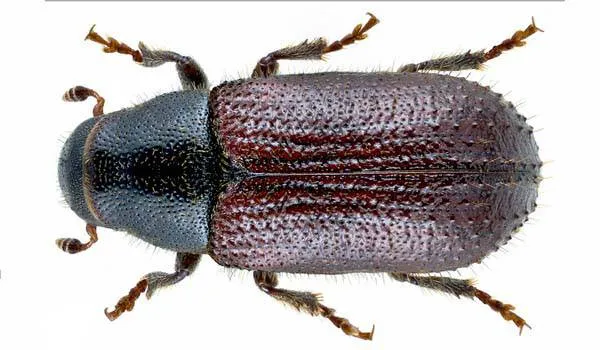
The great spruce bark beetle (Polygraphus major) is a member of the Coleoptera order and the Curculionidae family, specifically the bark beetle subfamily. Adults are small, measuring between 2.5 and 3.2 mm in length.
The body is cylindrical and dark brown to black in color. A distinctive feature of this species is the dense hair covering on the pronotum, which helps in accurate identification.
Larvae are white, legless, and have a well-developed head capsule with strong mandibles. They develop exclusively under the bark, living in galleries they carve within the cambium layer.
Pupae are whitish and reside in small chambers constructed by the larvae. The entire life cycle, excluding the adult flight period, is hidden from external view under the tree bark.
This species is highly specialized, targeting coniferous forests, particularly spruce trees, and is capable of causing significant mortality in dense, weakened stands.
What it damages
The primary host for this beetle is the Norway spruce. Under high population pressure or lack of spruce, it can occasionally infest other coniferous species such as fir.
The beetle primarily attacks the trunk of the tree. It prefers areas with thinner bark but will expand its colonization zone significantly during mass outbreaks.
Larval galleries disrupt the flow of water and nutrients within the cambium, which effectively girdles the tree and prevents the transport of photosynthates.
The damage often leads to rapid deterioration of the tree's health, making it susceptible to secondary fungal pathogens transmitted by the beetles during their feeding process.
In cases of severe infestation, the tree loses its needles and dies within one or two seasons, often collapsing if root rot or other structural issues are present.
When it appears
Adult flight typically begins in spring, triggered by rising temperatures. The beetles emerge to search for new, suitable host trees to establish their breeding galleries.
Generally, the beetle completes one generation per year. However, in regions with warmer climates or extended summer periods, overlapping or sister generations may occur.
Adult beetles overwinter within the bark or in the wood of the host tree, where they find refuge from freezing temperatures and other environmental stresses.
Peak activity occurs throughout the summer months, as beetles seek out weakened or stressed trees to lay eggs and continue the reproductive cycle.
By autumn, the development of the new generation is mostly complete, and the young beetles prepare to overwinter in their natal galleries or nearby sites.
Signs of infestation
Small, round entry holes in the bark are the most common sign of an active attack. These holes are often accompanied by piles of frass, or fine wood dust, at the base of the tree.
Visible changes in foliage color, transitioning from healthy green to pale yellow and finally reddish-brown, indicate that the tree's internal circulation has been severely damaged.
Peeling back sections of the bark reveals complex, star-shaped gallery patterns where adults and larvae have fed, confirming the presence of the beetle.
Drying of the bark and the loss of bark patches are late-stage signs of infestation, often occurring after the beetles have already completed their development and emerged.
Heavy woodpecker activity on the trunk is often a reliable indicator, as these birds hunt for the beetle larvae and adults beneath the bark surface.
Control measures
Sanitation logging is the most effective management strategy, involving the prompt removal and destruction of infested trees to prevent the spread of the beetle population.
Proper forest management, including the removal of windthrown or damaged timber, eliminates the prime breeding grounds that allow populations to reach outbreak levels.
Pheromone traps are highly effective for monitoring population densities and predicting the timing of adult emergence, which is crucial for scheduling protective measures.
In high-value ornamental plantings, trunk sprays with registered contact insecticides can provide a barrier against beetle entry during the main flight season.
Maintaining high tree vigor through regular irrigation and site-appropriate silviculture is the best preventative measure, as healthy trees can better resist beetle attacks.
Taxonomy
- Latin name
- Polygraphus major
- Order
- Coleoptera (beetles)
- Family
- Curculionidae
- EPPO code
- POLGMA
Discussion
No discussions yet — be the first.